
Mind map
Textual Variations
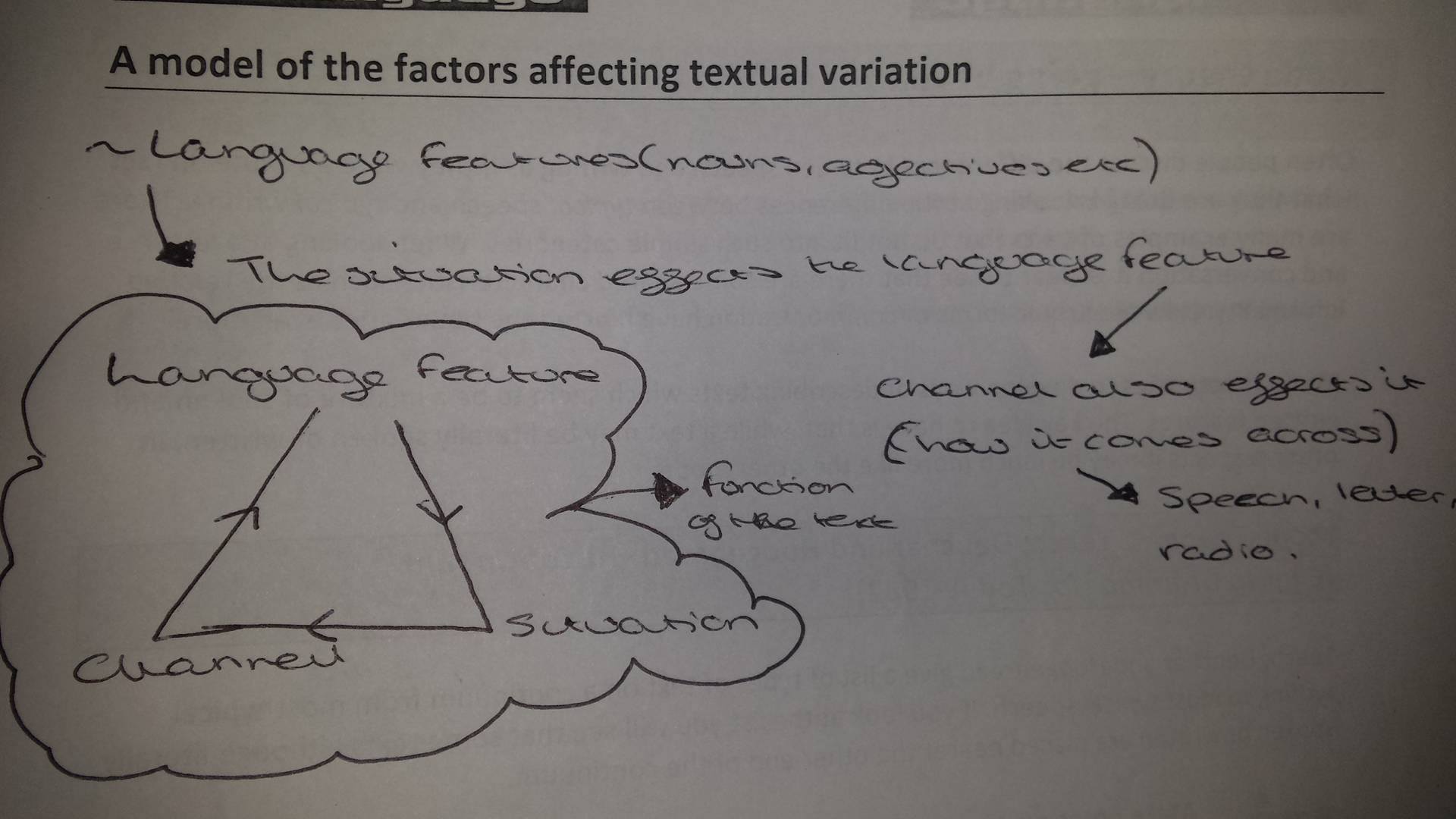
Map content
Textual Variations
The Functions of interaction: a classification system determined by the Open University
- Instrumental function - language used to get something done or to carry out business
- Control function: language used to control the behaviour of others or act in a way we want. e.g (parents and chidlren)
- Stimulation function: telling jokes and stories to amuse and entertain ourselves
- Information function: to pass information or request information
- Role- related function: language we are expected to use to fulfil our specific roles. e.g wedding service or a parent.
- Expression function: expressing our ideas, feelings and attitudes
- Alleviation of Anxiety function: talking about fears and problems can make them seem more manageable
- Social contact function: language used to open, establish and maintain relationships with people
- Control function: language used to control the behaviour of others or act in a way we want. e.g (parents and chidlren)
- Thurnows Classification of communication functions
- Instrumental function - language used to get something done or to carry out business
H.P Grice
- The Co-Operative Principle
- The Maxim of Relation: make sure whatever you say is relevant to the conversation
- Maxim of Quality: make sure whatever you say it true and there is evidence to what you say
- Maxim of Quantity: make sure that what you say is necessary - no more and no less
- Maxim of Manner: make sure it's clear and it's easy to understand
- Maxim of Quantity: make sure that what you say is necessary - no more and no less
- Maxim of Quality: make sure whatever you say it true and there is evidence to what you say
- Often speakers break the maxims but think they're still using the co-operative principle
- Flouting a maxim: not using the maxim/not following it. This is accidental
- Violating a maxim: Don't want the person to understand. Deliberately not co-operating e.g lying
- Implicatures: implying something, hidden meanings - trying to say more
- Flouting a maxim: not using the maxim/not following it. This is accidental
- The Maxim of Relation: make sure whatever you say is relevant to the conversation
- Wanted to explain the contextual conditions which had to be met for us to communicate meanings effectively. He created 4 Maxims
- Found that we often don't follow the maxims strongly. However we still manage to communicate our ideas
- This is because listeners assume we are trying to communicate and therefore make what we say fit the maxims.
- Found that we often don't follow the maxims strongly. However we still manage to communicate our ideas
- Limitations
- The maxims aren't always used and yet we can still have effective conversations.
- Focuses on the transactional functions and ignores interactional sides of language.
- The maxims aren't always used and yet we can still have effective conversations.
- The Co-Operative Principle
Face Theory:
- Erving Goffman created the term face to describe the public persona we present in interaction. He suggests we are constantly playing a role and presenting 'a version' of ourselves to others.
- Brown and Levinson built on Goffman's ideas and defined 'face' as something that we're emotionally invested in and can be lost, maintained or enhanced.
- Positive face: we want to look good and be noticed. We created a self image that can be appreciated
- Negative face: we don't want to get involved in something
- We try not to make face threatening acts to others in conversation and therefore we use 'facework' to avoid this.
- Positive face: we want to look good and be noticed. We created a self image that can be appreciated
- Brown and Levinson built on Goffman's ideas and defined 'face' as something that we're emotionally invested in and can be lost, maintained or enhanced.
- Erving Goffman created the term face to describe the public persona we present in interaction. He suggests we are constantly playing a role and presenting 'a version' of ourselves to others.
Politeness Principle - Robin Lakoff
- Created the politeness principle to explain why we flout Grice's maxims
- Lakoff proposed 3 maxims: Don't impose, Give options and Make the reciever(s) feel good
- Created the politeness principle to explain why we flout Grice's maxims
Turn Taking:
- Pauses can occur between a turn finishing and a turn starting.
- Overlaps are frequent. They happen when simultaaneous speech occurs etc when one turn starts and another ends. They are a sign of one speaker being keen to begin or slightly anticipating the end of a turn.
- Interruptions happen when a turn shifts from one speaker to another before the first speaker has finished their utterance.
- Kenneth Wardhaugh - How conversation works
- says there is several reasons for interruptions - to seek clarification, to correct and to challenge
- Kenneth Wardhaugh - How conversation works
- Interruptions happen when a turn shifts from one speaker to another before the first speaker has finished their utterance.
- Overlaps are frequent. They happen when simultaaneous speech occurs etc when one turn starts and another ends. They are a sign of one speaker being keen to begin or slightly anticipating the end of a turn.
- Deborah Tannen
- Identified two different styles of turn taking - high involvement style and high considerateness style.
- High-involvement style: this involves a lot of simultaneous speech in the form of interruptions and overlaps. = a high level of positive engagement and enthusiasm.
- High-considerateness style: Speakers are allowed to finish fully and any simultaneous speech creates apologies and withdrawal. = Respect for the speaker
- Identified two different styles of turn taking - high involvement style and high considerateness style.
- Pauses can occur between a turn finishing and a turn starting.
Effect of CHANNEL on textual variation
- Channel is how it exists so sounds, symbols and letters
- Prosodics: Stress, Pace, Volume and Intonation
- Not what you say but how you say it.
Images and files in the map
Information
- Description
- English Paper 1 Mind Map on Textual Variations, created by Abbie Jones on 18/04/2017.
- Created by
- Abbie Jones · Apr 2017
- Updated
- Apr 19, 2017
- Views
- 12
- Tags
- Rating