
Notes
Sponges
Content of the notes (1)
Page 1
PHYLUM: Porifera 'pore bearing'
Multi cellular organisms - highly adaptive way to increase body size
Heterophoric - feed on organic molecules produced by other organisms.
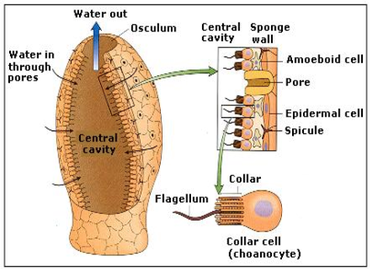
Structure and Function Collar cells are embedded in a gelatinous (spongy) matrix and supported by a skeleton of needle-like spicules and spongin fibers - elastic proteinaceous fibers
Pores, canals and chambers form a system of water currents one which they use to obtain food and oxygen. - tiny pores ostia are for incoming water and larger openings are for water outlet oscula
Coanocytes - 'collar cells'
Amoeboid cells in sponges are called Archaeocytes - used for phagocytosis and can differentiate into secreting cells and secrete spicules, spongin fibers and collagen.
Pinacocytes are flat cells that line the external surfaces - creating a pinacoderm which helps to keep water out.
No respiratory or excretory organs as these function can occur through diffusion
generally sessile organisms - stationary. But some can crawl slowly
Reproduction - asexual (budding - develops from the outgrowth/bud due to cell division at one particular site) and sexual.
Has specialised cells but not organised tissues or organs
Filter Feeding
Intracellular digestion
Food is drawn into the collar of the choanocytes by the beating flagellum
microvilli move food towards the centre of the body
phagocytised by the cell and passed on the archaocytes (amoeboids) for digestion
Information
- Description
- undergraduate Zoology (Sponges) Note on Sponges, created by Choon Fuller on 29/10/2015.
- Created by
- Choon Fuller
- Views
- 8
- Tags
- Rating