
Flashcards
Sugars and polysaccharides
Cards in this deck (88)
- 1What are the three monosaccharides?1) Glucose
2) Fructose
3) Galactose - 2What are the disaccharides? (2) Name their components.1) Sucrose (Glucose + Fructose)
2) Lactose (Galactose + Glucose) - 3Give an example of a polysaccharide.Glycogen.
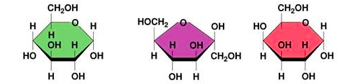
- 4Name these.1) Glucose
2) Fructose
3) Galactose - 5Describe the differences between the monosaccharides.CH2OH is on the 6' position in both glucose and galactose, 5' in fructose. In galactose the HO is superior to the H (otherway round in glucose)
- 6How are carbohydrates produced? What are they composed of? Why are they important?1) Produced by photosynthesis in plants
2) Composed of carbon, hydrogen and oxygen in ratio 1:2:1
3) Major source of energy in our diet - have many additional biological functions (for example stopping cells from sticking together) - 7Describe the characteristic of proteins (5) 1) Structure is.. 2) Coded by.. 3) Length 4) Linked by.. 5) Folding is..1) Defined structure
2) Coded by precise genes
3) Approx. 20 amino acids
4) Standard peptide link (apart from proline)
5) Normally tightly folded structures - 8Describe the structure of polysaccharides (5) 1) Structure is... 2) Synthesised by... 3) The building blocks are... number of residues... 4) Linked by... 5) Shape of structure is..1) Often poorly defined (some helices)
2) Enzymes, no template used
3) Many potential building blocks (hexoses and pentoses) but there are many homopolymers and rarely more than 3-4 residues
4) Various links: a(1-1); a(1-2); a(1-4); a(1-6); B(1-3) etc.
5) Range of structures (rod-coil) or amorphous - 9Why is there so much more room for variation with polysaccharides compared to proteins?How the individual monomers are stuck together determines the shape/sturcture
- 10What are the components of maltose?Glucose+glucose
- 11Mannose is...A monosaccharide
- 12What form do sugars need to be in to be absorbed across the gut?Monosaccharide
- 13How many monosaccharides are in an oligosaccharide? Give four examples.1) 3-10
2) Heparin
3) Fructo-oligosaccharides
4) Galacto-oligosaccharides
5) Blood group antigens - 14What is raffinose? What are its constituent components? Where is it found? What is it responsible for (and why)?1) Oligosaccharide
2) Galactose, glucose and fructose
3) Trisaccharide found in beans, cabbage and broccoli.
4) We don't have alpha-GAL to break it down - passes undigested through the stomach and small intestine. Ferments in the large intestine due to gut bacteria, consequently producing methane and leading to flatulence. - 15Why do fructo-oligosaccharides not really contribute to calories?Not digested in the stomach and small intestine - ferment in stomach.
- 16What is a source of galacto-oligosaccharides? What are they?1) Bananas
2) Prebiotics - feed the good gut bacteria but are not digested in the upper gastrointestinal system - 17What is heparin? When is given to patients?1) An anti-coagulant factor (anti-thrombin) found in mast cells.
2) Postoperatively to prevent thrombosis - 18What does the appearance of a polysaccharide depend on? Give three examples of polysaccharides and their components?1) Depends on how the bonds form and where
2) Starch - amylose - amylopectin
3) Glycogen - (Glc a - 1,4 glycosidic bonds)
4) Cellulose (Glc B-1,4) - 19Name each of these.1) Starch
2) Glycogen
3) Cellulose (fibre)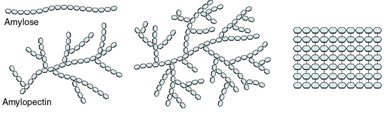
- 201) How many carbon atoms do monosaccharides contain? 2) What are the two groups of monosaccharides?1) 3 and 7 carbon atoms (CH2O)n
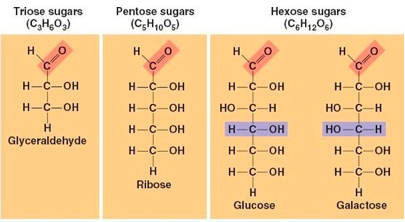
2) Aldoses or ketoses - 21What do aldoses contain?One aldehyde (-CH=O)
- 22Give an example of an aldose in the following categories: 1) Triose (C3H6O) 2) Pentose sugars (C5H10O5) 3) Hexose sugars (C6H12O6) (2) Draw the structure of each.
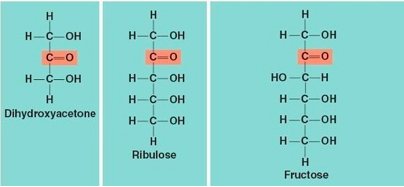
- 23What do ketoses contain?Contain a ketone group RC(=O)R', where R' can be a variety of carbon-containing structures.
- 24Give an example of a ketose in the following categories: 1) Triose (C3H6O) 2) Pentose sugars (C5H10O5) 3) Hexose sugars (C6H12O6) (1) Draw the structure of each.
- 25Which is the more important category of sugars in the body?Aldoses
- 26What do monosaccharides exist as? What property is this due to?1) Enantiomers (D and L, if they have a chiral carbon)- pair of isomers that are (non-superimposable) mirror images
2) Asymmetric (chiral) carbon - has covalent bonds to 4 different groups so cannot be superimposed on its mirror image. - 27What is the difference between the D- and L- enantiomer? What happens if there is more than 1 chiral C atom - which enantiomer is the most common?1) D: -OH is attached to the right of the asymmetric carbon; L: -OH is attached to the left of the asymmetric carbon
2) Absolute configuration of the chiral C-atom furthest away from the carbonyl group determines whether it is D or L-enantiomer.
3) D form is the most common - 28What is the reactive form of monosaccharides?The chain formation.
- 29Where is the chiral carbon in glucose?
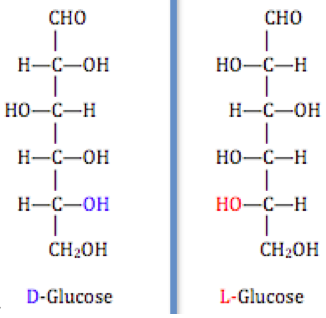
- 30Where is D-glucose found? L-glucose? What was L-glucose originally going to be used for? What else can it do?1) In plants
2) Not found naturally (some L-saccharides do form naturally).
3) A low calorie sweetener as it is not absorbed by the gut (but too expensive to be used in this way)
4) Works as a laxative because it doesn't fold when being digested - stays in the lumen of the gut, drawing out water and causing diarrhea. - 31Which types of monosaccharides from rings? How? What does this result in the monosaccharide being?1) Monosaccharides with 5-6 carbon atoms
2) The hydroxyl group on C5 reacts with the aldehyde or keton group
3) Inert - 32What does cyclization of a monosaccharide result in? (3)1) New asymmetric centre at C1
2) Anomeric carbon
3) 2-stereoisomers are called anomers a and B - 33What are different anomers of the same sugar recognised by? What is this important for?1) Different enzymes
2) Glycoside bond formation and hydrolysis - 34What % of glucose is in the cyclic conformation? What does this do to its characteristics?1) 99.9%
2) Least oxidisable and least reactive protein - 35What is the difference between a-D-glucose and B-D-glucose?a-D-glucose - the H is superior to the OH on the C1 (vice versa for B-D-glucose)
- 36Which anomer of glucose is more stable and why?B-D-glucose because the OH groups are more evenly distributed in the plane of the ring.
- 37Which type of interaction allows formation of a cyclic structures?Hydrogen bonds
- 38Which is the more common cyclic form of glucose?B-D-glucose (65% of anomers)
Glucose is 65:35 beta:alpha anomer - 39Why is important that monosaccharides move between ring structure anomers?Opens up into the traditional chain form - this allows the addition of other functional groups such as a phosphate, sulphate or amino acid, this changes the function.
- 40What are modified monosaccharides often used for?Specific recognition determinants on cell surfaces.
- 41What is an amine? Sulphate? Phosphate?1) NH2
2) SO4
3) PO4 - 42What is a glucosamine?Hydroxyl group replace with NH2 - second carbon from top of chain (i.e. primary carbon in the cyclic form)
- 43What is sugar which has had an OH group removed called? Give an example.A deoxy-sugar - deoxyribose (OH removed from 2' carbon)
- 44What are proteoglycans?A glucose which has had an amino group added following the removal of OH - found in the extracellular matrix, holds the cell in place.
- 45What do sulphated sugars form? What function are they important for?Glycosaminoglycans (water, gel-like), attract and trap water (keeps ECM hydrated) and important for allowing compression.
- 46What are phosphorylated sugars important for?Energy production - sugar phosphates help the metabolism of sugars.
- 47In what form are sugars protected from change in their functional groups?Cyclic form
- 48What are the first three steps of glycolysis to enable metabolism of glucose to pyruvate?1) Glucose to glucose-6-phosphate by hexokinase (ATP converted to ADP)
2) Glucose-6-phosphate is converted to fructose-6-phosphate by phosphoglucose isomerase
3) Fructose-6-phosphate is converted in fructose-1,6-biphosphate by phosphofructokinase (ATP is converted to ADP) - 49What is the last step in the production of pyruvate?Phosphoenolpyruvate (PEP) (CH2CPO4COO) is converted into pyruvate (CH3COCOO) by pyruvate kinase.
- 50How are sulphated sugars produced?By sulfotransferases - transfers a sulphate group from a donor molecule to an OH group on the sugar
- 51Give five examples of sulfated sugars1) Chondroitin sulfate
2) Heparan sulphate
3) Dermatan sulphate
4) Keratin sulphate
5) Hyaluronate - 52Draw the structures of the sulfated sugars on the previous card.See slide.
- 53Which sulfated sugar has the most negative charge?Heparin
- 54How are monosaccharides joined together? What does this result in the production of?1) Joined by glycosidic bonds (reversed by breaking bond in the presence of water)
2) Water - 55What catalyses the formation of a glycosidic bond? Describe how it happens.Glycosyltransferases - UDP (a charged sugar) is attached to the donor sugar and a nucleotide (uridine) which is then transferred to a disaccharide.
- 56How specific are glycosyl transferases? What do they catalyse? How many are coded in the human genome?1) Highly specific
2) Formation of specific glycoside bonds involving specific sugars (D/L, a/B) and specific OH groups
3) More than 250 - 57What bond forms between: 1) Sucrose 2) Maltose 3) Lactose1) Glucose and fructose joined by an a-1-2
2) 2X a-D-glucose joined by a a-1-4 glycosidic bond
3) B-D-galactose and B-D-glucose joined together by a B-1-4 glycosidic bond - 58How specific are the enzymes which hydrolyse glycosidic bonds?Highly specialised for precise sugar linkages.
- 59What does amylase hydrolyse? What is it inactive for?1) The Glc a-1-4 glycosidic bond in glycogen
2) Inactive for the Glc B-1-4 glycosidic bond in cellulose - amylase doesn't break down plant sugar. - 60What happens in individuals who are lactose intolerant? Why is this thought to happen?1) Lactase switches off (usually after ~6 months of life)
2) Don't need energy from lactose - 61What is the main form of carbohydrate storage in humans?Glycogen - a branched polysaccharide of glucose (primarily in the liver and muscle)
- 62How big is glycogen?20-50nm
- 63What are the backbone linkages formed of? Side chains?1) Glc a-1-4
2) Glc a-1-6 - 64Which two tissues have an absolute requirement for blood glucose for energy metabolism?RBC and the brain
- 65How much glucose is consumed every day? What % of this is consumed by the brain and RBC?1) 200g
2) 80% - 66How much glucose is in the plasma and ECF volume? What does this mean (and what would happen otherwise)?1) 10g
2) Blood glucose must be replenished constantly - otherwise hypoglycaemia occurs and compromises brain function leading to confusion and disorientation. - 67At what blood glucose concentration can a life-threatening coma occur?Less than 2.5mmol/L
- 68For how long is glucose absorbed from the intestines following a carbohydrate meal? What is glycogen therefore important for?1) 2-3 hours
2) Filling in the energy gaps between meals. - 69Explain the steps which occur after a carbohydrate is consumed and digested. (4)1) Blood glucose levels rise and the pancreas secretes insulin
2) Insulin acts on hepatocytes to stimulate glycogen synthase
3) Glucose molecules are added to chains of glycogen as long as both insulin and glucose remain high
4) A core protein glycogenin is surrounded by glucose branches acts as a primer and starts the polymerisation of the first few glucose molecules (this is classified as a glycosyltransferase) - 70What happens to glycogen when energy is required? When can it become depleted?1) Broken down by glycogen phosphorylase
2) After prolonged exercise - 71Give three examples of plant polysaccharides. How do they differ?1) Amylose - linear with just Glc a-1-4 bonds
2) Amylopectin - plant starch which is structurally related to glycogen but has fewer branches (a-1-4-glycosidic bonds and side chains attached through a-1-6-glycosidic bonds)
3) Cellulose has Glc B-1-4-bonds - 72What is heparin? What is its weight? What family does it belong to?1) A variable polymer
2) 3-30kDa in weight
3) Glycosaminoglycan family - 73What is heparan sulfate made up of?Variably sulfated disaccharide unit: (2-O-sulfated iduronic acid) and (6-O-sulfated, N-sulfate glucosamine). The most common disaccharide unit is glucuronic acid (GlcA) linked to N-acetylglucosamine (GlcNAc) - typically makes up 50% of the total disaccharide units.
- 74What is the role of heparin?Aside from its role in the anticoagulant cascade people are unsure.
- 75What is the blood coagulation dependent on?Activation of the clotting cascade
- 76What is the clotting cascade? What does it lead to the production of?1) A series of proteolytic enzymes in plasma
2) Leads to activation of thrombin which cleaves fibrinogen forming fibrin - 77What does heparin activate (and how)?Activates main inhibitor of thrombin and factor X - antithrombin III by an allosteric effect.
- 78What is heparin routinely used as?An anticoagulant
- 79How much thrombin is there in 10ml of blood? What does this mean in terms of the regulation of thrombin?1) Enough to clot all the fibrinogen in the body
2) Must be tightly regulated - main inhibitor antithrombin III - 80What is antithrombin III?A SERPIN - a serine protease inhibitor
- 81Give two more examples of SERPINs.1) a1-antitrypsin - neutrophil elastase
2) a2-antiplasmin - plasmin - 82What mechanism do all SERPINs have?All have the same mechanism of protease inhibition - irreversible
- 83What do A, B and O blood groups all have?All have different oligosaccharides attached glycoproteins and glycolipids but all have 1 fucose, 2-galactoses and 1 N acetyl-galactosamine
- 84What do A and B blood groups also have?One extra monosaccharide unit added by a specific glycosyltransferase.
A - N-acetyl-galactosamine
B - Galactose
(AB has two both A and B groups) - 85What group O have present?Precursor H oligosaccharide present.
- 86Where are lipopolysaccharides found? What are they used for? What are they distinct from?1) Membrane of cells.
2) Conserved and essential structures which are shared by a large group of pathogens. They are recognised by microbial pattern recognition receptors (TLR-4) of the innate immune system
3) Distinct from self-antigens - 87Describe the structure of LPS - what does their recognition lead to.1) Found on gram-negative bacteria - highly variable polysaccharide O-chain, an outer core made of neutral or amino hexose sugars (mainly D-galactose and D-glucose) but variable by sugar composition and substitution. Inner core made of 3-deoxy-D-manno octulosonic (KDO). Lipid A - disaccharide backbone carrying ester and amine-linked FA. Variable degree of acetylation.
2) Inflammatory reaction. - 881. Distinguish between the terms monosaccharide, disaccharide, oligosaccharide and polysaccharide, and name a biologically important example of each group 2. Define (with an example of each), the terms: glycosidic bond sugar esterification (phosphates + sulphates) amino sugar deoxy sugar 3. Define the mechanism and biological importance protein glycosylation 4. Outline the structures and biological roles of glycogen; heparin; proteoglycan; bacterial lipopolysaccharide