
Complex Numbers and Complex Analysis
11 resources created by 6 users
This Complex Numbers and Complex Analysis page on GoConqr gathers community-made quizzes, mind maps, flashcards, notes and slides, from the imaginary unit and Argand diagrams to De Moivre's theorem, Euler's identity and complex integration. It's built for school students revising a topic, university students and professional candidates filling gaps, and teachers after ready-made material. There are over 50 resources here, including 2 quizzes and more than 20 mind maps, made by more than 30 contributors. Pick a mind map, try a quiz to find your gaps, then make your own flashcards.
Top Complex Numbers and Complex Analysis resources
-
16 cardsArgard Diagrams What is the name given to the diagram which represents complex numbers?
-
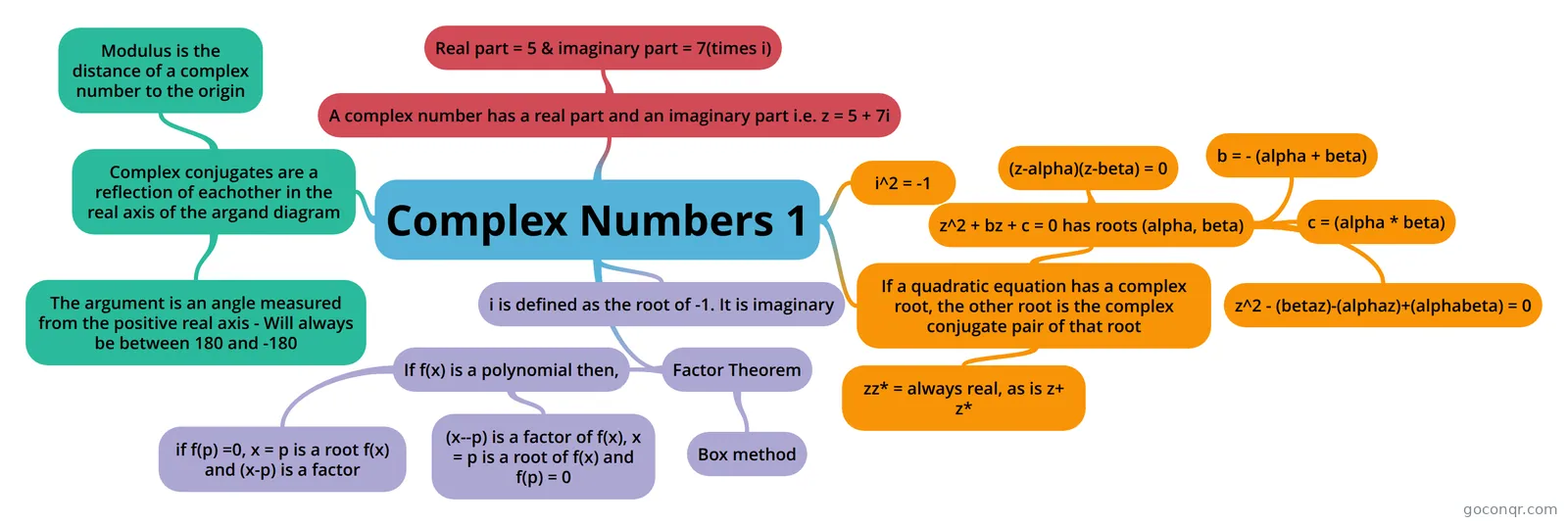 Mind map Complex Numbers 1
-
12 cardsLoci on an Argard Diagram If Z1 = A and Z2 = B , then what is AB?
-
4 questionsImaginary Numbers How would 6 + 7i be plotted on the complex plane?
-
6 cardsPolynomials Any quadratic with real coefficients has what 3 possible sets of roots?
Quizzes
Mind maps
Flashcards
Flowcharts
Notes
-
1.3 Complex Numbers Complex Number = a + bi a is the Real part b is the Imaginary partIf b = 0, then a + bi = aIf a = 0, and b does not equal 0, the Complex Number is a Pure Imaginary Number, eg. 3iIf a does not equal 0 and b does not eq...
-
Mathematics C Method of Finite Differences Determines the relationship between variables 1. Place variables in table 2. Find Change in y variables until difference column is equal 3. Number of difference columns determines type of ...
Slides
More Mathematics topics
About Complex Numbers and Complex Analysis
GoConqr OriginalWhat the resources cover
The unit opens with the basics. The mind map Section 1.4 - Complex Numbers introduces the imaginary unit i, where i squared equals -1, and the form a+bi. Another map, Complex Numbers 1, shows that a number such as 5 + 7i has a real part and an imaginary part. The map K1: Core maths places complex numbers alongside the natural numbers, integers, rationals and reals, and mentions how to divide complex numbers.
Where to begin
- Start with a mind map to see the whole topic on one screen.
- Move to the flashcard decks Complex numbers and Argard Diagrams to learn the terms: magnitude, real part, imaginary part and the diagram itself.
- Try the quiz Imaginary Numbers to check what stuck.
- Go on to the map De Moivre's Theorm and the map Euler's Identity.
Going further into analysis
Some resources are aimed at university-level study. The deck Chapter 2 asks when a complex variable is differentiable and covers the Cauchy-Riemann equations, Laplace's equation and holomorphic functions. Chapter One deals with polar form, convergence and open sets. There are also maps on complex integration and decks on complex functions and elementary functions.
For school exams
Some notes and maps suit school courses. The map CALC - COMPLEX NUMBERS covers polar form, the Argand diagram and complex roots of polynomials. The slides on solving cubics and quartics, and the note on algebra with complex numbers past exam review, give exam-style practice. Resources here mention A-level Maths.
Using quizzes and maps together
Read a map first, then take a quiz without looking at it. Whatever you miss, go back to that branch and turn it into a flashcard. This unit sits in the Advanced Pure Mathematics strand of Mathematics. Open a resource that matches your level and work through it at your own pace.
Frequently asked questions
Which resource should I open first?
Start with the mind map Section 1.4 - Complex Numbers or Complex Numbers 1. Both explain the imaginary unit and the real and imaginary parts of a number. Then use the Complex numbers flashcards to learn the key terms before you try a quiz.
Are there quizzes on this page?
Yes, there are 2 quizzes: Imaginary Numbers and Advanced Mathematics. They sit alongside the many mind maps and flashcard decks, so you can read a map first and then test yourself on what you remember.
What do the mind maps cover?
Over 20 mind maps cover the imaginary unit, the form a+bi, Argand diagrams, polar form, complex roots of polynomials, De Moivre's theorem and Euler's identity. Some go on to complex integration and complex analysis for university study.
Which levels and exams do these resources suit?
The mix is about half secondary and half university. School students will find material on algebra and polar form, and resources here mention A-level Maths. University students can use the decks on differentiability, holomorphic functions and convergence.
Are the resources free, and who made them?
Every resource listed here is free to open, study and take, with no account needed. They were made by GoConqr users, not by GoConqr itself. A free account saves your quiz scores and lets you make your own maps and flashcards.
What if the topic I need is missing?
Try a nearby resource first, such as the flowchart Number Systems or the deck Polynomials. If your topic still isn't covered, make your own mind map or flashcards for it and keep them for revision.