
Arithmetic and Order of Operations
177 resources created by 155 users
This Arithmetic and Order of Operations page on GoConqr gathers community-made quizzes, mind maps, flashcards and notes, from integer operations and decimals to BODMAS, percentages and word problems. It's built for school students and primary pupils practising their number work, and for teachers after ready-made material. There are over 600 resources here, including more than 180 quizzes, over 180 mind maps and more than 190 flashcard decks, with some aimed at exams such as GCSE Maths and the SAT. Pick a quiz and see where you stand.
Top Arithmetic and Order of Operations resources
-
4 questionsTwo-Step Word Problems Mr. Smith baked 3 trays of 36 cookies. After they cooled he divided the cookies evenly into 4 bags. How man...
-
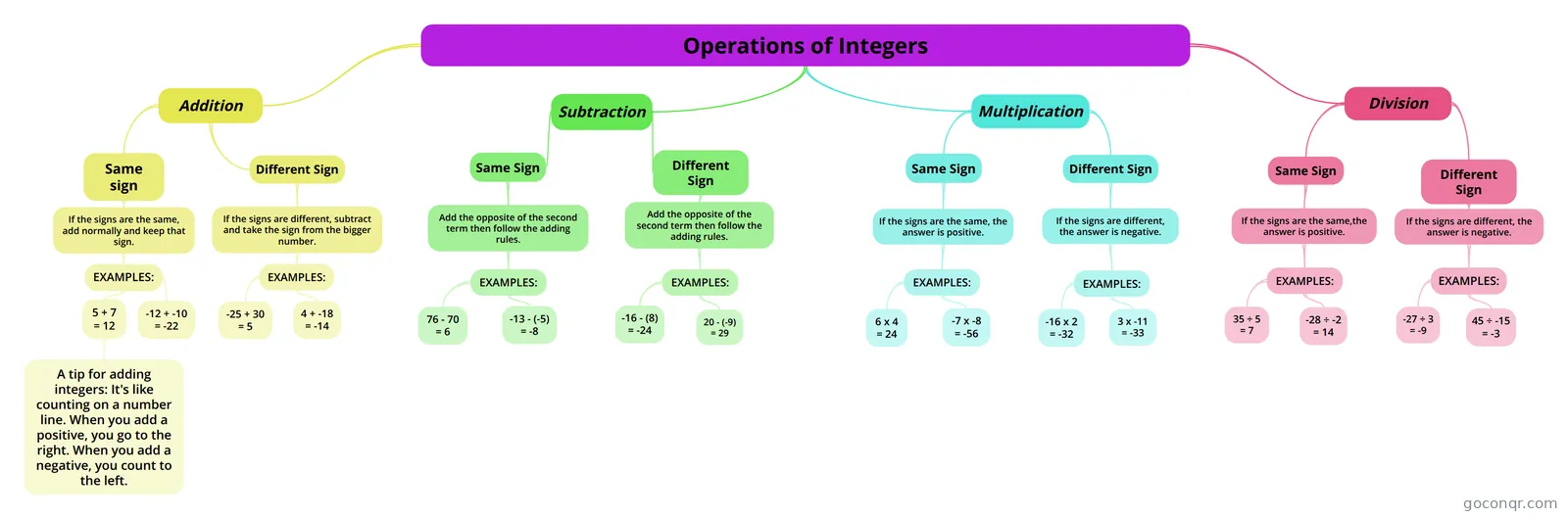 Mind map Operations of Integers
-
30 cardsGMAT Quant questions Level difficulty= Medium
-
30 questionsAsset Practice Paper 1 How many triangles are used to make the man shown here?
-
22 questionsMatemáticas II The population of a certain town increases by 50 percent every 50 years. If the population in 1950 was 810,...
-
5 questionsNon-Calculator Maths Quiz If I have £49.23 in my walled and I used £12.34 on shopping for groceries at a supermarket and spent £28.92...
-
11 questionsSolving Money Word Problems L1 Alan has saved £837 and wants to spend some of his money. He wants to leave £195 in his account. How much c...
-
5 questionsProblem testing quiz Harry had £3 . He bought a sandwich for £1.35 and also bought a drink. He got 50p change. How much was the ...
Quizzes
See all 93 quizzes-
4 questionsTwo-Step Word Problems Mr. Smith baked 3 trays of 36 cookies. After they cooled he divided the cookies evenly into 4 bags. How man...
-
30 questionsAsset Practice Paper 1 How many triangles are used to make the man shown here?
-
22 questionsMatemáticas II The population of a certain town increases by 50 percent every 50 years. If the population in 1950 was 810,...
-
5 questionsNon-Calculator Maths Quiz If I have £49.23 in my walled and I used £12.34 on shopping for groceries at a supermarket and spent £28.92...
-
11 questionsSolving Money Word Problems L1 Alan has saved £837 and wants to spend some of his money. He wants to leave £195 in his account. How much c...
-
5 questionsProblem testing quiz Harry had £3 . He bought a sandwich for £1.35 and also bought a drink. He got 50p change. How much was the ...
-
4 questionsDivision There are 9 pencils for 3 children. You have to give them the same amount. How many pencils would you give ...
-
9 questionsFraction, Decimal and Percentage calculations. what is 1/2 +1/5?
Mind maps
See all 21 mind maps-
Operations of Integers
-
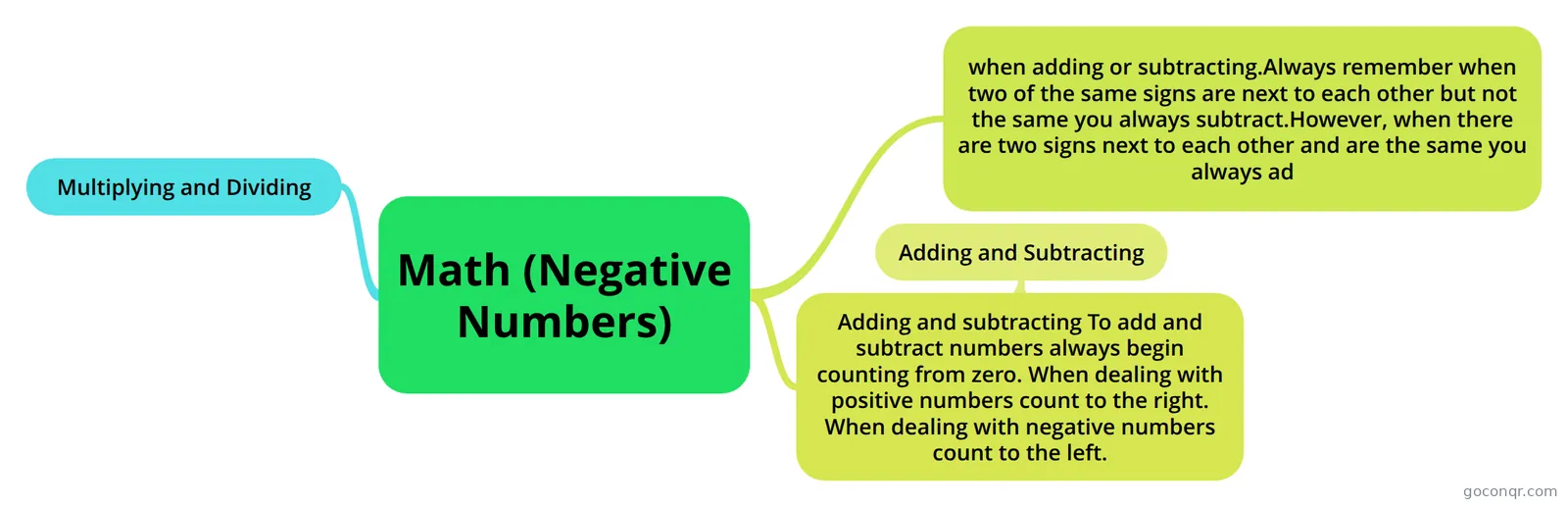 Math (Negative Numbers)
-
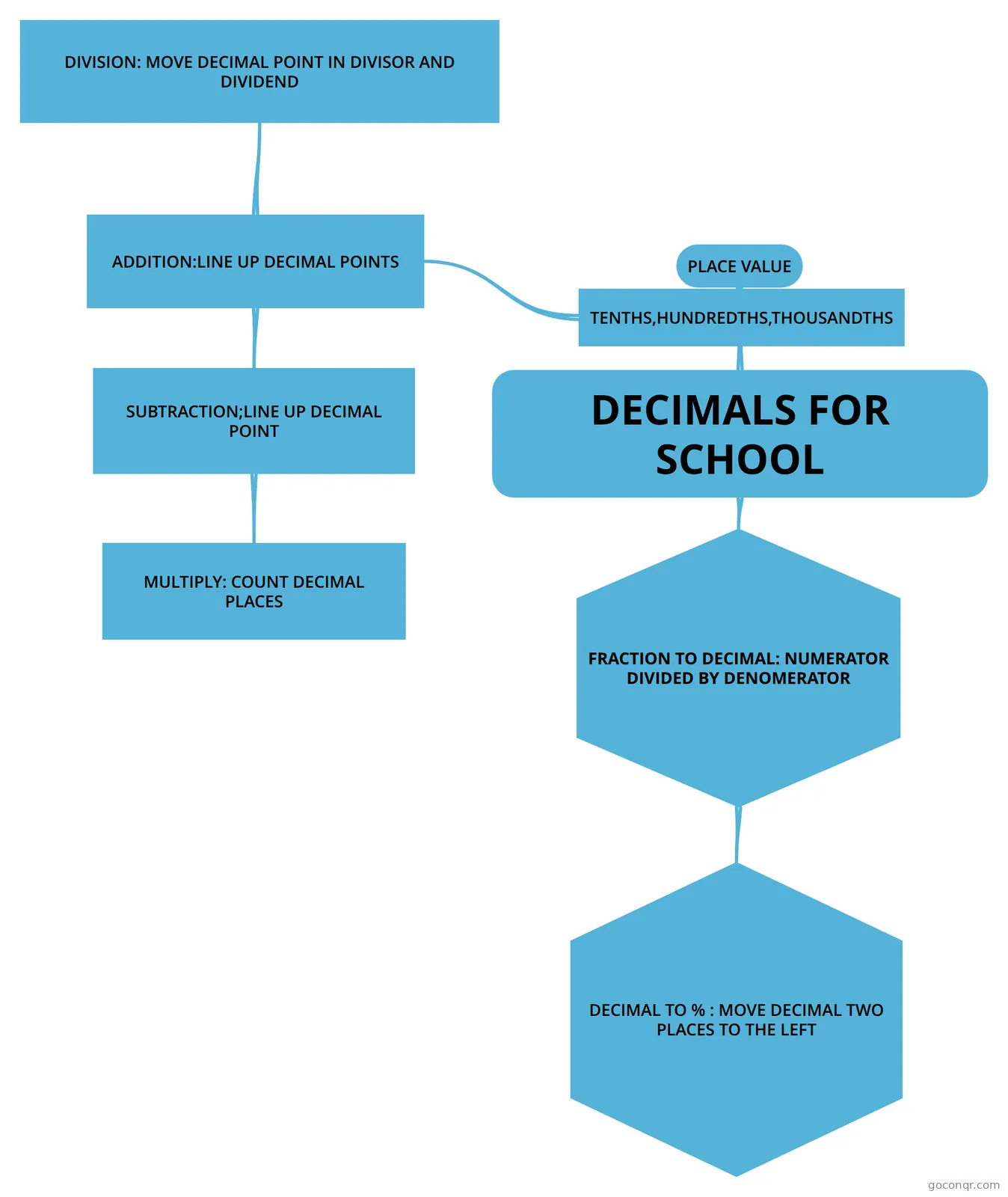 DECIMALS FOR SCHOOL DECIMALS
-
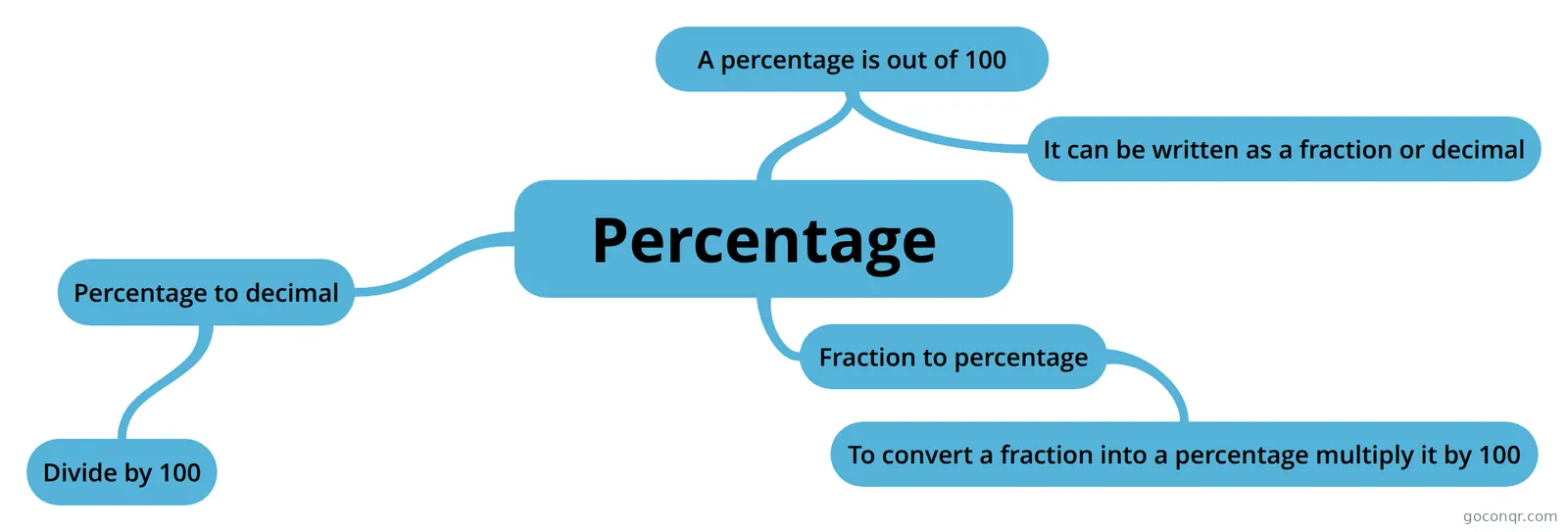 Percentage A short summary of percentages and how to increase, decrease and work.
-
 Fraction, decimals and percentages mind-map where, when and how to we use fractions. how are fractions, decimals and percentages relate to each other.
-
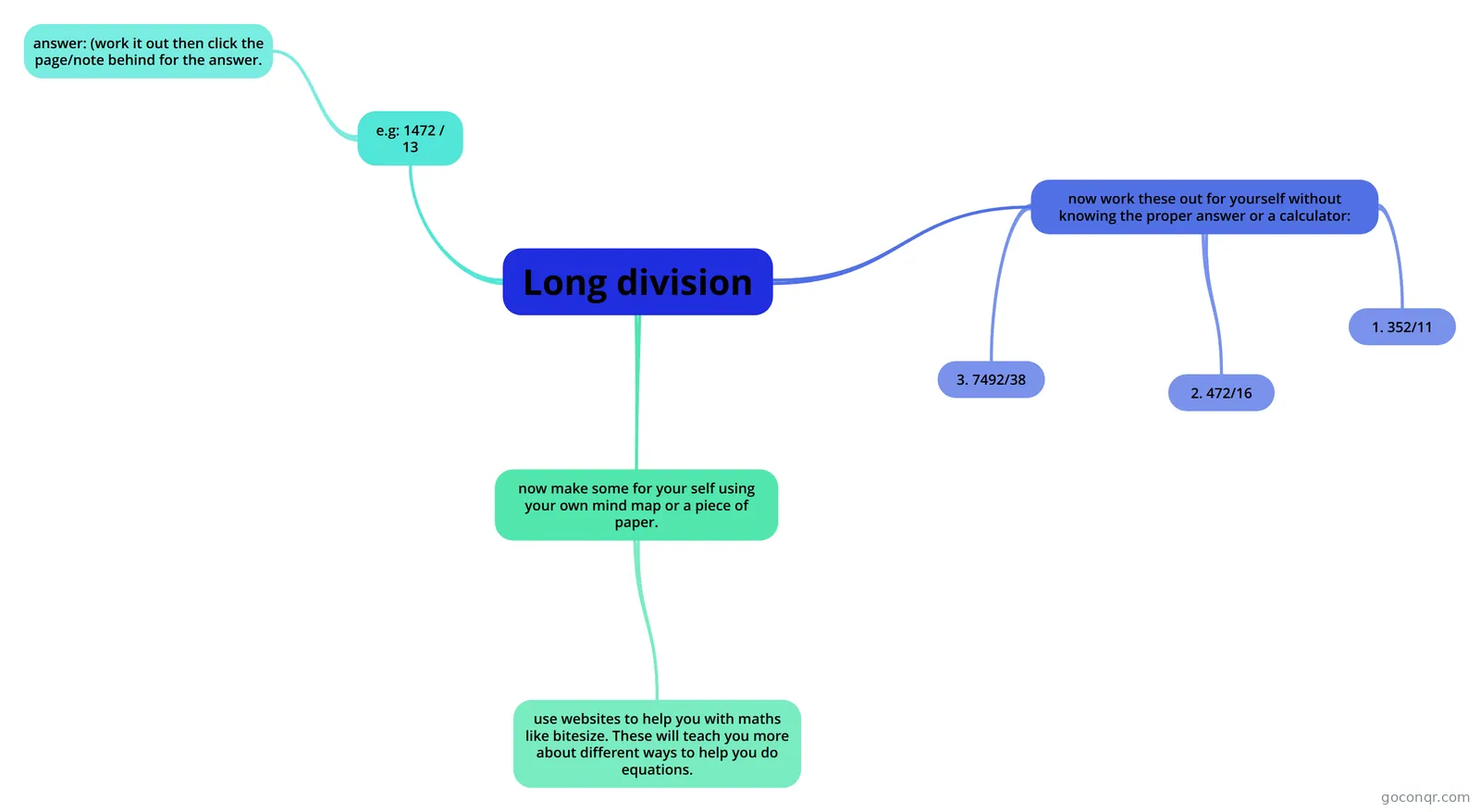 Long division long division questions which get harder. Try not to use a calculator. Use a calculator if stuck.
-
Mathematics Basic Operations This is a simple diagram that shows what are the mathematics basic operations that are going to be explained.
-
FRACTIONS/FRACTIONS It's all about fractions
Flashcards
See all 51 flashcards-
30 cardsGMAT Quant questions Level difficulty= Medium
-
9 cardsVicki BODMAS
-
21 cardsPerfect Squares (1 - 15) and Cubes (1 - 5) Zookie
-
36 cardsChatper 1 & 2 Flash Cards
-
51 cards19 even + even =
-
28 cardsGRE Percent to decimals
-
20 cardsMath Quiz Review WHAT ARE THE NUMBERS BEING ADDED TOGETHER CALLED?
-
17 cardsChapter 1 Key terms Chapter 1 Key Terms Introduction to Business Quantitative Methods
Flowcharts
Notes
See all 10 notes-
Reciprocals RECIPROCALS The reciprocal of a number is the number such that the original × reciprocal = 1
-
numbers 1 Directed Numbers Bookmark this page Numbers can either be positive or negative. Often brackets are put around negative numbers to make them easier to read, e.g. (-2). If a number is positive, the + is usually missed o...
-
numbers 2 Ratios If the ratio of one length to another is 1 : 2, this means that the second length is twice as large as the first. If a boy has 5 sweets and a girl has 3, the ratio of the boy's sweets to the girl's sweets is 5 ...
-
Maths noted 2× table 2 4 6 8 10 12 14 16 18 20 22 24 3× table 3 6 9 12 15 18 21 24 27 30 33 36 4× table 4 8 12 16 20 24 28 32 36 40 44 48 5× table 5 10 15 20 25 30 35 40 45 50 55 60 6× table 6 12...
-
Mathematics LESSON 1: PRIME NUMBERS AND COMPOSITE NUMBERS Prime Numbers:Prime numbers are numbers that are only divisible by 1 or itself.Composite Numbers:Composite numbers are numbers that have more than 2 factors.PRIME NUBERS (...
-
Place Value - created from Mind Map Place value is the basis of our entire number system. A place value system is one in which the position of a digit in a number determines its value. In the standard system, called base ten, each place represents ten t...
-
Order of Operations
-
Factors and Multiples If one number divides exactly into a second number, the first number is said to be a factor of the second. Thus 35/5=7 . . . 5 is a factor of 35 or 35 = 5 * 7 &nbs...
Slides
More Mathematics topics
About Arithmetic and Order of Operations
GoConqr OriginalWhat the resources cover
The unit brings together the core of everyday calculation. The Operations of Integers mind map sets out addition, subtraction, multiplication and division, with the rules for same and different signs. Other maps cover percentages, decimals and negative numbers, so you can see how each idea links to the next.
Quizzes turn those ideas into practice. Two-Step Word Problems asks about cookies baked in trays and shared into bags. Non-Calculator Maths Quiz works through money left in a wallet after shopping. Solving Money Word Problems L1 covers savings and book sales.
Where to start
If order of operations is new, begin with the BODMAS/BIDMAS Warm up maths quiz. It checks what the letters stand for and reminds you that brackets come first. Then look at the flashcard deck Order of operations and the flowchart called Order of Operations to see the steps laid out in sequence.
If negative numbers are the sticking point, try the mind map Math (Negative Numbers). It explains counting from zero, right for positives and left for negatives. Follow it with the slide set Maths Negative Numbers and Order of Operations.
Using quizzes and maps together
- Read a mind map first to get the main rules in view.
- Take a short quiz without looking at the map.
- Note which questions went wrong and go back to that branch of the map.
- Use flashcards to fix the facts you missed, then try another quiz.
The DECIMALS FOR SCHOOL mind map pairs well with the fraction, decimal and percentage quizzes, because it covers place value and lining up the decimal point.
Exam-style practice
Some decks and quizzes are aimed at tests. You will find GMAT Quant questions, a GRE deck, the ASVAB (AFQT) Arithmetic Reasoning Test and a GCSE Maths quiz. These suit older students who want timed-style arithmetic. Younger learners will find more help in the grade-level quizzes and mental maths tests.
Where it fits
This unit sits in the Number strand of Mathematics. It is a good base to return to whenever calculations feel shaky. Choose one resource today, work through it, and see what you would like to revisit.
Frequently asked questions
Which resource should I start with?
For order of operations, try the BODMAS/BIDMAS Warm up maths quiz, then the Order of operations flashcards. If you are working with positive and negative numbers, the Operations of Integers mind map is a clear first stop. Both routes lead naturally into the word problem quizzes.
What do the mind maps cover?
They cover integers, negative numbers, decimals, percentages, fractions, exponents and BODMAS. Operations of Integers sets out the sign rules for each operation, while DECIMALS FOR SCHOOL covers place value and the steps for adding, subtracting, multiplying and dividing decimals.
Are the resources free to use?
Yes. Every resource on this page is free to open, study and take, with no account needed. They were made by GoConqr users, not by GoConqr itself. A free account also saves your quiz scores and lets you make your own quizzes, mind maps, flashcards and notes.
Which exams do the resources mention?
The listed resources mention GCSE Maths, GRE, GMAT, SAT, ACT Aspire and ASVAB. You will find decks such as GMAT Quant questions and quizzes such as the ASVAB (AFQT) Arithmetic Reasoning Test. Check each resource first, since the community wrote them.
Is there anything for younger learners?
Yes. Many resources suit primary pupils and early secondary students, including Basic Multiplication and Division, Mental maths test 1 and Grade 4 ASSET. Flashcards such as Adding +9 to sums of 20 give short, repeatable practice with simple sums.
What if I cannot find the topic I need?
Browse the notes, slide sets and flowcharts as well as the quizzes, since a topic may appear in a different format. Factors and Multiples and Scientific Notation Rules are examples. You can also build your own mind map or flashcards for the gap.