
Integumentary System (Skin)
49 resources created by 40 users
This Integumentary System (Skin) page on GoConqr gathers community-made mind maps, quizzes, flashcards and notes on skin histology, from the epidermal layers and melanocytes to the dermis, hair follicles and glands. It's built for university students revising a topic and teachers after ready-made material. There are more than 40 resources here, including more than 10 quizzes and over 10 mind maps, all at university level. Pick a mind map to get your bearings, then try a quiz to find your gaps.
Top Integumentary System (Skin) resources
-
47 cardsIntegumentary system histology what type of skin is represented by this slide
-
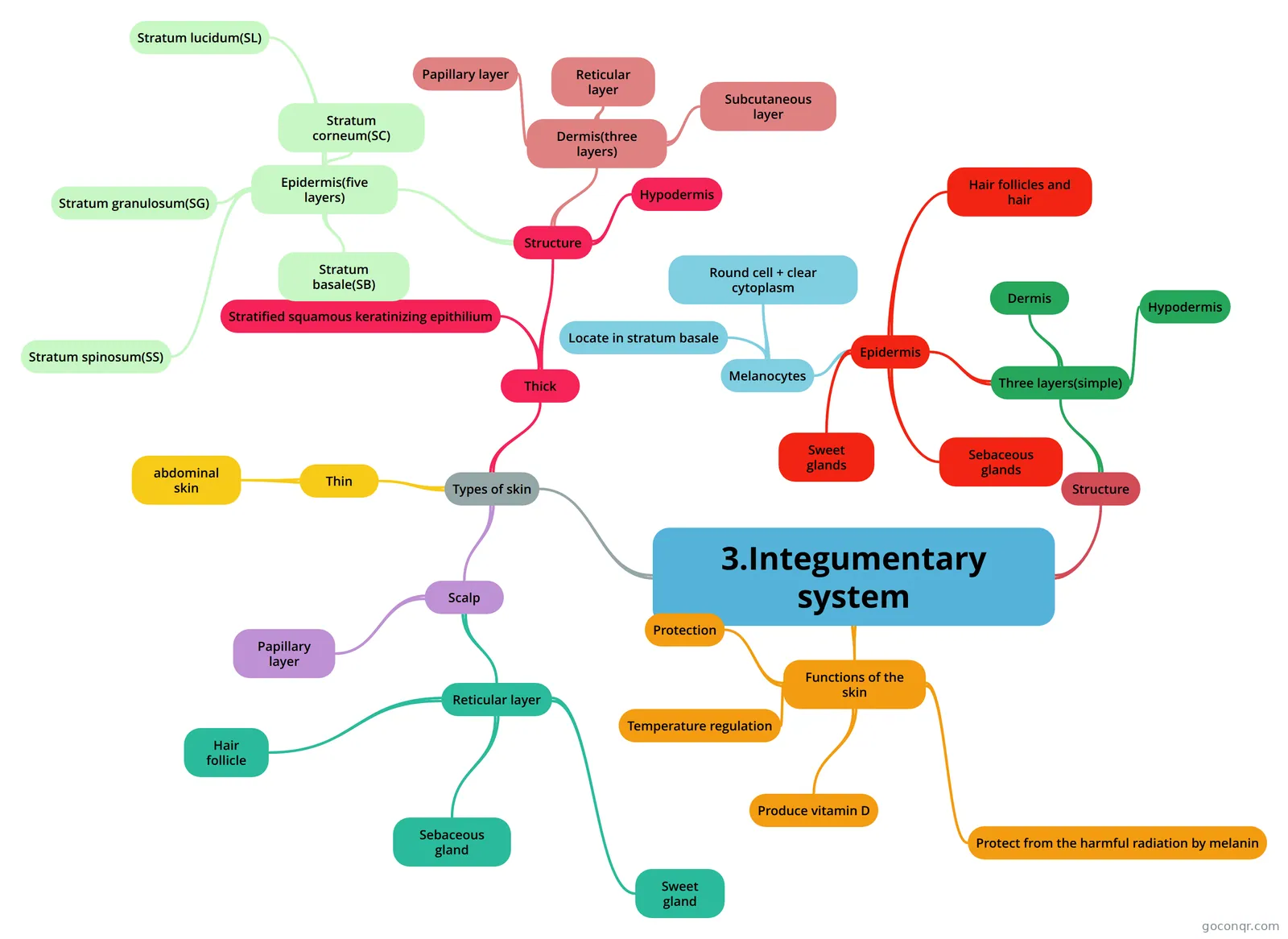 Mind map 3.Integumentary system skin
-
53 questionsSkin :)
-
36 cardsFlash cards-Histology-Integument What type of epithelium would you expect to form the epidermis of the skin
-
105 cardsHistology of Integument Which part of the integument restricts water entry and loss?
-
23 questionsWeek 6 Anatomy: Selected Histology and Integument System The three types of capillaries are
-
53 cardsTh3L06 The epidermis
-
24 questionsLecture 23 & 24: Structure of Skin and Fibre Growth Provitamin D3 is synthesised in the dermis
Quizzes
See all 12 quizzes-
53 questionsSkin :)
-
23 questionsWeek 6 Anatomy: Selected Histology and Integument System The three types of capillaries are
-
24 questionsLecture 23 & 24: Structure of Skin and Fibre Growth Provitamin D3 is synthesised in the dermis
-
20 questionsQuiz on skin and receptors No. of layers of stratum malpighi in thick skin is ........ while stratum spinosum in thin skin is .........
-
20 questions1_Quiz on skin and receptors No. of layers of stratum malpighi in thick skin is ........ while stratum spinosum in thin skin is .........
-
11 questions41 Integument Keratinocytes and melanocytes are derived from the ectoderm. Merkel cells originate from the neural crest.
-
15 questions1_Mcq on skin and nerve ending اللهم اجعله عملًا خالصًا لوجهك الكريم
-
17 questionsAbnormal Skin/ Skin Regeneration How is the stratum corneum held together?
Mind maps
See all 17 mind mapsFlashcards
See all 16 flashcards-
47 cardsIntegumentary system histology what type of skin is represented by this slide
-
36 cardsFlash cards-Histology-Integument What type of epithelium would you expect to form the epidermis of the skin
-
105 cardsHistology of Integument Which part of the integument restricts water entry and loss?
-
53 cardsTh3L06 The epidermis
-
40 cardsTissues and Cells
-
26 cardsBMS08-1007-Histology of Skin & it's Appendages What are the functions of skin? (5)
-
38 cardsTh3L06 Glands and hair follicles What are the skin appendages?
-
37 cardsTh3L06 Glands and hair follicles What are the skin appendages?
Flowcharts
Notes
-
Epidermis - created from Mind Map Consists mainly of squamous keratinized epithelium, also: Melanocytes; Langerhans cells and Merkel's cells. consists of 5 layers of keratin producing cells 1. Stratum Basale- have keratin filaments Filaments has role ...
-
Histology of skin system Skin/integument system Functions: Protective: against thermal/mechanical/pathogens- if pathogens do penetrate skin = alert lymphocytes and antigen presenting cells- melanin pigment protects cell nuclei from UV radiati...
-
Keratinisation Mitotic activity in basale layer. Cells in this layer contain amino acids which combine to form polypeptide chains. S. Spinosum. Filligrin in the cells begins to bind to keratin microfibrils, and the cells...
Topics in Integumentary System (Skin)
More Histology and embryology topics
About Integumentary System (Skin)
GoConqr OriginalWhat this unit covers
The resources follow the skin from the surface down. The mind map Epidermis describes squamous keratinized epithelium with five layers of keratin-producing cells, plus melanocytes, Langerhans cells and Merkel's cells. Separate maps look at Stratum basale, Stratum Spinosum and Cells contained in epidermis. The Dermis map covers the basal lamina and the connective tissue that supports the epidermis and binds it to subcutaneous tissue.
Where to start
Begin with the mind map Integumentary System or the one on the functions of the skin, which sets out protection, temperature regulation, vitamin D production and the three simple layers. Then move to Epidermis and Dermis for the detail.
- Read a broad overview map.
- Work through the layer-by-layer maps.
- Look at Epidermal derivatives and HAIR FOLLICLE.
- Check the notes on keratinisation.
Using quizzes and maps together
Once you have read a map, try the quiz Skin or Abnormal Skin/ Skin Regeneration. The first has fill-in-the-blank questions on cell types such as melanocytes and Merkel cells. The second asks how the stratum corneum is held together and what is found only in thick skin. Go back to the map for any answer you missed.
The flashcard deck Integumentary system histology asks you to identify skin types from slides. That makes it a good partner for the quizzes, because it trains you to recognise what you have read about.
Going deeper
The mind map Skin goes into the cornified layer, the cornified envelope and filaggrin, including how it is processed and degraded. It suits students who want more than the basic layers.
Where it sits
This unit belongs to the strand Digestive, Respiratory and Integumentary Systems in Histology and embryology. Open a resource, test yourself, and add your own maps or flashcards for the parts you find hardest.
Frequently asked questions
Which resource should I open first?
Start with the mind map Integumentary System, or the one covering the functions and three simple layers of the skin. They give you the overall picture. After that, move on to the Epidermis and Dermis maps before you try a quiz.
What do the mind maps on this page cover?
They cover the epidermis and its layers, melanocytes, the dermis and basal lamina, epidermal derivatives, hair follicles and cells found in the epidermis. One map goes further into the cornified layer, the cornified envelope and filaggrin.
Are the resources free to use?
Yes. Every resource listed here is free to open, study and take, with no account needed. They were made by GoConqr users, not by GoConqr itself. A free account also saves your quiz scores and lets you make your own quizzes, mind maps, flashcards and notes.
What level are these resources?
All the resources here are at university level. They suit university students studying skin histology and teachers who want ready-made material to share. There are no exam-specific resources on this page.
Which quiz tests the epidermal cell types?
The quiz Skin has fill-in-the-blank questions on epidermal cells, for example melanocytes producing pigment and Merkel cells, also known as tactile epithelial cells. It is a good check after you have read the Epidermis mind map.
What if I can't find a topic I need?
Try the related resources on hair follicles, glands and epidermal derivatives, which may cover it. If a topic is still missing, you can build your own mind map, flashcards or notes with a free account and use them alongside the existing material.