
Introduction to Criminology
24 resources created by 20 users
This GoConqr page gathers over 200 community-made resources on Introduction to Criminology: quizzes, mind maps, flashcards and notes to revise and practise with.
Top Introduction to Criminology resources
-
 Mind map BLM Andrew Sullivan
-
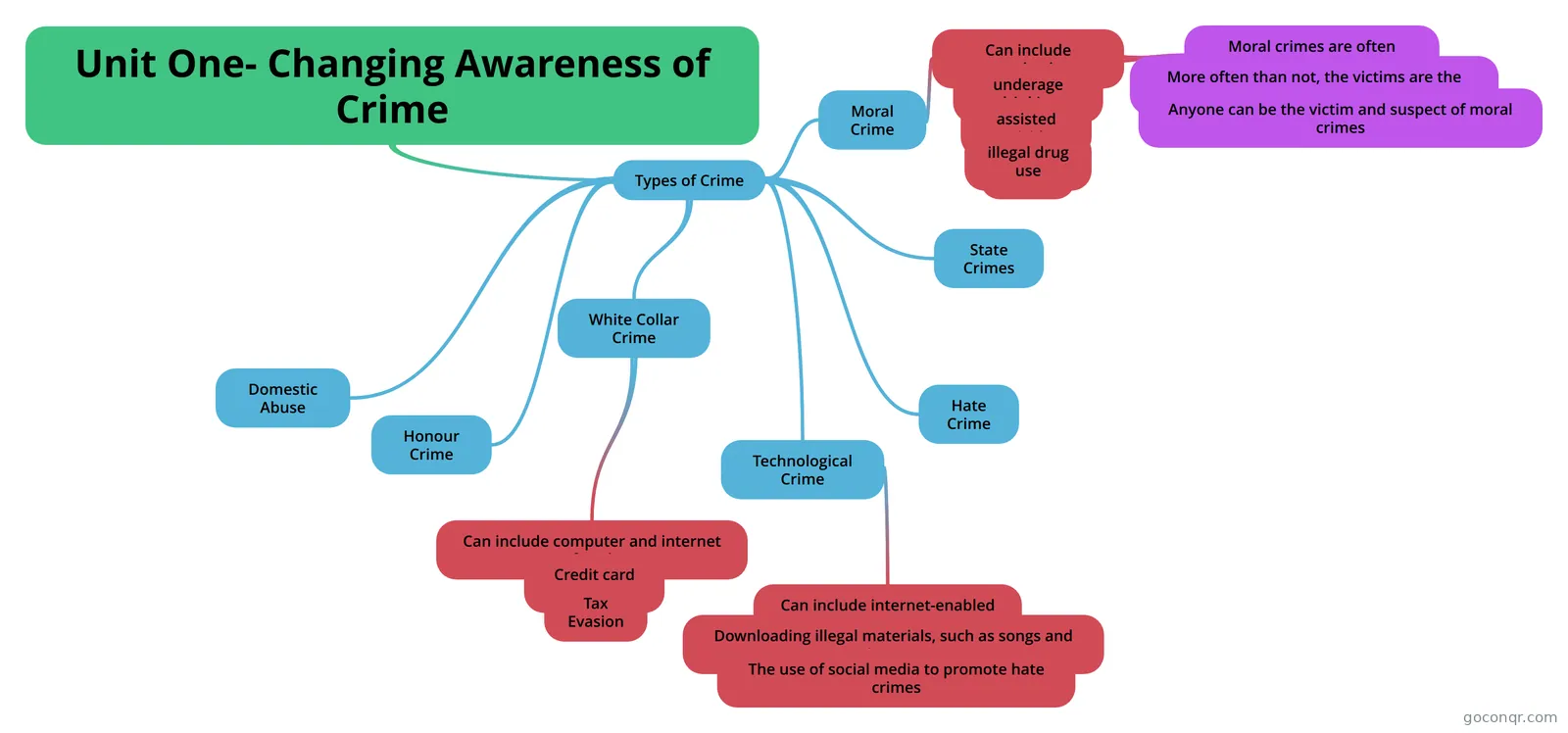 Mind map Unit One- Changing Awareness of Crime Unit one of criminology for those on the WJEC.
-
 Mind map Individualistic Theories of Crime and Learning Theories Mind map outlining the Individualistic Theories of Crime and Learning Theories
-
Mind map Serial Killers my epq ideas
-
200 cardsFinal Exam Flashcards t/f: crime in Australia is on the rise
-
89 cardsCriminology Unit 4 Full word doc in college account
-
 Mind map control theories
-
75 cardsCriminology chpt.1,2,3 What is deviance?
Quizzes
Mind maps
See all 10 mind maps-
BLM Andrew Sullivan
-
Unit One- Changing Awareness of Crime Unit one of criminology for those on the WJEC.
-
Individualistic Theories of Crime and Learning Theories Mind map outlining the Individualistic Theories of Crime and Learning Theories
-
Serial Killers my epq ideas
-
control theories
-
BIOLOGICAL THEORIES... THEORIES DESCRIBING BIOLOGICAL CRIMINOLOGY
-
THEORY OF DELINQUENCY This is the finished project.
-
 WEEK 1 REVIEW QUESTIONS Mind Map of Week 1 Review Questions for Final Exam
Flashcards
-
200 cardsFinal Exam Flashcards t/f: crime in Australia is on the rise
-
89 cardsCriminology Unit 4 Full word doc in college account
-
75 cardsCriminology chpt.1,2,3 What is deviance?
-
53 cardsThe Positive School (ch. 2) How did people explain bad behavior "back in the day"?
-
21 cardsCC 100- (1) What is criminology David Milgaard Case
-
24 cardsIntro to Theories (ch. 1) What is Criminology?
-
10 cardsCC 100- (6) Flashcards Significance of social context
-
3 cardsCriminologists Cesare Beccaria 18th C. Italian Criminologist and Jurist "On Crimes and Punishment" - 1764 Condemned tortur...
Notes
-
Restorative Justice Usually involves meetings between offender and victim, allowing the offender to make amends and see the suffering the crime caused. Emphasises psychological healing and collaboration. Study: Sherman and St...
-
Criminology Study Guide Study Guide Chapter One 1) What is the difference between what is legal and what is illegal? 2) Illegal does not mean “criminal” 3) In order for something to be criminal it has to violate the laws (criminal laws) 4) W...
More Criminology topics
About Introduction to Criminology
GoConqr OriginalWhat this unit covers
The resources here follow the ideas a first course in criminology tends to meet. The mind map on changing awareness of crime sorts crime into types, including white collar crime, state crimes, technological crime, hate crime, honour crime and domestic abuse. Other maps look at Classical criminology, control theories, Victimology and Restorative justice.
Theories and perspectives
Several items deal with why people offend. The map on individualistic theories and learning theories explains operant conditioning, built on positive reinforcement and punishment. Are criminals born or made? (Biological vs Social evidence) sets two views side by side, and Cesare Lombroso and Beccaria On Crimes And Punishment (1764) are there for the early thinkers. For newer angles, try the flashcards on Green Criminology and Post-Colonial Criminology, or the BLM map on cultural criminology and media coverage.
Prevention and measurement
The Situational Crime Prevention flashcards explain the idea of engineering the environment to prevent crime, not to cure offenders. The Criminology Exam deck covers how crime is measured, including the Uniform Crime Reports and self-report studies. The Major Longitidunal studies and Farrington (2006) Cambridge Study In Delinquent Development maps suit anyone looking at risk factors.
A sensible order
- Start with Defining criminology or what is criminology? to get the vocabulary.
- Move to Classical criminology, then the positive school and later theories.
- Take a quiz such as Criminology Test 1 or classicism quiz CK straight after each map.
- Return to the maps for anything you missed, and finish with a mixed deck.
Maps show how ideas connect. Quizzes show what you can actually recall. Using them together helps you see which is which.
Where it fits
This unit sits in the Foundations of Criminology strand of the Criminology subject. The listed material mentions WJEC Criminology, and most of it is university level, with some for school students. Choose one map today, test yourself on it, and then add your own notes.
Frequently asked questions
Which resource should I open first?
If you are new to the topic, try the mind maps called Defining criminology and what is criminology? They set out the basic terms. After that, Criminology Test 1 is a quick quiz to see what stuck, and Classical criminology is a natural next map.
What do the mind maps cover?
They range from types of crime, including white collar, state, technological and hate crime, to theories such as classicism and control theories. Others cover victimology, restorative justice, risk factors for young people and longitudinal studies. There are over 100 to choose from.
Are the resources free to use?
Yes. Every resource listed here is free to open, study and take, with no account needed. If you want to save your quiz scores or make your own quizzes, mind maps, flashcards and notes, you can add a free account.
Who made these resources?
They were made by GoConqr users, not by GoConqr itself. Over 160 contributors have shared material here, so styles and depth vary. Check a resource against your own course notes or textbook before relying on it.
Which levels and exams do they suit?
Most of the material is aimed at university students and professional candidates, with a smaller share for school students. One exam is mentioned in the listed resources: WJEC Criminology. Teachers can also use the maps and quizzes as ready-made material.
What if I can't find my topic?
Try the related titles first, such as the theory maps, the lecture flashcards or the quizzes by week. Some topics appear under a course name rather than a theory name. If it is still missing, you can build your own map or flashcards.