
Sociological Theories of Crime and Deviance
61 resources created by 50 users
This Sociological Theories of Crime and Deviance page on GoConqr gathers community-made mind maps, flashcards, quizzes, slides and notes, from functionalist and Marxist explanations to realism, labelling, gender, globalisation and green crime. It's built for school students revising for exams such as A-level Sociology and GCSE Sociology, and for teachers after ready-made material. There are over 700 resources here, including more than 500 mind maps, over 140 flashcards and more than 15 quizzes, with a few for university students too. Pick a theory, try a quiz, then make your own.
Top Sociological Theories of Crime and Deviance resources
-
 Mind map Gender, Crime & Justice
-
67 cardsFlashcards on Realist Theories of Crime (1.4) Although left realism developed out of the marxist criminology, it is highly critical of aspects of the the...
-
Mind map Left/Right Realism Mindmap about the two types of realism: Left and Right. This concerns their views, critiques, strengths and...
-
49 cardsTHEORIES OF CRIME AND DEVIANCE Crime and Deviance: Definitions and explanations// Crime
-
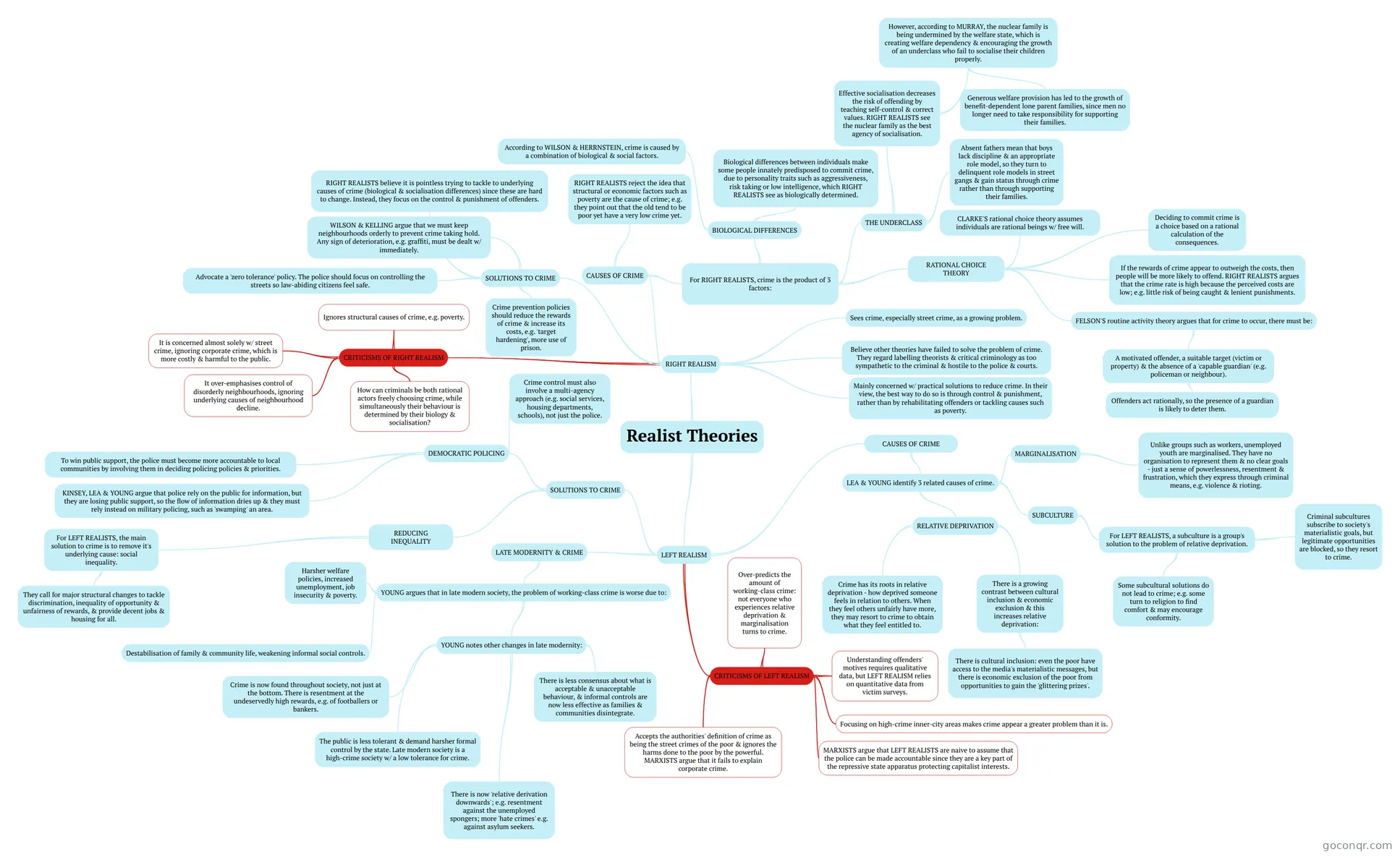 Mind map Realist Theories
-
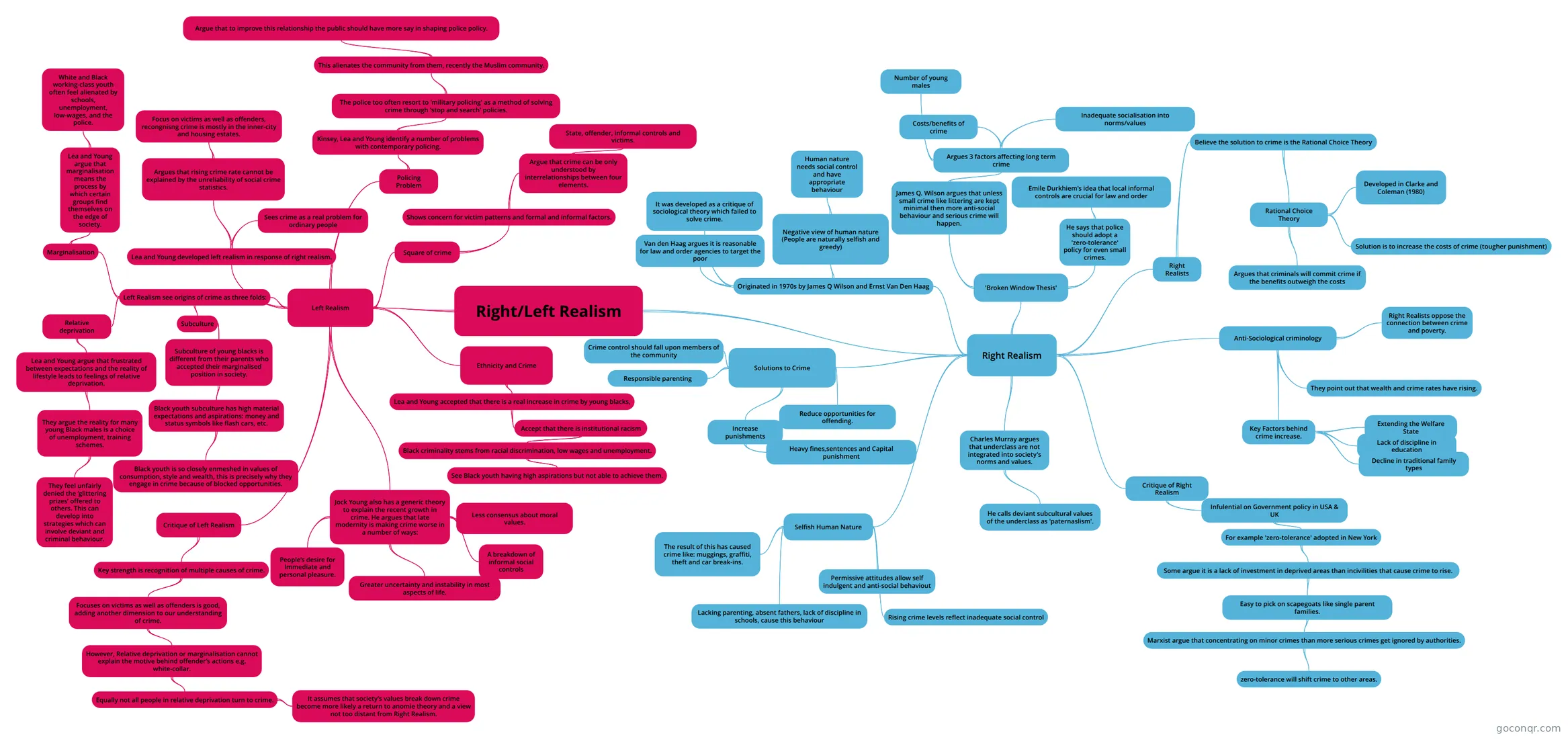 Mind map Right/Left Realism Sociology
-
Mind map Left and Right Realism stuff
-
36 cardsWhy might crimes go unreported? Unreported crime is where...
Quizzes
Mind maps
See all 38 mind maps-
Gender, Crime & Justice
-
Left/Right Realism Mindmap about the two types of realism: Left and Right. This concerns their views, critiques, strengths and...
-
Realist Theories
-
Right/Left Realism Sociology
-
Left and Right Realism stuff
-
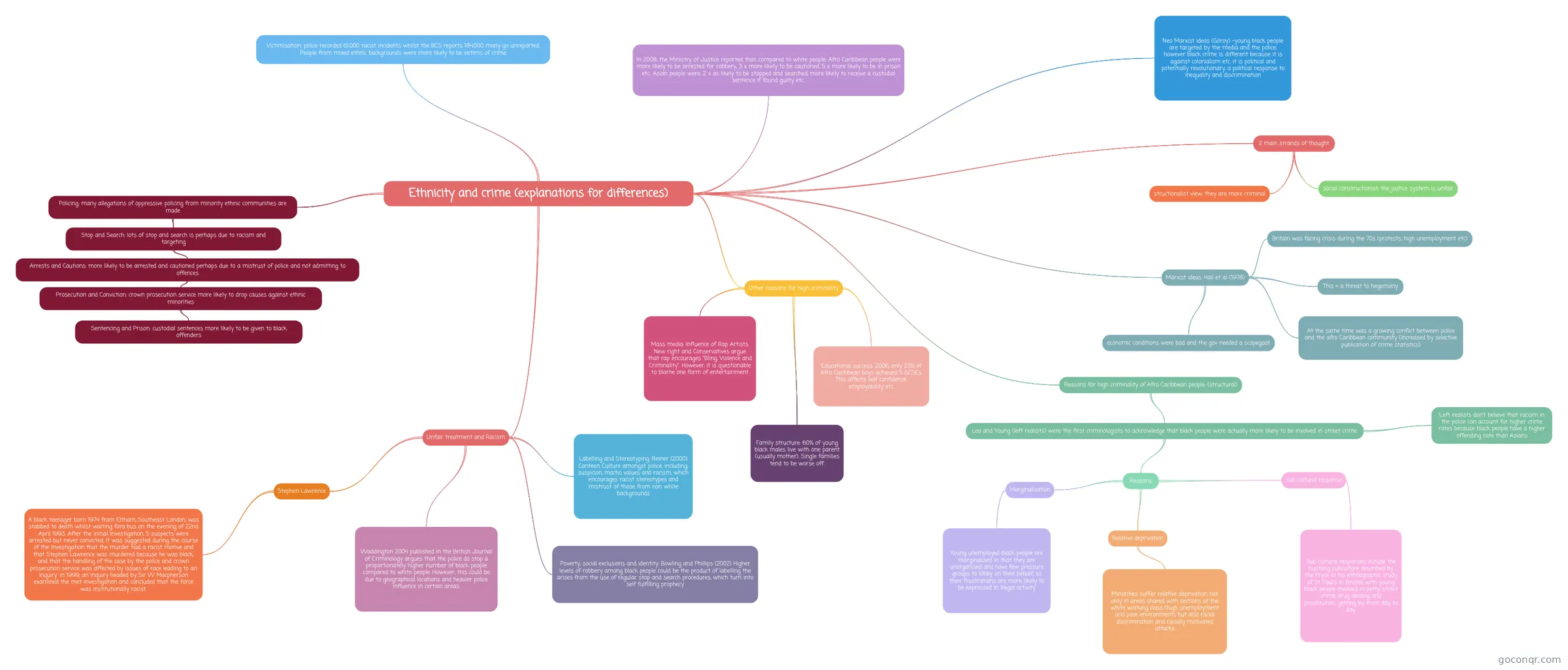 Ethnicity and crime (explanations for differences)
-
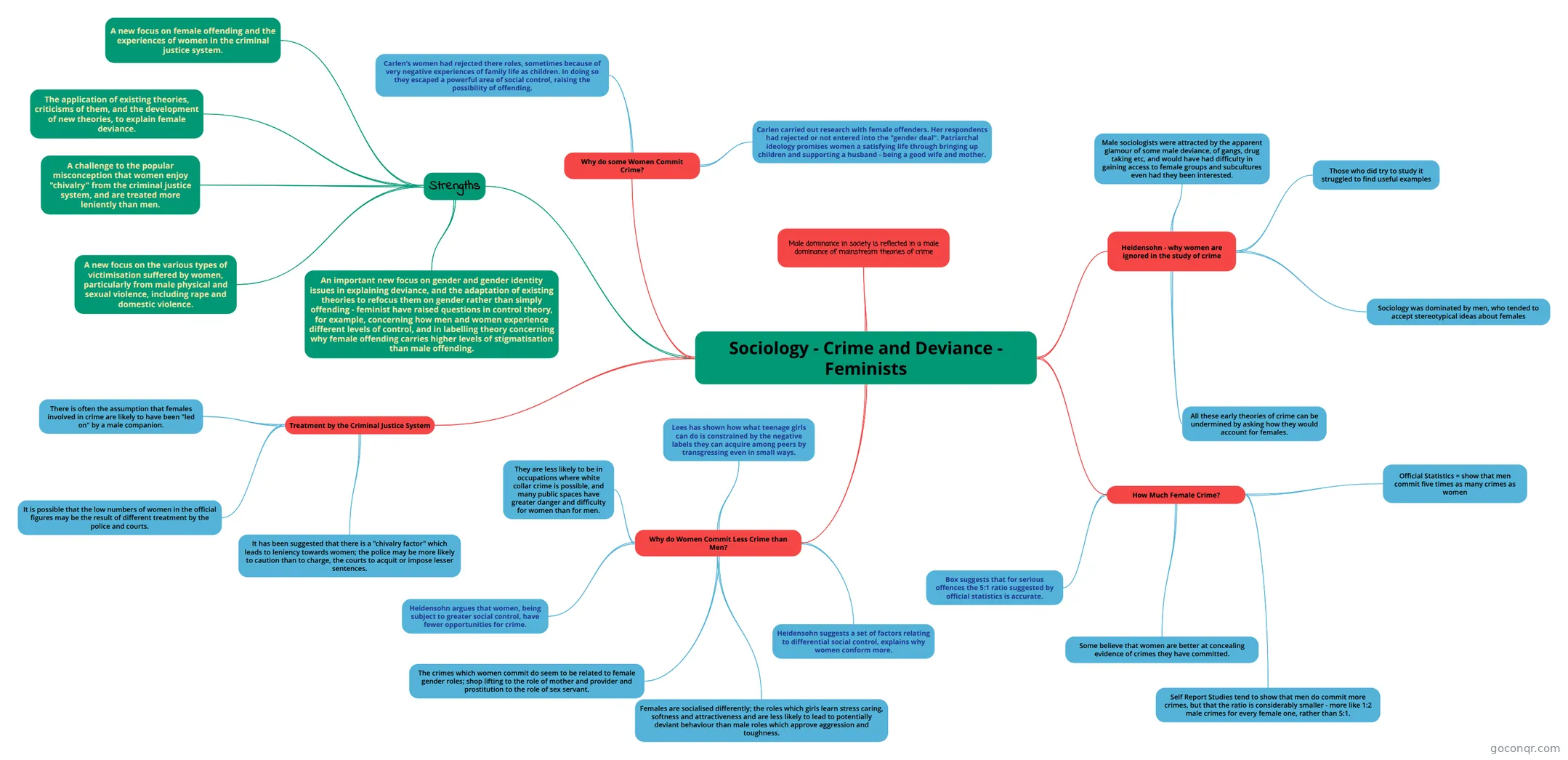 Sociology - Crime and Deviance - Feminists Feminist view of crime and deviance
-
Right realism mindmap
Flashcards
See all 18 flashcards-
67 cardsFlashcards on Realist Theories of Crime (1.4) Although left realism developed out of the marxist criminology, it is highly critical of aspects of the the...
-
49 cardsTHEORIES OF CRIME AND DEVIANCE Crime and Deviance: Definitions and explanations// Crime
-
36 cardsWhy might crimes go unreported? Unreported crime is where...
-
17 cardsGender and crime and deviance Gender Patterns in Crime As Heidensohn and Silvestri (2012) observe, gender differences are the most signif...
-
48 cardsFlashcards on Social Class and Crime (1.8) What two sources are used to understand the relationship between social class and crime?
-
15 cardsCrime and Deviance, Topic 8: Globalisation, Green Crime, Human Rights and State Crime The global criminal economy
-
108 cardscrim cards What is deviant behaviour?
-
27 cards5. Marxist View of Crime What are the key assumptions of Marxists ideas?
Notes
-
GCSE Sociology: UNIT 2: Socialisation, Culture and Identity: Crime And Deviance 8 MARK EXAM QUESTIONS:CRIME AND DEVIANCE1. Identify and describe two reasons why women are less likely to commit crime.2. Identify and describe two reasons why some ethnic minorities are over represented in criminal s...
-
premise structure theory (10) exam prep Discuss premise of structure theories (10) Structure theories represent the purest form of sociological explanations. According to structure theories, crime is a product of defect in social structure...
-
Mock Concerns 7/2/2017 According the the mock exams, what I need to adhere to.The exam is out of 60, divided into two sections, both 30 marks each.Crime and Deviance [25/30]Power [18/20] I got a B due to achieving 43/60. 44/60 = A49/60 = A*...
Slides
More Criminology topics
About Sociological Theories of Crime and Deviance
GoConqr OriginalWhat this unit covers
The page is built mostly from mind maps, with flashcard decks, quizzes, slide sets and notes alongside them. Together they follow the main sociological explanations of crime. There are maps on Marxist Theory of Crime, which looks at criminogenic capitalism and working-class crime, and on Realist Theories, which sets right realism beside left realism. The Interactionist view of Crime and deviance map starts from the idea that there is no such thing as a deviant act, only acts that are labelled as deviant.
Wider topics
Several resources move beyond the core theories. Gender, Crime & Justice opens with the point that most convicted offenders are male. The feminist map on male dominance in the study of crime brings in Heidensohn. Other maps cover ethnicity and crime, social class and crime, and the dark figure of crime. Newer themes include Globalisation and Crime, State Crime and Green Crime, which uses Nigel South's definition of a crime against the environment.
Where to start
Begin with a broad map such as Theories of Crime or Functionalist Explanations of Crime and Deviance (Including Subcultural Theories). Then move to the Marxist and realist maps, then interactionism, then the topics on gender, ethnicity and globalisation. If you are revising for GCSE Sociology, the notes on crime and deviance within Unit 2 are a useful way in. A-level Criminology and WJEC Criminology students will find related material in the wider theory maps.
Using quizzes and maps together
- Read a map and try to explain each branch in your own words.
- Take a quiz such as Left Realism or Measurement of crime to see what stuck.
- Go back to the map for any gaps.
- Use a flashcard deck, for example Functionalist theories of crime, for quick repeat practice.
Where it fits
This unit sits in the Theories of Crime strand of Criminology. Teachers can set a map as a starter or a quiz as a short check. When you are ready, choose one theory and build your own map or flashcards from what you have learned.
Frequently asked questions
Which resource should I open first?
Start with a broad overview such as the Theories of Crime mind map or the Functionalist Explanations map. They give you the main ideas in one view. After that, move to the Marxist Theory of Crime and Realist Theories maps, then test yourself with the Left Realism quiz.
What do the mind maps cover?
The mind maps cover functionalism and subcultures, Marxism, left and right realism, interactionism and labelling, and feminist views. They also look at gender, ethnicity, social class, globalisation, state crime and green crime. There are over 500 of them, made by different contributors, so you can compare how each one organises a topic.
Are these resources free to use?
Yes. Every resource listed here is free to open, study and take, with no account needed. They were made by GoConqr users, not by GoConqr itself. If you want to save quiz scores or make your own maps, flashcards, quizzes and notes, a free account lets you do that.
Which exams and levels do they suit?
Most resources are aimed at school students, and the listed material mentions A-level Sociology, GCSE Sociology, A-level Criminology and WJEC Criminology. A smaller share suits university students. Check each title and excerpt to see whether it matches your course, because contributors organise their material differently.
Are there quizzes on this page?
Yes, there are over 15 quizzes. Topics include Left Realism, Youth Crime, Measurement of crime, Interactionism and labelling theory, and Globalisation and green crime. They work well after reading a mind map, since they show which parts of a theory you can recall and which need another look.
What if I can't find the topic I need?
Try a related title first. For example, material on the media or on victims appears in flashcard decks and slide sets rather than maps. If nothing fits, you can build your own mind map, flashcards or notes on the topic and use the existing resources as a model.