
IP Addressing and Subnetting
269 resources created by 172 users
This IP Addressing and Subnetting page on GoConqr gathers community-made quizzes, mind maps, flashcards, notes and slides, from IPv4 classes and private ranges to VLSM, NAT, DHCP and IPv6. It's built for university students and professional candidates practising address maths and exam-style questions, and for teachers after ready-made material. There are over 260 resources here, including more than 60 quizzes, over 120 mind maps and over 50 flashcard decks. Pick a topic, try a quiz to find your gaps, then study the maps.
Select topic
Top IP Addressing and Subnetting resources
-
44 cardsE2_11 NAT IPv4 Private Address Space All public IPv4 addresses that transverse the Internet must be registered with a...
-
20 questionsReview Questions - Chapter 5 VLSMs, Summarization, and Troubleshooting TCP/IP On a VLSM network, which mask should you use on point-to-point WAN links in order to reduce the waste of IP...
-
7 questionsDIKTA ICND 1 Ch 14 When thinking about an IP address using classful addressing rules, an address can have three parts: network...
-
Flowchart Module 4: Implement IP Address Management > Flowchart: Deploy IP Address Management
-
10 cardsIPv4 Address Flash Cards What is the IP range of a Class A IPv4 Address?
-
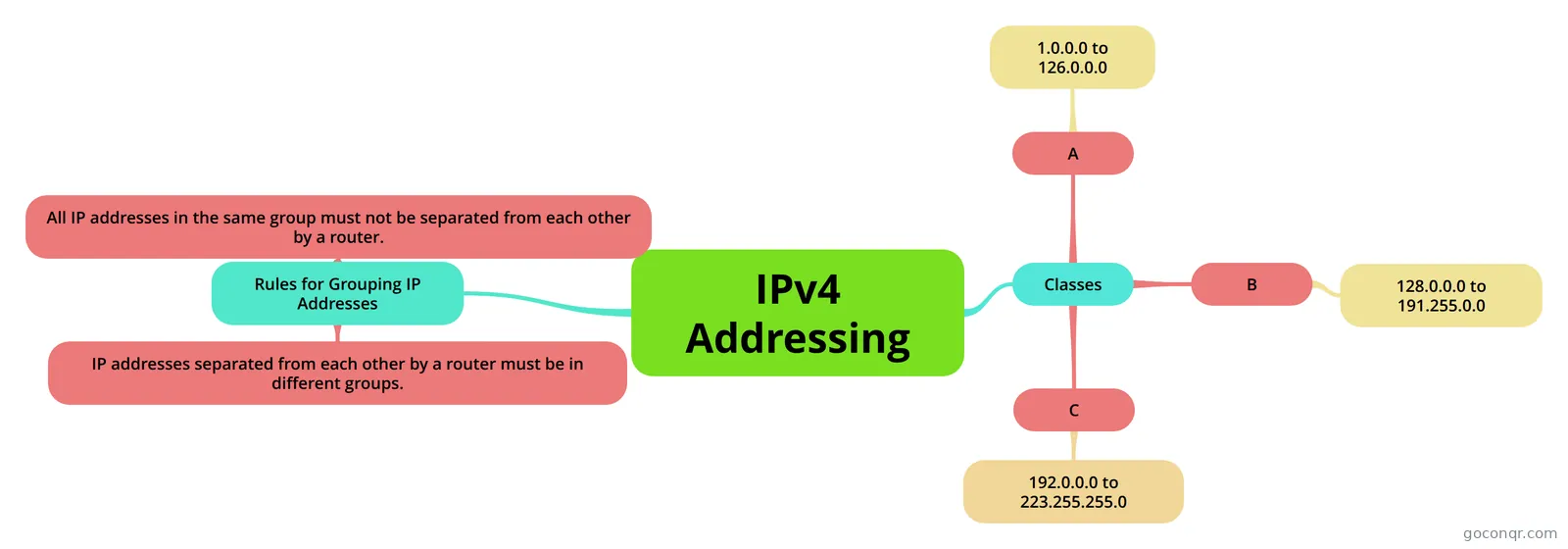 Mind map IPv4 Addressing
-
Mind map Windows Server 2012 R2 - Chapter 4
-
87 questionsNWGR Final test Consider the following IPv4 address structure and answer the following questions. Check all that apply
Quizzes
See all 69 quizzes-
20 questionsReview Questions - Chapter 5 VLSMs, Summarization, and Troubleshooting TCP/IP On a VLSM network, which mask should you use on point-to-point WAN links in order to reduce the waste of IP...
-
7 questionsDIKTA ICND 1 Ch 14 When thinking about an IP address using classful addressing rules, an address can have three parts: network...
-
87 questionsNWGR Final test Consider the following IPv4 address structure and answer the following questions. Check all that apply
-
10 questionsDChapter 4 - Fundamentals of IPv4 Addressing and Routing 1. Which of the following are functions of OSI Layer 3 protocols? (Choose two answers.)
-
15 questionsModule Quiz - IPv4 Addressing What is the prefix length notation for the subnet mask 255.255.255.224?
-
8 questionsDChapter 13 - Perspectives on IPv4 Subnetting 1. Host A is a PC, connected to switch SW1 and assigned to VLAN 1. Which of the following are typically ass...
-
112 questionsTest Refer to the exhibit. A network administrator is configuring a router as a DHCPv6 server. The administrator...
-
80 questionsExamen CCNA 200-120 Part 2 Given this output for SwitchC, what should the network administrator's next action be?
Mind maps
See all 132 mind mapsFlashcards
See all 51 flashcards-
44 cardsE2_11 NAT IPv4 Private Address Space All public IPv4 addresses that transverse the Internet must be registered with a...
-
10 cardsIPv4 Address Flash Cards What is the IP range of a Class A IPv4 Address?
-
179 cardsCompTIA Network+ Ch_3 How many octets does a Class A address use to represent the network portion?
-
77 cardsNetAcad 11 - 13 10.5.4.100 255.255.255.0 What is the network address?
-
21 cardsComputer network and infrastructure (5.1) Give an overview of internet organisations?
-
69 cardsIp addresses and Ports How many bits are IPv4 addresses?
-
35 cardsCCNA2: NAT What is the private address spaces?
-
40 cardsChapter 8-IP Address flashcards What does 255.255.255.255 indicate the packet is being sent to
Flowcharts
Notes
See all 14 notes-
Formato de direccionamiento IP Formato de direccionamiento IP Una dirección IP (Protocolo Internet) es una serie de cuatro números (4 bytes) que se utilizan para identificar exclusivamente un cliente o sistema principal, en la que cada campo es un ...
-
Networking Ethical hacking pre-requsite: - IP Address Type Define: 1. IP ver6 &nbs...
-
IPv6 Type:a) Link local address:- same like 169.254.x.x address.- always begin with FE80::/10- this will be assigned automatically- always use EUI-64 b) Global unicast address1st 3 bits should be 001x- 2000::/3c) Unique lo...
-
DHCP Every device that connects to a network needs a unique IP address. Network administrators assign static IP addresses to routers, servers, printers, and other network devices whose locations (physical and logical) are ...
-
IPv6 tunneling and NAT64(CCNP) Static point-to-point IPv6 tunnels- point to point- support IPv6 IGP over tunnel!interface Tunnel0 no ip address ipv6 address 2001:33::3/64 ipv6 ospf 1 area 0 keepalive 10 3 tunnel source FastEthernet0/1 tunnel destin...
-
Ip Adressing - creado desde un Mapa Mental Ipv4 Network Addressing Ipv6 Network Addressing Connectivity Verification
-
IP ADDRESS ASSIGNMENT - creado desde un Mapa Mental IPv4 network addresses IPv6 network addresses Connectivity verification
-
IP Addressing
Slides
Topics in IP Addressing and Subnetting
More Networks and telecommunications topics
About IP Addressing and Subnetting
GoConqr OriginalWhat the page covers
This unit sits in the Addressing and Protocols strand of Networks and telecommunications. It starts with the basics of IPv4 and moves on to subnetting, address translation and IPv6. The resources were made by GoConqr users, so styles differ, and some are in Spanish or German.
Where to begin
Start with the mind map IPv4 Addressing. It sets out the rule that addresses in one group must not be separated by a router, and that addresses divided by a router belong in different groups. Then try the IPv4 Address Flash Cards, which ask for the range of each class from A to D. Pair them with the map on IPv4 address classes based on first-octet values.
Moving on to subnetting
Once classes feel familiar, work through the quizzes in order:
- The quiz on Chapter 14 of the ICND 1 guide, which asks how network, subnet and host parts fit together.
- The quiz on perspectives on IPv4 subnetting, which asks which devices share a subnet with a PC on VLAN 1.
- The VLSM review questions, which explain why a /30 mask suits a point-to-point WAN link, since such a link uses only two hosts.
The several Subnetting Procedures maps and the Powers of 2 flashcards help with the arithmetic behind these questions.
NAT, DHCP and IPv6
The E2_11 NAT flashcards explain how private IPv4 space is translated to public addresses, which must be registered with a Regional Internet Registry. Maps and notes on DHCP cover address assignment. For IPv6, look at the maps and the flashcards on IPv6 header details and special addresses. Anyone working on server tools can follow the flowchart on deploying IP Address Management.
Using quizzes and maps together
Read a map first, then take a quiz on the same topic. Wrong answers show which map branch to revisit. Several resources are tied to CCNA and BCS study, so use the exam-style quizzes once the basics are steady. Choose one topic today and open a quiz to see where you stand.
Frequently asked questions
Which resource should I open first?
Begin with the IPv4 Addressing mind map, then the IPv4 Address Flash Cards. They cover grouping rules and class ranges, which the subnetting quizzes assume. After that, move to the quiz on Chapter 14 of the ICND 1 guide and carry on through the subnetting quizzes.
What do the mind maps cover?
The maps span IPv4 classes, network and host bits, subnetting procedures, NAT for IPv4, DHCP and IPv6. Some are in Spanish. There are over 120 of them, so you can usually find one for the topic you are revising before trying a quiz.
Are these resources free to use?
Yes. Every resource listed here is free to open, study and take, with no account needed. A free account also saves your quiz scores and lets you make your own quizzes, mind maps, flashcards and notes.
Which exams do the resources relate to?
Resources on this page mention CCNA and BCS. You will find CCNA-style subnetting quizzes, a CCNA 200-301 flashcard deck and practice exams. The level mix leans towards university students and professional candidates, so the material suits both.
Who made these resources?
They were made by GoConqr users, not by GoConqr itself. Over 170 contributors have added quizzes, maps, flashcards, notes and slides, so teachers can also pick items to share with a class.
What if I cannot find what I need?
Try a nearby topic. Subnetting appears under several titles, such as Subnetting Questions and Subnetting IP Networks. You can also make your own map or flashcards on the missing point.