
Laboratory Skills and Safety
78 resources created by 74 users
This Laboratory Skills and Safety page on GoConqr gathers community-made quizzes, mind maps, flashcards and notes, from hazard symbols and apparatus to titrations, significant figures and required practicals. It's built for school students practising lab technique and safety, and for teachers after ready-made material. There are over 500 resources here, including more than 30 quizzes, over 130 mind maps and over 250 flashcards, mostly at GCSE, IGCSE and A-level. Pick a topic, try a quiz, then build your own.
Top Laboratory Skills and Safety resources
-
52 cardsChemistry Core Practicals Measuring the Molar Volume of a Gas
-
Mind map Chemistry ATP Key points for Cambridge IGCSE Chemistry Paper 6
-
30 cardsLaboratory Tools Flash cards for common laboratory tools
-
19 cardsLaboratory Apparatus Common lab equipment
-
32 cardsLab equipment
-
23 questionsSignificant figures Significant figures
-
10 questionsHEAT SOURCES AND FLAMES Heat is the same as a flame
-
9 cardsHazard Warning Signs
Quizzes
-
23 questionsSignificant figures Significant figures
-
10 questionsHEAT SOURCES AND FLAMES Heat is the same as a flame
-
15 questionsRequired Practicals for AQA A Level Chemistry INCOMPLETE
-
6 questionsOCR B Chemistry Practical Questions
-
20 questionsChemical Hygiene Plan Safety Training The Health Center is equipped and staffed to handle emergencies.
-
10 questionsScience - Safety and Apparatus Quiz Lab Coats and Safety Glasses must be worn when handling chemicals or heating.
-
2 questionsChemistry symbols test What is the name of the symbol that makes fire burn more fiercely
-
5 questionsScience What is This
Mind maps
See all 15 mind maps-
Chemistry ATP Key points for Cambridge IGCSE Chemistry Paper 6
-
Practical & Investigative Skills Practical and Investigative skills mindmap
-
IGCSE Chemistry Revision Key points for Cambridge IGCSE Chemistry Paper 6
-
Emulsions GCSE AQA ISA Controlled Assessment: Emulsions Assessment Have a nice day : )
-
Practical and Investigative Skills This is a mindmap of the notes we have on practical and investigative skills.
-
Purification of organic products
-
Scientific method mapa mental quimica
-
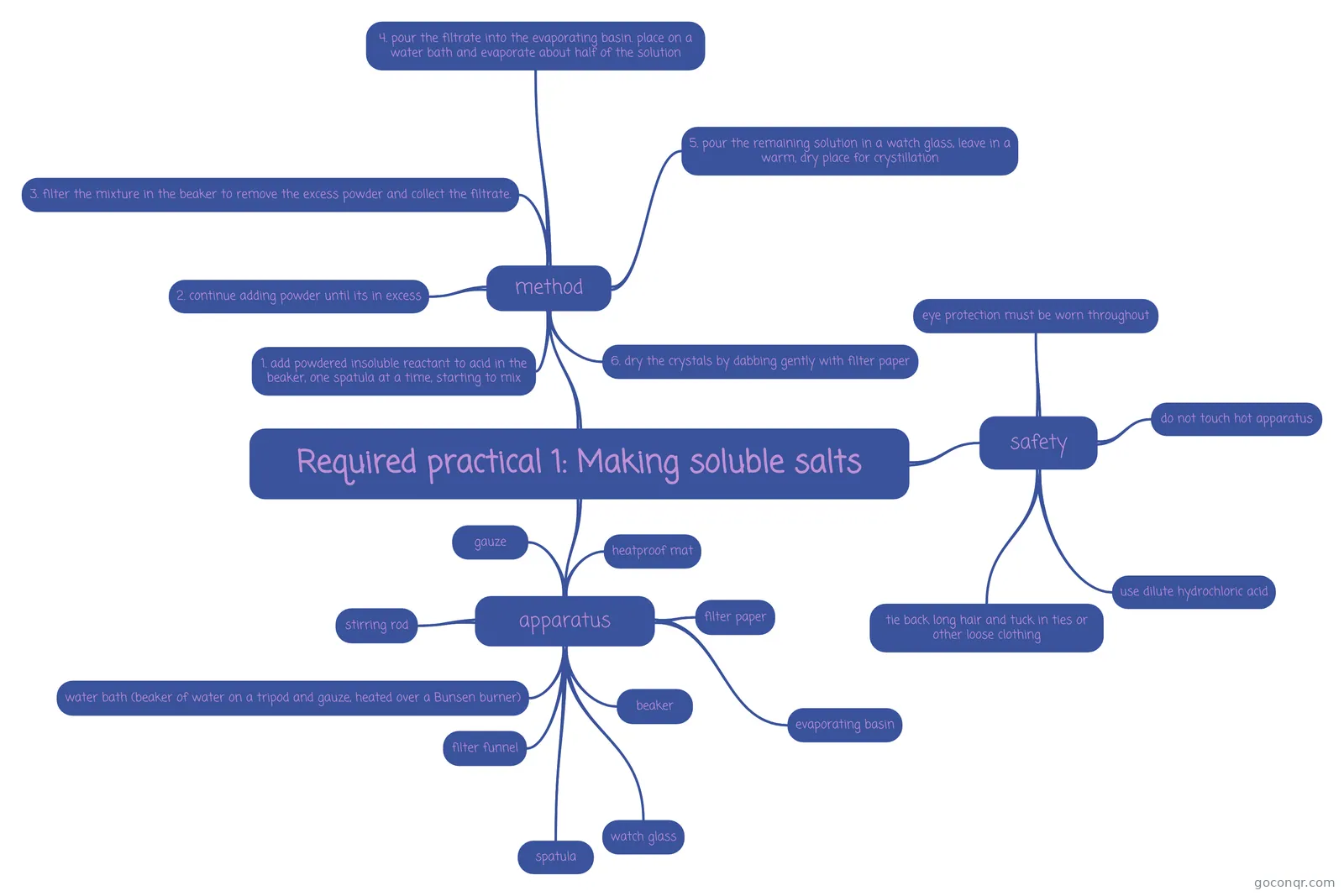 Required practical 1: Making soluble salts yuh
Flashcards
See all 41 flashcards-
52 cardsChemistry Core Practicals Measuring the Molar Volume of a Gas
-
30 cardsLaboratory Tools Flash cards for common laboratory tools
-
19 cardsLaboratory Apparatus Common lab equipment
-
32 cardsLab equipment
-
9 cardsHazard Warning Signs
-
13 cardsPractical and investigative skills Practical and investigative skills
-
10 cardsChemistry Hazard Symbols
-
34 cardsMariner Chem Lab Equipment I got all of the definitions/ uses from google so if there's a test, the definitions probably won't be exac...
Notes
See all 12 notes-
Error and % error EXCERCISE EXAMPLES: 1. A student estimated a mass to be 250g, but upon carefully measuring it, found the actual mass to be 240g. What is the percent error? 250g - 240g= 10 x 100%= 1,000/ 240g= 4.16%&...
-
Chemistry Experiments Diffusion Particles in the gas are free due to its process called diffusion. You can see how diffusion works in the apparatus below. Gas is a state freely because it has a low density. In the apparatus below, you can ...
-
Bunsen Burner Flames Bunsen Burner Flames:Safety Flame: A luminous flame. A yellow flame. The air hole must be closed. Not all of the gas is burned. Soot is in the flame. Use only when lighting the Bunsen burner or when you are not heatin...
-
Chemistry Experiments Chemistry Experiments CH-17 Solid liquids and gases To Demonstrate Diffusion in a Liquid Using forceps gently place a few potassium manganate crystals at the bottom of a beaker of water. Observe what happens for a few...
-
Significant Figures RULES: 1. All non-zero numbers ARE significant. The number 33.2 has THREE significant figures 2. Zeros between two non-zero digits ARE significant. 2051 has FOUR significant figures. 3. Leadin...
-
C2: Experimental Techniques How does it work?It's a way of separating solutions or liquids which are mixed togetherA bit on ink is placed on the X spot Then the paper is put into waterAs the water rises up the paper, the different dyes trav...
-
Unit 1 PPA - Prep of Potassium trioxalatoferrate (III) Aim - prepare crystals of the above compound and calc the %yield Method -Hydrated ammonium iron (II) sulphate contains pale green Fe2+ ion.This is reacted with oxalic acid.When heated, brown precipitate appears ...
-
metric system and Significant figures SCIENTIFIC METHOD The study of scientific method is the attempt to discern the activities by which that success is achieved. Among the activities often identified as characteristic of science are s...
Slides
More Chemistry topics
About Laboratory Skills and Safety
GoConqr OriginalWhat this unit covers
This unit sits in the Foundations of Chemistry strand of Chemistry. It pulls together the practical side of the subject: knowing your equipment, working safely, taking careful measurements and describing experiments clearly. Most of the material was made for secondary courses, with a small share for university and professional study.
Start with equipment and hazards
Begin with the flashcard decks Laboratory Tools and Laboratory Apparatus. They pair each piece of kit with its job, such as the beaker for mixing and rough volume measurement, the thermometer for temperature and the Bunsen burner for heating. Then move to Chemistry Hazard Symbols, which covers explosive, corrosive, toxic, oxidising, harmful, flammable and irritant warnings, among others.
- Check yourself with the quiz HEAT SOURCES AND FLAMES, which asks how heat differs from a flame and what separates a luminous flame from a non-luminous one.
- Look through the lab safety mind maps to see precautions grouped on one page.
Move on to technique and measurement
The deck Practical and investigative skills lists separation methods such as filtration, distillation, fractional distillation, crystallisation and the separating funnel. Next, the notes Error and % error show how to work out error and percentage error from a measured and an actual value. There are also several notes and a quiz on significant figures, plus resources on titrations, standard solutions and serial dilution.
Prepare for practical assessment
For A-level work, the slide set Required Practicals - AQA A Level Chemistry explains that Paper 3 can assess any content and any practical skills. The deck Chemistry Core Practicals prompts you to name safety precautions, draw the equipment, describe the procedure and sketch the graph. The mind map Chemistry ATP covers common variables such as concentration, volume, surface area, mass and temperature.
Using quizzes and maps together
Read a mind map first to see the shape of a topic. Then take a quiz and note the questions you missed. Go back to the matching flashcards or notes and try again. Teachers can set a deck or quiz as a quick starter or revision task.
Choose one practical you find hardest and work through it from equipment to results.
Frequently asked questions
Where should I start on this page?
Start with the flashcard decks Laboratory Tools and Chemistry Hazard Symbols. They cover the equipment and warning signs that every practical relies on. Then try a safety or apparatus quiz to see what stuck, and move on to techniques such as titration and separation once the basics feel familiar.
Which exams do these resources suit?
Most of the resources are at secondary level, and the ones that name exams mention GCSE Chemistry, IGCSE Chemistry, A-level Chemistry, CIE A-level Chemistry and IB. A small share is aimed at university students, so check each resource's title and content to see whether it matches your course.
What do the mind maps cover?
The mind maps cover hazard symbols, lab safety, lab equipment, titrations, separating mixtures, determining melting and boiling points, and measurements and errors. There are also revision maps for IGCSE Chemistry and a map called Chemistry ATP that sets out precautions and common variables in practicals.
Are the resources free to use?
Yes. Every resource listed here is free to open, study and take, with no account needed. They were made by GoConqr users rather than by GoConqr itself. A free account also saves your quiz scores and lets you make your own quizzes, mind maps, flashcards and notes.
Is there anything for practical exam preparation?
Yes. The slide set Required Practicals - AQA A Level Chemistry outlines how Paper 3 assesses practical skills, and Chemistry Core Practicals works through the molar volume of a gas. You will also find a quiz on measuring an enthalpy change and a set of OCR B practical questions.
What if I cannot find the topic I need?
Browse the related notes, flashcards and mind maps on this page first, since many topics appear in more than one format. If something is still missing, you can build your own flashcards, mind map or quiz on the topic and use it for revision.