
States of Matter and Gases
151 resources created by 139 users
This States of Matter and Gases page on GoConqr gathers community-made quizzes, mind maps, flashcards, notes and slides, from particle arrangement in solids, liquids and gases to gas laws and intermolecular forces. It's built for school students revising a topic and teachers after ready-made material. There are over 900 resources here, including more than 70 quizzes, over 400 mind maps and more than 300 flashcard decks, mostly at secondary level. Pick a resource, try a quiz to find your gaps, then make your own.
Top States of Matter and Gases resources
-
69 questionsChapter 10- liquids and intermolecular forces Originally chapter 11
-
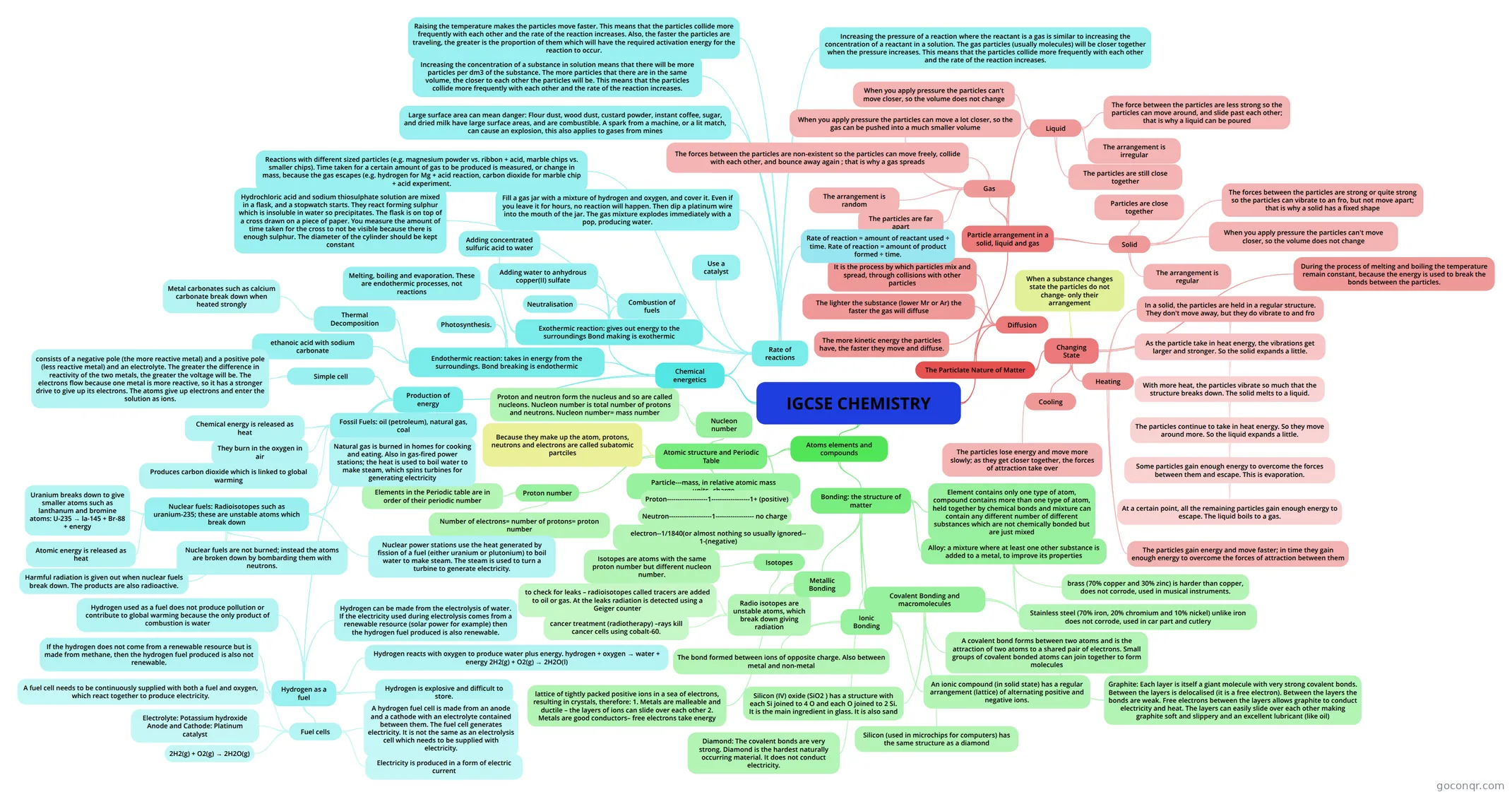 Mind map IGCSE CHEMISTRY
-
19 cardsSolids, Liquids and Gases Solids have particles that....? Solids have....?
-
20 cardsUnderstanding Physical Changes Unit 1.2 Why do scientists use models?
-
26 cardsTopic 1 CC1,CC2 – Key concepts in chemistry (Paper 3)
-
12 questionsG9 IGCSE Chemistry C1 The Particulate Nature of Matter Quiz In which changes do the particles move further apart?
-
Mind map States Of Matter IGCSE CHEMISTRY
-
13 cards1.1 Solids, Liquids and Gases What are the three states of matter?
Quizzes
See all 19 quizzes-
69 questionsChapter 10- liquids and intermolecular forces Originally chapter 11
-
12 questionsG9 IGCSE Chemistry C1 The Particulate Nature of Matter Quiz In which changes do the particles move further apart?
-
57 questionsIHS Test 1 - Chemistry Questions Which of the following is the definition of a gas?
-
18 questionsEnd of Year Quiz What are the 3 states of matter?
-
7 questionsParticulate nature of matter Arrangement of particles in all three states
-
68 questionsHonors Chemistry Finals Exam Which process can be explained by the kinetic-molecular theory?
-
3 questionsChanging States Reading What Are Changes of State? The water droplets of fog form from water vapor in the air. Fog disappears when ...
-
4 questionsC1 - Particles
Mind maps
See all 50 mind maps
Flashcards
See all 62 flashcards-
19 cardsSolids, Liquids and Gases Solids have particles that....? Solids have....?
-
20 cardsUnderstanding Physical Changes Unit 1.2 Why do scientists use models?
-
26 cardsTopic 1 CC1,CC2 – Key concepts in chemistry (Paper 3)
-
13 cards1.1 Solids, Liquids and Gases What are the three states of matter?
-
8 cardsStates Of Matter Three States of Matter
-
13 cardsSolid, liquid and gas questions What are the properties of a Solid?
-
12 cardsstates of matter Safi Flashcards Science
-
20 cardsUNIT 2.1 1.What are the 3 states of matter?
Notes
See all 18 notes-
Chemistry iGCSE Notes 1a) States of matter Boiling - All of the particles have enough energy to break away. Only happens at the boiling point.Evapouration - Only the surface particles have enough energy to break away. Happens at any temper...
-
Chapter 5 - Gases There are 5 properties of gases that are important: Their shape and volume vary depending on the container by filling it up completely. If the container changes shape or volume so does the gas. They ...
-
Gas Laws and the Mole
-
2. Notes on states of matter Physical states of matter Characteristics of states of matterSolid1) Have definite shape and volume.2) substances will resist forces that try and change the volume of the shape.Liquid1) Have definite volume, but can c...
-
Vapor Pressure Notes Vapor Pressure: Vaporization is an endothermic process because it requires energy to overcome the IMF's holding molecules together in a liquid Factors that affect vapor pressure: Temperature: higher temperature = grea...
-
Chapter 10 Notes Intramolecular vs. Intermolecular Forces Intramolecular forces: the combination of attractive and repulsive electrical forces between pairs of electrons within a molecule Intermolecular forces: the forces that act bet...
-
Chemistry Notes Kinetic Particle Theory The kinetic particle theory states all matter is made up of tiny particles and that these particles are in constant random motion. Solid state The particles of a so...
-
Chapters 10, 11, 24 CHAPTER 10Section 10.1Substances that are gases at room temperature tend to be molecular substances with low molar masses. Air, a mixture composed mainly of N2 and O2, is the most common gas we encounter. Some liquids...
Slides
More Chemistry topics
About States of Matter and Gases
GoConqr OriginalWhat the resources cover
This unit sits in the Matter and Its Properties strand of Chemistry. Much of it follows the particle model. The mind map States Of Matter IGCSE CHEMISTRY describes solids with particles in neat rows that vibrate, and liquids with particles that touch but can move. The Kinetic Particle Theory mind maps and the notes on kinetic molecular theory build on the same idea.
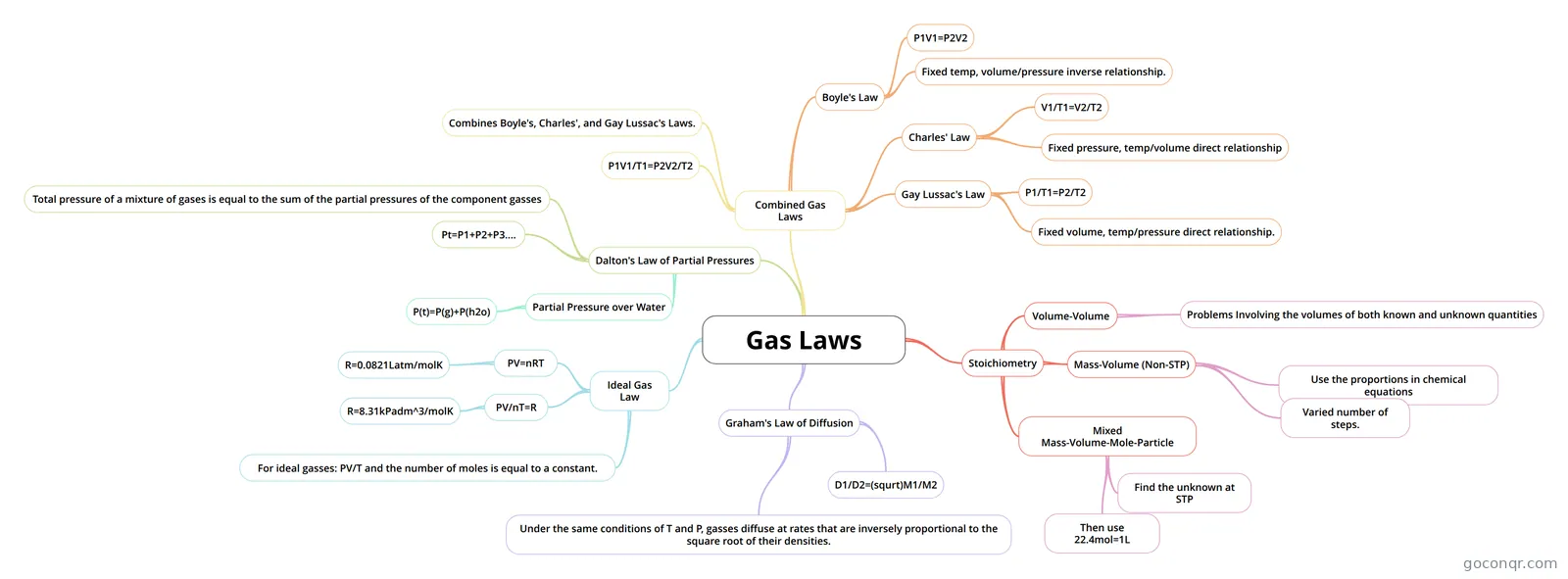
The gas side is covered too. Two mind maps called Gas Laws set out pressure units, Boyle's Law, Charles' Law, Gay Lussac's Law and the combined gas law. There is also a flashcard deck called MCAT Chemistry - Ideal Gases, and the deck 5 Tests For Gases covers testing for gases.
Where to start
- Open the flashcard deck States Of Matter or the deck Solids, Liquids and Gases to learn the three states and their properties.
- Read a mind map such as Changes in State to see how heating and cooling move particles.
- Move on to diffusion, using the mind map Diffusion.
- Finish with the gas laws, through the mind maps and the slides called The gas laws slides.
Using quizzes and maps together
Read a mind map first, then close it and take a quiz. The G9 IGCSE Chemistry C1 The Particulate Nature of Matter Quiz asks which changes move particles further apart and what happens during evaporation. The quiz Chapter 10- liquids and intermolecular forces asks you to complete statements about crystalline solids and liquids. Note the questions you miss, go back to the matching map, then retry.
Levels and exams
Most resources are written for secondary students. Listed resources mention GCSE Chemistry, IGCSE Chemistry and A-level Chemistry, and one deck mentions the MCAT. Check each resource's title and content to see whether it matches your course.
Make it your own
Once you have worked through a few resources, pick the gaps that remain and build your own flashcards or mind map to fill them. Teachers can also pick a ready-made deck or slide set to use in class.
Frequently asked questions
Which resource should I open first?
Start with the flashcard deck States Of Matter or the mind map States Of Matter IGCSE CHEMISTRY. Both set out how particles are arranged and behave in solids, liquids and gases. Once those make sense, move on to changes of state, diffusion and then the gas laws.
What do the Gas Laws mind maps include?
The two mind maps called Gas Laws cover pressure units, molecular collisions, Boyle's Law, Charles' Law and Gay Lussac's Law. One also lists the combined gas law and links to stoichiometry, including volume-volume problems. They work well as a summary before you try a gas laws quiz.
Are the resources free to use?
Yes. Every resource listed here is free to open, study and take, with no account needed. They were made by GoConqr users, not by GoConqr itself, so it is worth checking that each one matches your course. A free account saves your quiz scores and lets you make your own resources.
Which levels and exams do these resources suit?
Most of the resources are at secondary level, so they suit school students. Listed titles and content mention GCSE Chemistry, IGCSE Chemistry and A-level Chemistry, and one flashcard deck is aimed at the MCAT. Teachers can use them as ready-made starting points for lessons or revision.
Are there quizzes on this unit?
Yes, there are more than 70 quizzes. Examples include the quiz on liquids and intermolecular forces, the G9 IGCSE Chemistry particulate nature of matter quiz and a quiz called gas laws test. Use them after reading a mind map or going through flashcards.
What if I cannot find the topic I need?
Try searching for a related term, such as particles, kinetic theory, diffusion or gases, since many resources use different titles for the same idea. If nothing fits, make your own mind map, flashcards or quiz from your class notes.