
Particle Physics mind maps
187 mind maps by 154 users · Page 1 of 5
This page gathers over 180 community-made Particle Physics mind maps, covering quarks, leptons, matter and radiation. They offer school students a way to revise particle classification and teachers material to use in lessons, with some university-level resources too. Pick a map and explore its branches.
Select topic
- Atomic Structure and Subatomic Particles23
- The Standard Model and Particle Classification52
- Quarks, Leptons and Hadrons53
- Matter and Antimatter31
- Fundamental Forces and Particle Interactions27
- Conservation Laws in Particle Interactions6
- Radioactive Decay and Particle Interactions23
- Particle Accelerators and Detectors8
Mind maps
-
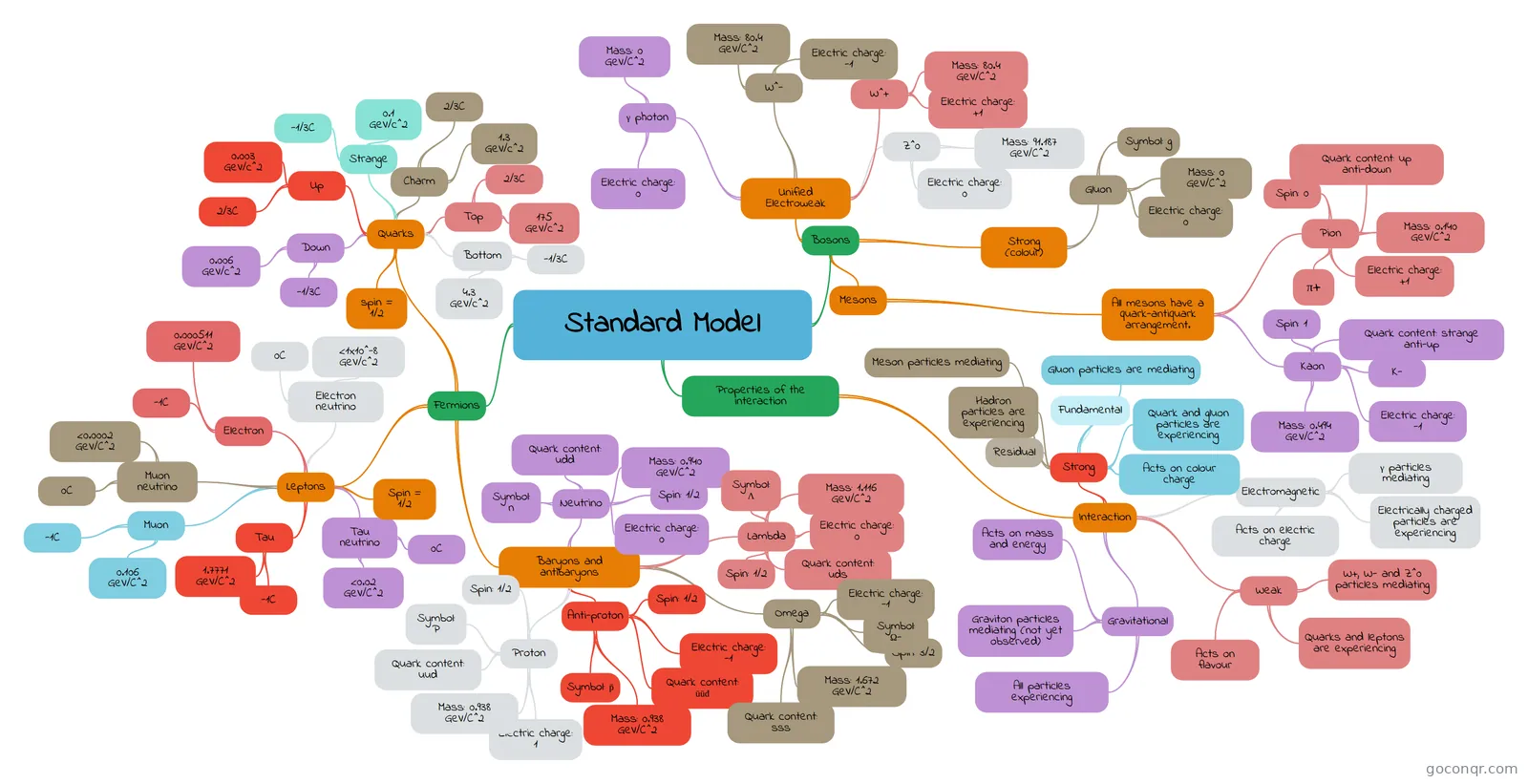 Standard Model
-
Particle Physics
-
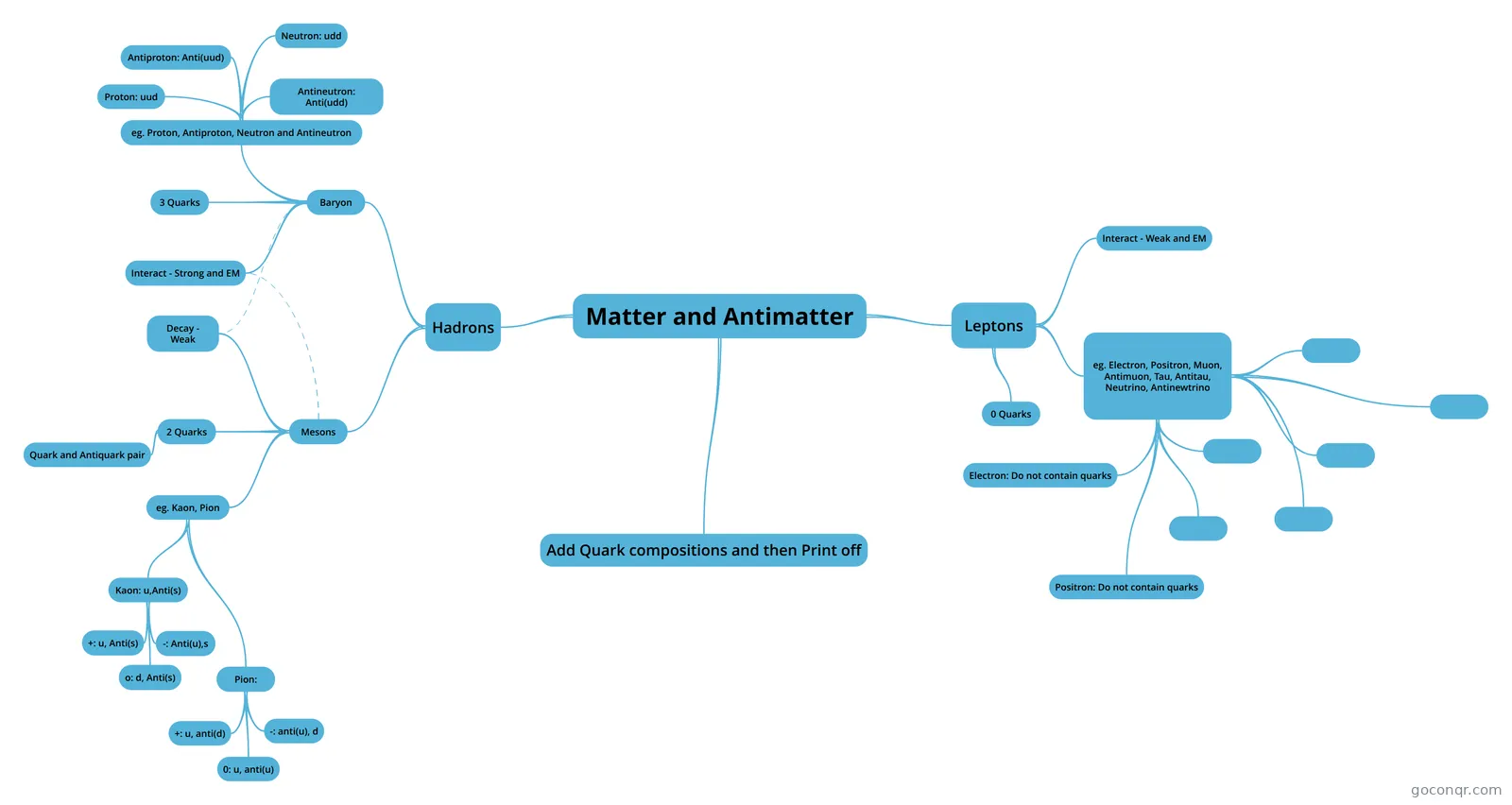 Matter and Antimatter Physics mindmap of Matter and Antimatter groups
-
Physics Section 1 - Particles and Radiation Physics Section 1 - Particles and Radiation revision mind map
-
Quarks and Leptons
-
Physics Unit 1
-
Particle physics
-
The Standard Model
-
Unit 2 - Particles and radiation
-
Particles
-
Particle Physics
-
Physics Section 1 - Particles and Radiation Physics Section 1 - Particles and Radiation revision mind map
-
Module 12- Atomic and Particle Physics
-
Physics Unit 1
-
FUNDAMENTAL FORCES
-
Unit 1
-
Particles and Radiation
-
Physics - Matter and Radiation
-
Physics (MB) - Matter and Radiation
-
Particles
-
Unit 4
-
3.2 Particles and Radiation
-
Particles and radiation
-
Particle Physics
-
Particles
-
Unit 1
-
Matter and Radiation
-
Particle Physics
-
Physics
-
Quarks and Leptons
-
Matter and Radiation
-
Physics P1 - Energy (1)
-
Particle Physics
-
Quarks and Leptons
-
particle physics
-
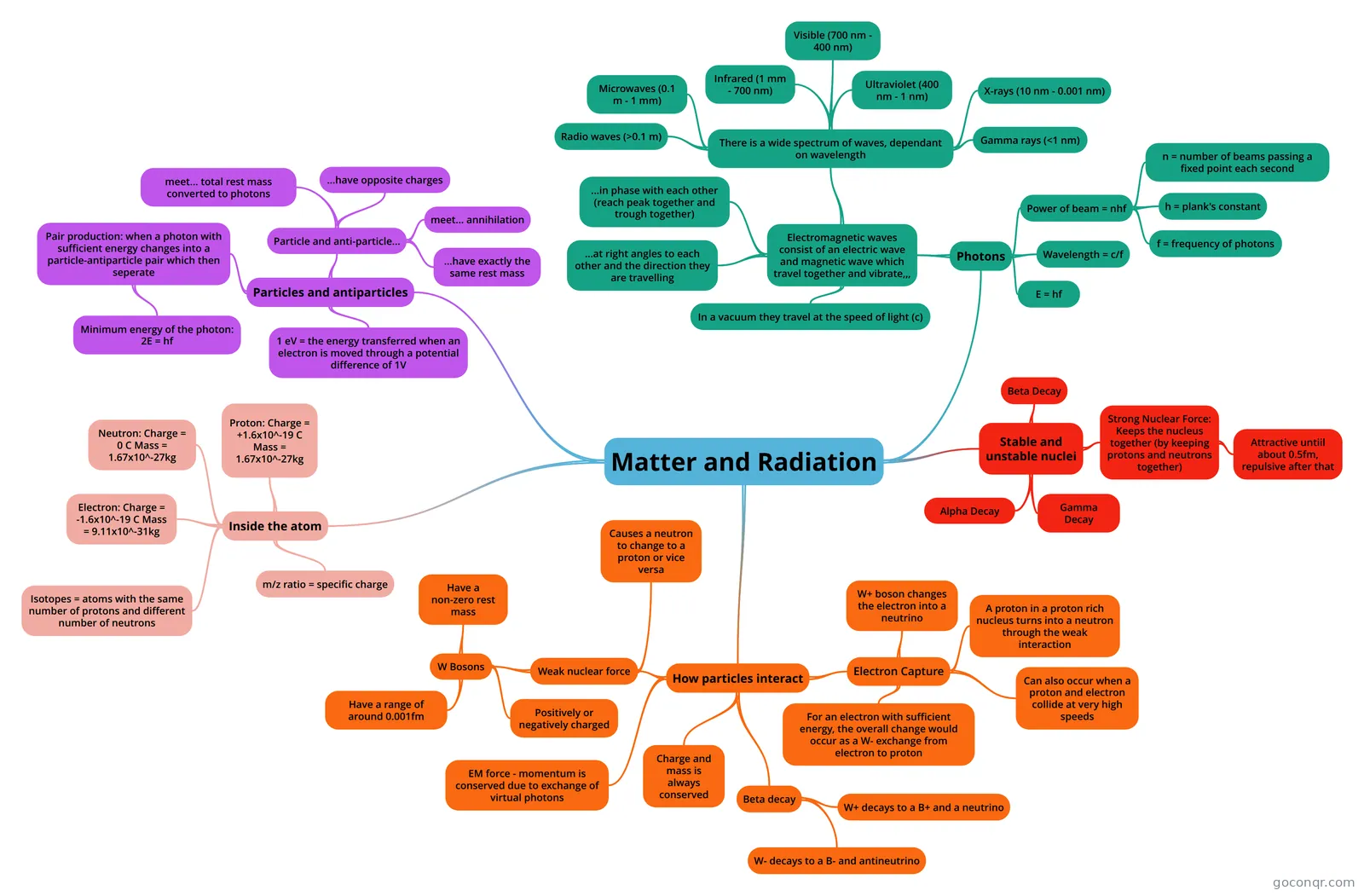 Matter and Radiation
-
Particles & Radiation
-
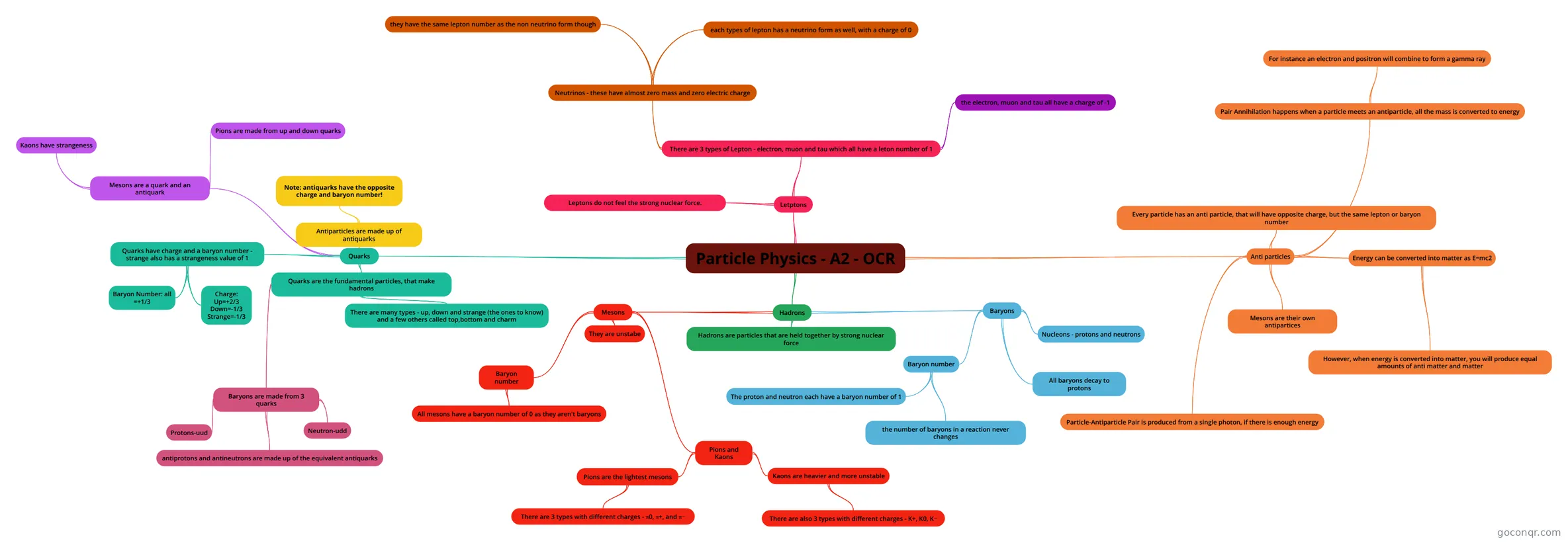 Particle Physics - A2 - OCR
-
Matter and Radiation
-
Antimatter
More Particle Physics resources
About particle physics mind maps
GoConqr OriginalUsing Particle Physics mind maps
Mind maps let you follow a topic through connected branches. Start with Matter and Radiation if you want to revisit what is inside the atom. Then look at Quarks and Leptons, which includes a branch on cosmic rays and the particles they produce.
For classification practice, find the Particles map that groups quarks into baryons and mesons. Cover a branch and see whether you can recall its connections before opening it again. You can compare maps on the same topic to see how their authors organise the material.
Moving between formats
When you want to check recall rather than follow a diagram, switch to a quiz or flashcards on the Particle Physics unit page. Return to a map when you need to revisit a connection or see where a detail fits. Choose a branch to review, then try another format.
Frequently asked questions
Which mind map should I start with?
Try Matter and Radiation if you want to begin inside the atom. Its branches include the nucleus, protons and neutrons. If you are already reviewing particle groups, look for the Particles map that sets out quarks, baryons and mesons.
What do the mind maps cover?
The maps cover topics including quarks, leptons, matter, antimatter and radiation. They organise details in different ways: Quarks and Leptons includes cosmic rays, while Matter and Antimatter has branches for hadrons, leptons, baryons and mesons. Choose a map that matches the topic you are reviewing.
Are these mind maps free to use?
Yes. Every resource listed here is free to open and study without an account. The maps were made by GoConqr users. A free account also lets you make your own quizzes, mind maps, flashcards and notes, and save your quiz scores.
Who are these mind maps for?
The collection is mainly suited to school students revising Particle Physics and teachers looking for material to use in lessons. It also includes some university-level resources. Check an individual map's content against the topic you want to study or teach.