
Welding and Joining
113 resources created by 80 users
This Welding and Joining page on GoConqr gathers community-made quizzes, mind maps, flashcards and a flowchart, from arc welding processes and TIG and MIG to residual stress, weld inspection and brazing. It's built for university students and professional candidates, plus teachers after ready-made material. There are over 100 resources here, including more than 20 quizzes, more than 50 mind maps and over 20 flashcard decks, with a few suited to school students too. Pick a topic, try a quiz, then make your own.
Top Welding and Joining resources
-
36 questionsW.I.T. Chapter 3: welding and cutting processes 1) which of the following is a function of the flux coating of a smaw electrode
-
16 cardsChapter 30 Name the principal groups of processes included in fusion welding.
-
27 questionsCWB - Module 4 ( Welding Processes an Equipment) Welding is a joining process that by definition requires the application of:
-
26 questionsW.I.T. Chapter 1: welding inspection and certification 1. Why is there an increasing need for welder quality?
-
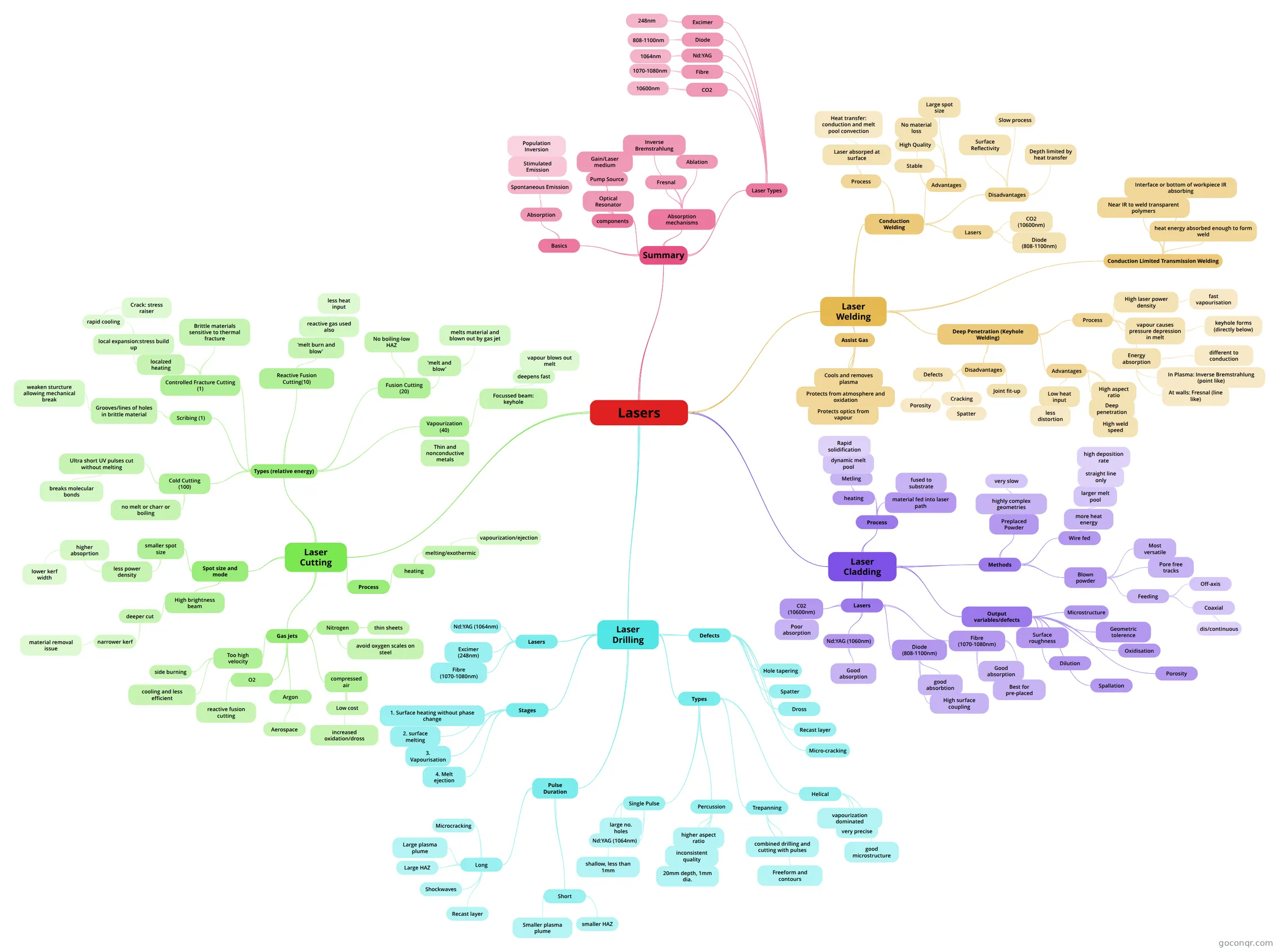 Mind map Lasers
-
10 cardsChapter 31 How do brazing and soldering differ from the solid-state welding processes?
-
Mind map Non-mechanical joints 1 tipos de soldadura
-
30 cardsFusion-Welding Processes Why is shielded metal-arc welding a commonly used process?
Quizzes
See all 26 quizzes-
36 questionsW.I.T. Chapter 3: welding and cutting processes 1) which of the following is a function of the flux coating of a smaw electrode
-
27 questionsCWB - Module 4 ( Welding Processes an Equipment) Welding is a joining process that by definition requires the application of:
-
26 questionsW.I.T. Chapter 1: welding inspection and certification 1. Why is there an increasing need for welder quality?
-
40 questionsWelding Test Practice The ability of a metal to permanently deform under load without breaking is known as:
-
7 questionsClass 5 - Chapter 15 - Welding Terms & Inspection With regards to welding, a Procedure Qualification means that a welding procedure
Mind maps
See all 59 mind maps-
Lasers
-
Non-mechanical joints 1 tipos de soldadura
-
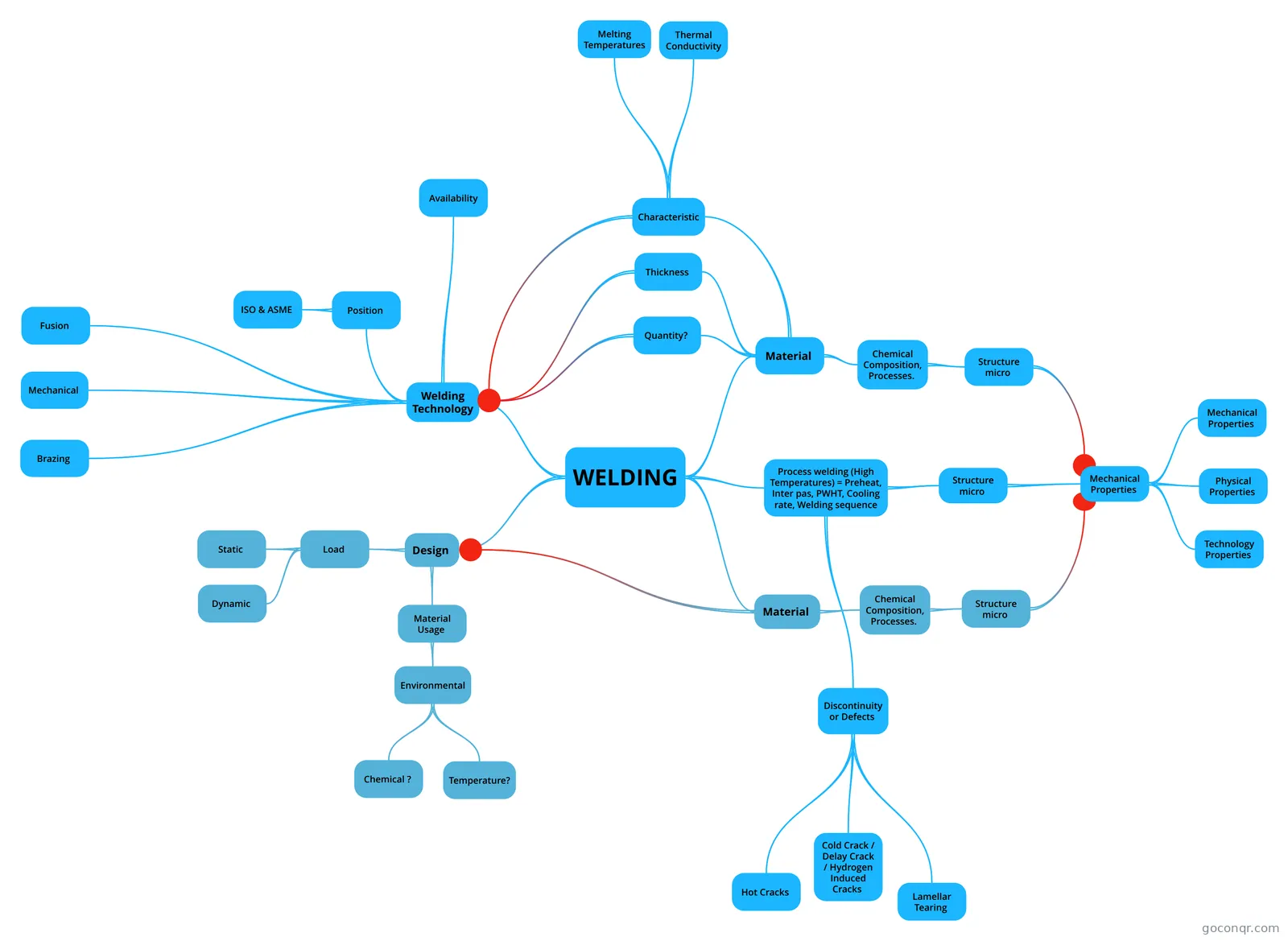 WELDING Mind Map on Welding , created by anang abdullah on 14/09/2016.
-
WELDING METALLURGY
-
WHAT IS WELDING MIN MAP
-
Crack Analysis Mind Map on Identification Material , created by anang abdullah on 15/09/2016.
-
Welding 1
-
Introduce el texto aquí MIND MAP
Flashcards
See all 21 flashcards-
16 cardsChapter 30 Name the principal groups of processes included in fusion welding.
-
10 cardsChapter 31 How do brazing and soldering differ from the solid-state welding processes?
-
30 cardsFusion-Welding Processes Why is shielded metal-arc welding a commonly used process?
-
13 cardsChapter 29 What were the two discoveries of Sir Humphrey Davy that led to the development of modern welding technology?
Flowcharts
Topics in Welding and Joining
More Mechanical engineering topics
About Welding and Joining
GoConqr OriginalWhat the page covers
The unit brings together the main routes to joining metal. Process material includes the quiz CWB - Module 4 ( Welding Processes an Equipment), which starts from the definition of welding and arc temperatures, and the deck Fusion-Welding Processes, which asks about shielded metal-arc welding, electrode functions and shielding gas. Several mind maps cover TIG and MIG welding, and others cover solid-state welding, diffusional welding and laser-beam welding.
Quality, defects and inspection
A second group looks at what happens after the arc is struck. The mind maps on residual stress and distortion, welding metallurgy and crack analysis sit alongside quizzes on residual stress and mechanical testing. For inspection, try W.I.T. Chapter 1: welding inspection and certification, which asks about welder quality and the AWS rules for CWI certification. The deck Chapter 25 Testing and inspecting welds/Discontinuities supports it.
Where to start
- Begin with a broad mind map such as Types of welding or Methods of Joining to see the whole field.
- Move to the decks Chapter 30 and Chapter 31 for fusion welding, brazing and soldering.
- Test yourself with W.I.T. Chapter 3: welding and cutting processes, which covers SMAW electrode flux and designations.
- Finish with joint design through W.I.T. Chapter 4: weld joint geometry and welding symbols.
Using quizzes and maps together
Read a map first, then take the matching quiz and note what you missed. Go back to that branch of the map and check it again. Candidates preparing for API 510 will find several quizzes on ASME Section IX and welding procedure specifications, while the AWS CWI exam links to the inspection and certification material. Teachers can set a quiz or share a map as ready-made classroom material.
Place in the subject
This unit sits in the Manufacturing strand of Mechanical engineering. Open a resource that suits your level, and when you find a gap, build a map or deck of your own.
Frequently asked questions
Which quiz should I try first?
Start with CWB - Module 4, which covers the definition of welding, arc temperatures and shielding gas for gas shielded processes. It gives a quick read on the basics. If you prefer inspection topics, W.I.T. Chapter 1 on welding inspection and certification is a good alternative.
What do the mind maps cover?
There are over 50 mind maps. They cover TIG and MIG welding, solid-state and diffusional welding, laser-beam welding, brazing and soldering, adhesive bonding, weld types and joints, welding metallurgy, residual stress and distortion, and crack analysis.
Are there resources for API 510 or AWS CWI?
Yes. Several quizzes are labelled API 510 Module ASME SEC IX, including ones on general topics and welding procedure specifications. The AWS CWI exam is mentioned in resources on inspection and certification, such as W.I.T. Chapter 1. They are community-made, so use them as practice alongside official material.
Are the resources free to use?
Every resource listed here is free to open, study and take, with no account needed. They were made by GoConqr users rather than by GoConqr itself. A free account also saves your quiz scores and lets you make your own quizzes, mind maps, flashcards and notes.
Who is this page for?
Mostly university students and professional candidates, with some material that school students can follow. Teachers can use the quizzes, decks and maps as ready-made material. Students can use the flashcards for terms, symbols and defects, and the quizzes to check understanding.
What if I can't find the topic I need?
Browse the mind maps first, since their branches cover many sub-topics, such as power sources, flame cutting and plasma arc cutting. If your topic is still missing, you can make your own quiz, map or flashcard deck for it.