
Mapa mental
MAINTENANCE
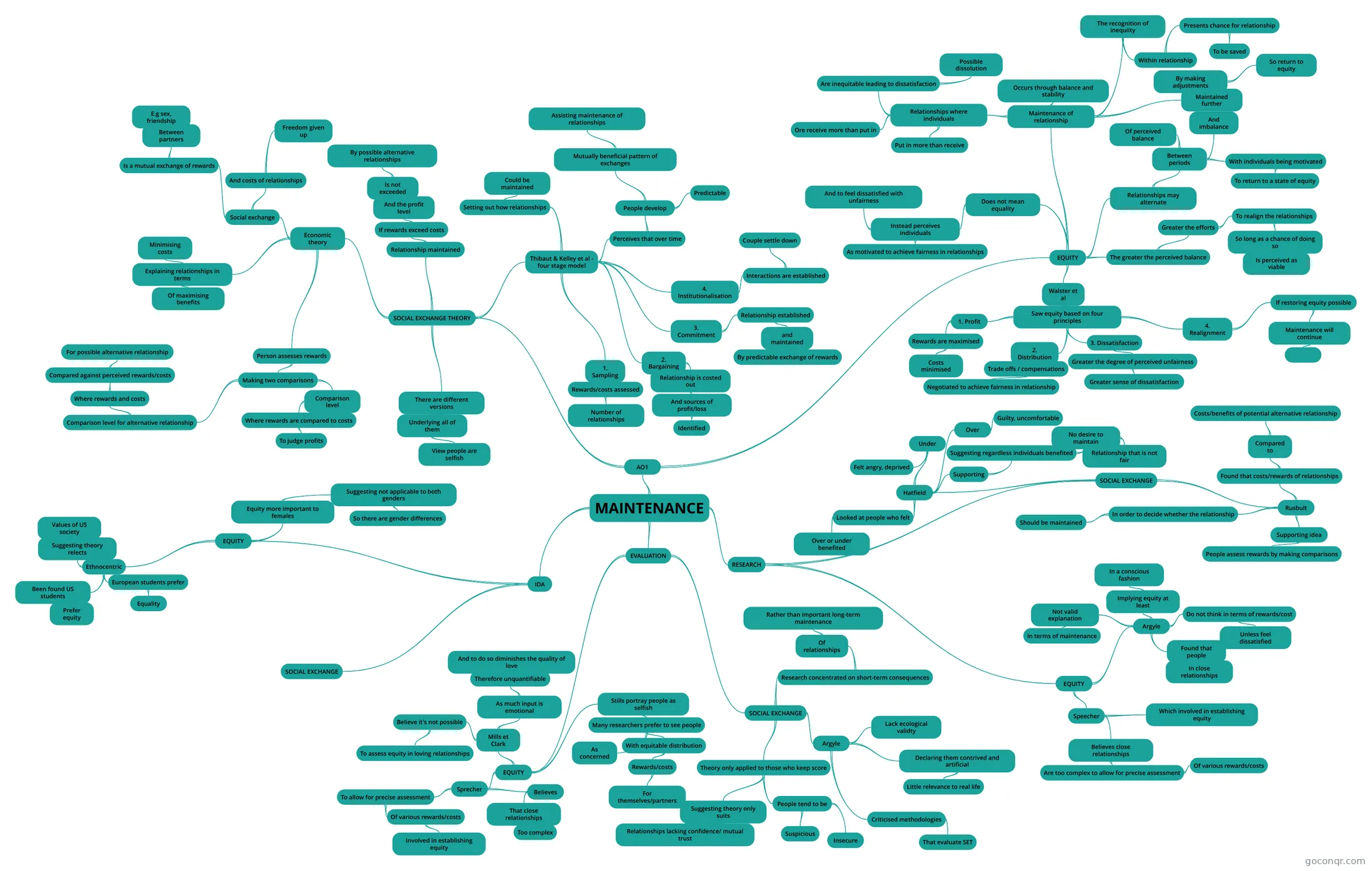
Mind map: Maintenance
Contenido del mapa
MAINTENANCE
AO1
- SOCIAL EXCHANGE THEORY
- There are different versions
- Underlying all of them
- View people are selfish
- Underlying all of them
- Economic theory
- Explaining relationships in terms
- Of maximising benefits
- Minimising costs
- Social exchange
- Is a mutual exchange of rewards
- Between partners
- E.g sex, friendship
- Between partners
- And costs of relationships
- Freedom given up
- Is a mutual exchange of rewards
- Person assesses rewards
- Making two comparisons
- Comparison level for alternative relationship
- Where rewards and costs
- Compared against perceived rewards/costs
- For possible alternative relationship
- Compared against perceived rewards/costs
- Where rewards and costs
- Comparison level
- Where rewards are compared to costs
- To judge profits
- Where rewards are compared to costs
- Comparison level for alternative relationship
- Making two comparisons
- Explaining relationships in terms
- Relationship maintained
- If rewards exceed costs
- And the profit level
- Is not exceeded
- By possible alternative relationships
- Is not exceeded
- And the profit level
- If rewards exceed costs
- Thibaut & Kelley et al - four stage model
- Setting out how relationships
- Could be maintained
- Perceives that over time
- People develop
- Predictable
- Mutually beneficial pattern of exchanges
- Assisting maintenance of relationships
- People develop
- 1. Sampling
- Rewards/costs assessed
- Number of relationships
- Rewards/costs assessed
- 2. Bargaining
- Relationship is costed out
- And sources of profit/loss
- Identified
- And sources of profit/loss
- Relationship is costed out
- 3. Commitment
- Relationship established
- and maintained
- By predictable exchange of rewards
- and maintained
- Relationship established
- 4. Institutionalisation
- Interactions are established
- Couple settle down
- Interactions are established
- Setting out how relationships
- There are different versions
- EQUITY
- Does not mean equality
- Instead perceives individuals
- As motivated to achieve fairness in relationships
- And to feel dissatisfied with unfairness
- Instead perceives individuals
- Maintenance of relationship
- Occurs through balance and stability
- Relationships where individuals
- Put in more than receive
- Ore receive more than put in
- Are inequitable leading to dissatisfaction
- Possible dissolution
- The recognition of inequiity
- Within relationship
- Presents chance for relationship
- To be saved
- Presents chance for relationship
- Within relationship
- Maintained further
- By making adjustments
- So return to equity
- By making adjustments
- Relationships may alternate
- Between periods
- Of perceived balance
- And imbalance
- With individuals being motivated
- To return to a state of equity
- Between periods
- The greater the perceived balance
- Greater the efforts
- To realign the relationships
- So long as a chance of doing so
- Is perceived as viable
- So long as a chance of doing so
- To realign the relationships
- Greater the efforts
- Walster et al
- Saw equity based on four principles
- 1. Profit
- Rewards are maximised
- Costs minimised
- Rewards are maximised
- 4. Realignment
- If restoring equity possible
- Maintenance will continue
- Maintenance will continue
- If restoring equity possible
- 3. Dissatisfaction
- Greater the degree of perceived unfairness
- Greater sense of dissatisfaction
- Greater the degree of perceived unfairness
- 2. Distribution
- Trade offs / compensations
- Negotiated to achieve fairness in relationship
- Trade offs / compensations
- 1. Profit
- Saw equity based on four principles
- Does not mean equality
- SOCIAL EXCHANGE THEORY
RESEARCH
- SOCIAL EXCHANGE
- Rusbult
- Found that costs/rewards of relationships
- Compared to
- Costs/benefits of potential alternative relationship
- Compared to
- In order to decide whether the relationship
- Should be maintained
- Supporting idea
- People assess rewards by making comparisons
- Found that costs/rewards of relationships
- Hatfield
- Looked at people who felt
- Over or under benefited
- Under
- Felt angry, deprived
- Over
- Guilty, uncomfortable
- Supporting
- Suggesting regardless individuals benefited
- No desire to maintain
- Relationship that is not fair
- No desire to maintain
- Suggesting regardless individuals benefited
- Looked at people who felt
- Rusbult
- EQUITY
- Argyle
- Found that people
- In close relationships
- Do not think in terms of rewards/cost
- Unless feel dissatisfied
- Implying equity at least
- In a conscious fashion
- Not valid explanation
- In terms of maintenance
- Found that people
- Speecher
- Believes close relationships
- Are too complex to allow for precise assessment
- Of various rewards/costs
- Are too complex to allow for precise assessment
- Which involved in establishing equity
- Believes close relationships
- Argyle
- SOCIAL EXCHANGE
EVALUATION
- SOCIAL EXCHANGE
- Research concentrated on short-term consequences
- Of relationships
- Rather than important long-term maintenance
- Of relationships
- Argyle
- Criticised methodologies
- That evaluate SET
- Declaring them contrived and artificial
- Little relevance to real life
- Lack ecological validty
- Criticised methodologies
- Theory only applied to those who keep score
- People tend to be
- Suspicious
- Insecure
- Suggesting theory only suits
- Relationships lacking confidence/ mutual trust
- People tend to be
- Research concentrated on short-term consequences
- EQUITY
- Stills portray people as selfish
- Many researchers prefer to see people
- As concerned
- With equitable distribution
- Rewards/costs
- For themselves/partners
- Rewards/costs
- Many researchers prefer to see people
- Sprecher
- Believes
- That close relationships
- Too complex
- That close relationships
- To allow for precise assessment
- Of various rewards/costs
- Involved in establishing equity
- Of various rewards/costs
- Believes
- Mills et Clark
- Believe it's not possible
- To assess equity in loving relationships
- As much input is emotional
- Therefore unquantifiable
- And to do so diminishes the quality of love
- Therefore unquantifiable
- Believe it's not possible
- Stills portray people as selfish
- SOCIAL EXCHANGE
IDA
- SOCIAL EXCHANGE
- EQUITY
- Equity more important to females
- Suggesting not applicable to both genders
- So there are gender differences
- Suggesting not applicable to both genders
- Ethnocentric
- Been found US students
- Prefer equity
- European students prefer
- Equality
- Suggesting theory relects
- Values of US society
- Been found US students
- Equity more important to females
Información
- Descripción
- (Relationships) Psychology A2 Mapa Mental sobre MAINTENANCE, creado por becca_walls el 23/03/2015.
- Creado por
- becca_walls
- Visitas
- 0
- Valoración
Más sobre Childhood experiences and adult relationships