
Mapa mental
The evolutionary explanations for partner preferences
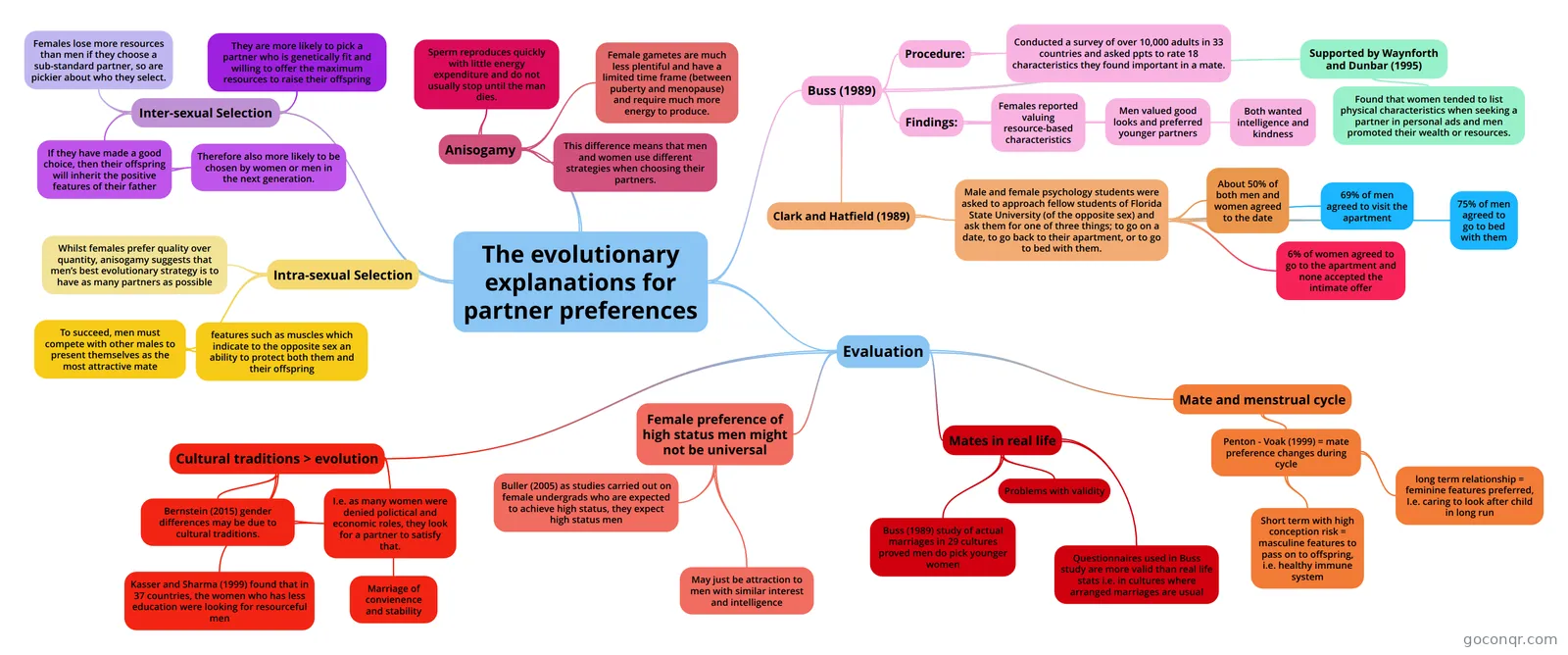
Mind map: The evolutionary explanations for partner preferences
Contenido del mapa
The evolutionary explanations for partner preferences
Inter-sexual Selection
- Females lose more resources than men if they choose a sub-standard partner, so are pickier about who they select.
- They are more likely to pick a partner who is genetically fit and willing to offer the maximum resources to raise their offspring
- If they have made a good choice, then their offspring will inherit the positive features of their father
- Therefore also more likely to be chosen by women or men in the next generation.
Intra-sexual Selection
- Whilst females prefer quality over quantity, anisogamy suggests that men’s best evolutionary strategy is to have as many partners as possible
- To succeed, men must compete with other males to present themselves as the most attractive mate
- features such as muscles which indicate to the opposite sex an ability to protect both them and their offspring
Anisogamy
- Sperm reproduces quickly with little energy expenditure and do not usually stop until the man dies.
- Female gametes are much less plentiful and have a limited time frame (between puberty and menopause) and require much more energy to produce.
- This difference means that men and women use different strategies when choosing their partners.
Buss (1989)
- Procedure:
- Conducted a survey of over 10,000 adults in 33 countries and asked ppts to rate 18 characteristics they found important in a mate.
- Findings:
- Females reported valuing resource-based characteristics
- Men valued good looks and preferred younger partners
- Both wanted intelligence and kindness
- Supported by Waynforth and Dunbar (1995)
- Found that women tended to list physical characteristics when seeking a partner in personal ads and men promoted their wealth or resources.
- Clark and Hatfield (1989)
- Male and female psychology students were asked to approach fellow students of Florida State University (of the opposite sex) and ask them for one of three things; to go on a date, to go back to their apartment, or to go to bed with them.
- About 50% of both men and women agreed to the date
- 69% of men agreed to visit the apartment
- 75% of men agreed to go to bed with them
- 6% of women agreed to go to the apartment and none accepted the intimate offer
- Male and female psychology students were asked to approach fellow students of Florida State University (of the opposite sex) and ask them for one of three things; to go on a date, to go back to their apartment, or to go to bed with them.
- Procedure:
Evaluation
- Cultural traditions > evolution
- Bernstein (2015) gender differences may be due to cultural traditions.
- I.e. as many women were denied polictical and economic roles, they look for a partner to satisfy that.
- Kasser and Sharma (1999) found that in 37 countries, the women who has less education were looking for resourceful men
- Marriage of convienence and stability
- Bernstein (2015) gender differences may be due to cultural traditions.
- Female preference of high status men might not be universal
- Buller (2005) as studies carried out on female undergrads who are expected to achieve high status, they expect high status men
- May just be attraction to men with similar interest and intelligence
- Mates in real life
- Problems with validity
- Buss (1989) study of actual marriages in 29 cultures proved men do pick younger women
- Questionnaires used in Buss study are more valid than real life stats i.e. in cultures where arranged marriages are usual
- Mate and menstrual cycle
- Penton - Voak (1999) = mate preference changes during cycle
- long term relationship = feminine features preferred, I.e. caring to look after child in long run
- Short term with high conception risk = masculine features to pass on to offspring, i.e. healthy immune system
- Penton - Voak (1999) = mate preference changes during cycle
- Cultural traditions > evolution
Información
- Descripción
- A-Level (Relationships) Psychology A2 Mapa Mental sobre The evolutionary explanations for partner preferences, creado por Jess Hughes el 03/11/2016.
- Creado por
- Jess Hughes
- Visitas
- 9
- Valoración