
Mind map
1929 Labour Government
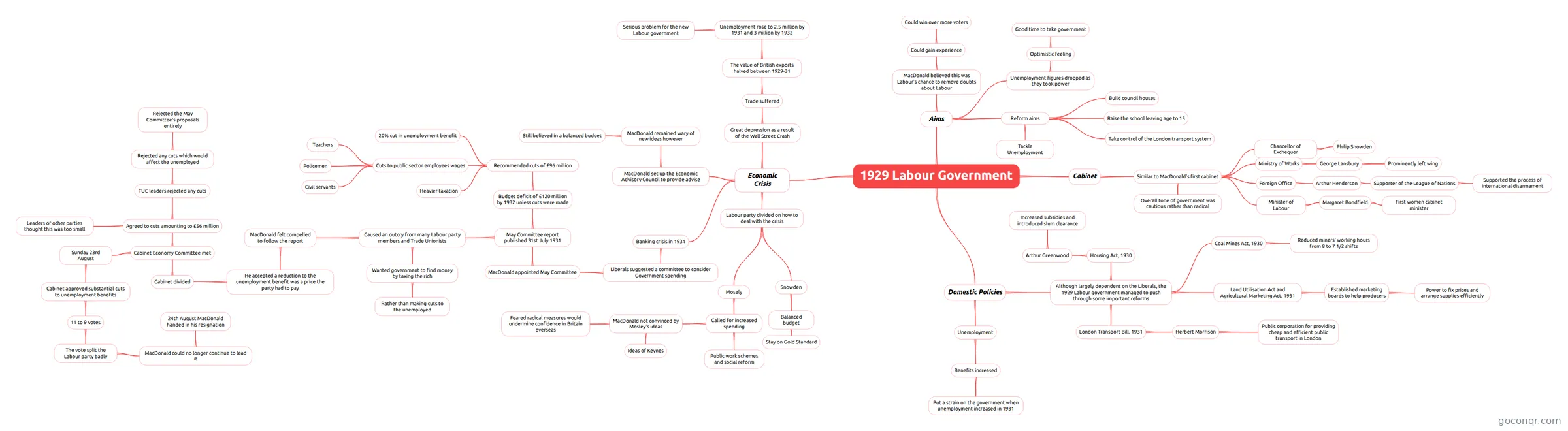
Mind map: 1929 Labour Government
Map content
1929 Labour Government
Aims
- MacDonald believed this was Labour's chance to remove doubts about Labour
- Could gain experience
- Could win over more voters
- Could gain experience
- Unemployment figures dropped as they took power
- Optimistic feeling
- Good time to take government
- Optimistic feeling
- Reform aims
- Build council houses
- Raise the school leaving age to 15
- Take control of the London transport system
- Tackle Unemployment
- MacDonald believed this was Labour's chance to remove doubts about Labour
Cabinet
- Similar to MacDonald's first cabinet
- Chancellor of Exchequer
- Philip Snowden
- Ministry of Works
- George Lansbury
- Prominently left wing
- George Lansbury
- Foreign Office
- Arthur Henderson
- Supporter of the League of Nations
- Supported the process of international disarmament
- Supporter of the League of Nations
- Arthur Henderson
- Minister of Labour
- Margaret Bondfield
- First women cabinet minister
- Margaret Bondfield
- Overall tone of government was cautious rather than radical
- Chancellor of Exchequer
- Similar to MacDonald's first cabinet
Domestic Policies
- Although largely dependent on the Liberals, the 1929 Labour government managed to push through some important reforms
- Housing Act, 1930
- Arthur Greenwood
- Increased subsidies and introduced slum clearance
- Arthur Greenwood
- Coal Mines Act, 1930
- Reduced miners' working hours from 8 to 7 1/2 shifts
- Land Utilisation Act and Agricultural Marketing Act, 1931
- Established marketing boards to help producers
- Power to fix prices and arrange supplies efficiently
- Established marketing boards to help producers
- London Transport Bill, 1931
- Herbert Morrison
- Public corporation for providing cheap and efficient public transport in London
- Herbert Morrison
- Housing Act, 1930
- Unemployment
- Benefits increased
- Put a strain on the government when unemployment increased in 1931
- Benefits increased
- Although largely dependent on the Liberals, the 1929 Labour government managed to push through some important reforms
Economic Crisis
- Great depression as a result of the Wall Street Crash
- Trade suffered
- The value of British exports halved between 1929-31
- Unemployment rose to 2.5 million by 1931 and 3 million by 1932
- Serious problem for the new Labour government
- Unemployment rose to 2.5 million by 1931 and 3 million by 1932
- The value of British exports halved between 1929-31
- Trade suffered
- MacDonald set up the Economic Advisory Council to provide advise
- MacDonald remained wary of new ideas however
- Still believed in a balanced budget
- MacDonald remained wary of new ideas however
- Labour party divided on how to deal with the crisis
- Snowden
- Balanced budget
- Stay on Gold Standard
- Balanced budget
- Mosely
- Called for increased spending
- Public work schemes and social reform
- MacDonald not convinced by Mosley's ideas
- Ideas of Keynes
- Feared radical measures would undermine confidence in Britain overseas
- Called for increased spending
- Snowden
- Banking crisis in 1931
- Liberals suggested a committee to consider Government spending
- MacDonald appointed May Committee
- May Committee report published 31st July 1931
- Budget deficit of £120 million by 1932 unless cuts were made
- Recommended cuts of £96 million
- Cuts to public sector employees wages
- Teachers
- Policemen
- Civil servants
- 20% cut in unemployment benefit
- Heavier taxation
- Cuts to public sector employees wages
- Recommended cuts of £96 million
- Caused an outcry from many Labour party members and Trade Unionists
- Wanted government to find money by taxing the rich
- Rather than making cuts to the unemployed
- MacDonald felt compelled to follow the report
- He accepted a reduction to the unemployment benefit was a price the party had to pay
- Cabinet divided
- Cabinet Economy Committee met
- Agreed to cuts amounting to £56 million
- Leaders of other parties thought this was too small
- TUC leaders rejected any cuts
- Rejected any cuts which would affect the unemployed
- Rejected the May Committee's proposals entirely
- Rejected any cuts which would affect the unemployed
- Sunday 23rd August
- Cabinet approved substantial cuts to unemployment benefits
- 11 to 9 votes
- The vote split the Labour party badly
- MacDonald could no longer continue to lead it
- 24th August MacDonald handed in his resignation
- MacDonald could no longer continue to lead it
- The vote split the Labour party badly
- 11 to 9 votes
- Cabinet approved substantial cuts to unemployment benefits
- Agreed to cuts amounting to £56 million
- Cabinet Economy Committee met
- Cabinet divided
- He accepted a reduction to the unemployment benefit was a price the party had to pay
- Wanted government to find money by taxing the rich
- Budget deficit of £120 million by 1932 unless cuts were made
- May Committee report published 31st July 1931
- MacDonald appointed May Committee
- Liberals suggested a committee to consider Government spending
- Great depression as a result of the Wall Street Crash
Information
- Description
- A level British History (The Interwar Years) Mind Map on 1929 Labour Government, created by ELeanor Turner on 17/02/2018.
- Created by
- ELeanor Turner
- Views
- 0
- Rating
More on Labour Governments of 1924 and 1929–1931