
Mind map
ECONOMIC ISSUES 1929-1939
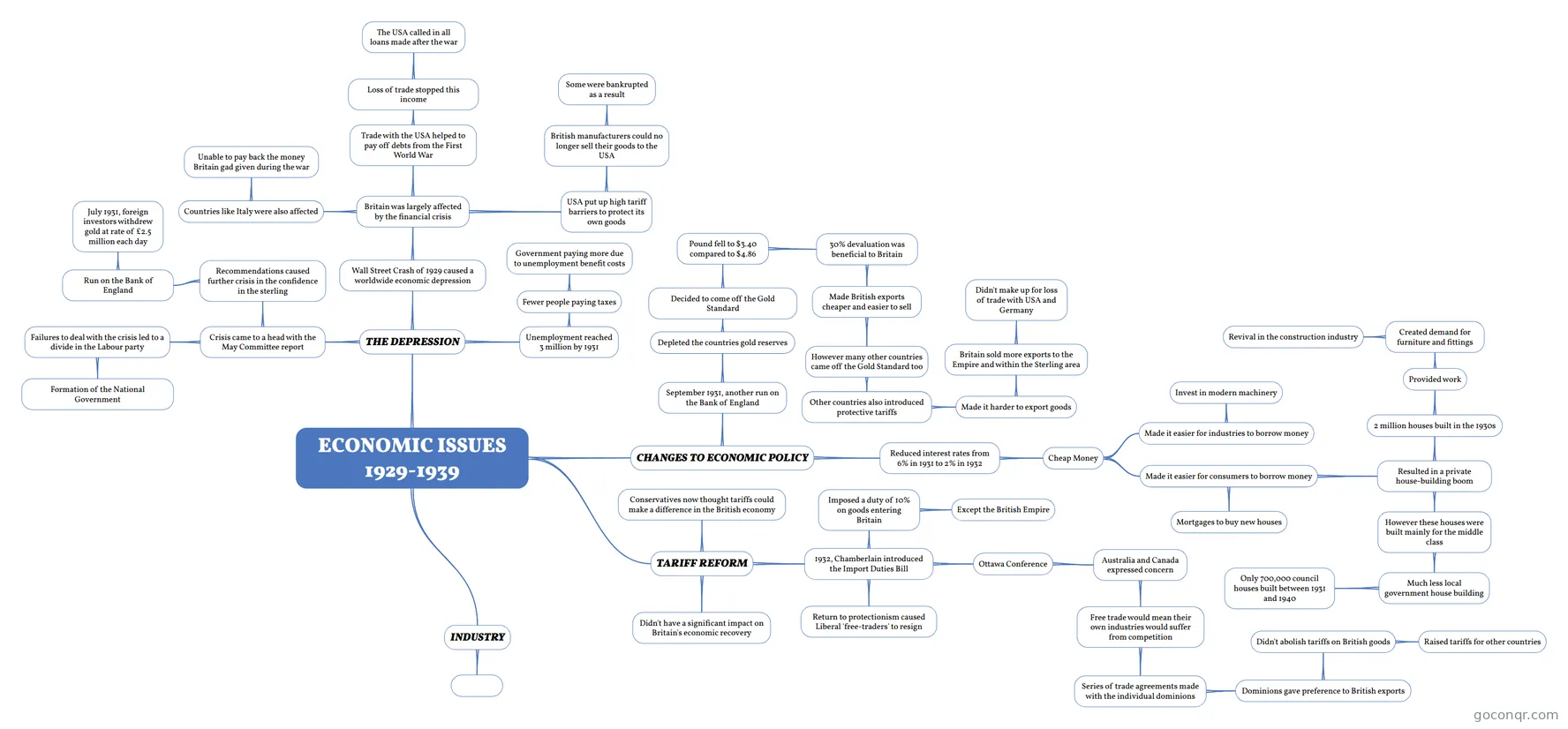
Mind map: Economic issues 1929-1939
Map content
ECONOMIC ISSUES 1929-1939
THE DEPRESSION
- Wall Street Crash of 1929 caused a worldwide economic depression
- Britain was largely affected by the financial crisis
- USA put up high tariff barriers to protect its own goods
- British manufacturers could no longer sell their goods to the USA
- Some were bankrupted as a result
- British manufacturers could no longer sell their goods to the USA
- Trade with the USA helped to pay off debts from the First World War
- Loss of trade stopped this income
- The USA called in all loans made after the war
- Loss of trade stopped this income
- Countries like Italy were also affected
- Unable to pay back the money Britain gad given during the war
- USA put up high tariff barriers to protect its own goods
- Britain was largely affected by the financial crisis
- Unemployment reached 3 million by 1931
- Fewer people paying taxes
- Government paying more due to unemployment benefit costs
- Fewer people paying taxes
- Crisis came to a head with the May Committee report
- Recommendations caused further crisis in the confidence in the sterling
- Run on the Bank of England
- July 1931, foreign investors withdrew gold at rate of £2.5 million each day
- Run on the Bank of England
- Failures to deal with the crisis led to a divide in the Labour party
- Formation of the National Government
- Recommendations caused further crisis in the confidence in the sterling
- Wall Street Crash of 1929 caused a worldwide economic depression
CHANGES TO ECONOMIC POLICY
- September 1931, another run on the Bank of England
- Depleted the countries gold reserves
- Decided to come off the Gold Standard
- Pound fell to $3.40 compared to $4.86
- 30% devaluation was beneficial to Britain
- Made British exports cheaper and easier to sell
- However many other countries came off the Gold Standard too
- Other countries also introduced protective tariffs
- Made it harder to export goods
- Britain sold more exports to the Empire and within the Sterling area
- Didn't make up for loss of trade with USA and Germany
- Britain sold more exports to the Empire and within the Sterling area
- Made it harder to export goods
- Other countries also introduced protective tariffs
- However many other countries came off the Gold Standard too
- Made British exports cheaper and easier to sell
- 30% devaluation was beneficial to Britain
- Pound fell to $3.40 compared to $4.86
- Decided to come off the Gold Standard
- Depleted the countries gold reserves
- Reduced interest rates from 6% in 1931 to 2% in 1932
- Cheap Money
- Made it easier for industries to borrow money
- Invest in modern machinery
- Made it easier for consumers to borrow money
- Mortgages to buy new houses
- Resulted in a private house-building boom
- 2 million houses built in the 1930s
- Provided work
- Created demand for furniture and fittings
- Revival in the construction industry
- Created demand for furniture and fittings
- Provided work
- However these houses were built mainly for the middle class
- Much less local government house building
- Only 700,000 council houses built between 1931 and 1940
- Much less local government house building
- 2 million houses built in the 1930s
- Made it easier for industries to borrow money
- Cheap Money
- September 1931, another run on the Bank of England
TARIFF REFORM
- Conservatives now thought tariffs could make a difference in the British economy
- 1932, Chamberlain introduced the Import Duties Bill
- Imposed a duty of 10% on goods entering Britain
- Except the British Empire
- Ottawa Conference
- Australia and Canada expressed concern
- Free trade would mean their own industries would suffer from competition
- Series of trade agreements made with the individual dominions
- Dominions gave preference to British exports
- Didn't abolish tariffs on British goods
- Raised tariffs for other countries
- Didn't abolish tariffs on British goods
- Dominions gave preference to British exports
- Series of trade agreements made with the individual dominions
- Free trade would mean their own industries would suffer from competition
- Australia and Canada expressed concern
- Return to protectionism caused Liberal 'free-traders' to resign
- Imposed a duty of 10% on goods entering Britain
- Didn't have a significant impact on Britain's economic recovery
INDUSTRY
Information
- Description
- A level British History (The Interwar Years) Mind Map on ECONOMIC ISSUES 1929-1939, created by ELeanor Turner on 21/02/2018.
- Created by
- ELeanor Turner
- Views
- 0
- Rating