
Mind map
Unit 3 AoS 2: Learning and Memory
Map content
Unit 3 AoS 2: Learning and Memory
Neural Basis
- Neural Plasticity
- Long-Term Potentiation
- the increased tendency of a group of neurons to fire together after they have been electrically stimulated at a particular electrical frequency
- increased release of the relevant neurotransmitte
- increased receptor sensitivity
- Increased receptor sights
- Long-Term Depression
- The frequency of the electrical stimulation to be reduced, weakening the synapse
- Developmental Plasticity
- Occurs in the foetal stage, children and adolescents.
- Adaptive Plasticity
- Occurs through our whole lives, resulting from stimulating experience and the environment.
- The way the brain changes in response to stimulation from the environment and is linked to the ability of the brain’s synapses to be formed, removed remade continually
- Long-Term Potentiation
- Neurotransmitters and Neurohormones
- Glutamate
- repeated glutamate release stimulates the release of dopamine which prompts the growth of Dendritic spines making the neuron more sensitive to future firing by neighbouring presynaptic neurons
- Adrenalin
- Post-Traumatic Stress Disorder
- Some circumstances adrenalin encoding memories may be a problem, such as in the case of post-traumatic stress disorder (PTSD), which is a condition where victims suffer symptoms such as sleep disturbances and flashbacks due to a traumatic event.
- Flashbulb Memories
- detailed, vivid and long-lasting memories of important or emotional events in our lives
- If this hormone is present in the bloodstream during a highly emotional event, then it might enhance the encoding of the event
- Post-Traumatic Stress Disorder
- Glutamate
- Neural Plasticity
Observational Learning
- Process
- Attention
- learner actively watches model
- Retention
- learner stores mental representation of behaviour.
- Reproduction
- learner has the mental and physical ability to perform behaviour.
- Motivation
- environmental stimuli make learner wish to perform behaviour
- Reinforcement
- positive outcome means the learner will repeat the behaviour when again motivated to do so
- Attention
- As social learning
- The Bobo Doll Experiment
- Resulted in our understanding that learning can occur through watching others
- Modelling it: When the observer demonstrates the learnt behaviour by imitating it, this is referred to as modelling
- consequences of those behaviours.
- Learning can remain Latent
- The Bobo Doll Experiment
- Applications
- Children and TV violence
- children are more likely to copy another’s behaviour if the model is similar to them in age and sex or if the model has desirable characteristics and is seen as attractive
- Children and TV violence
- tendency to observe and mimic others
- Process
Conditioning
- Classical Conditiong
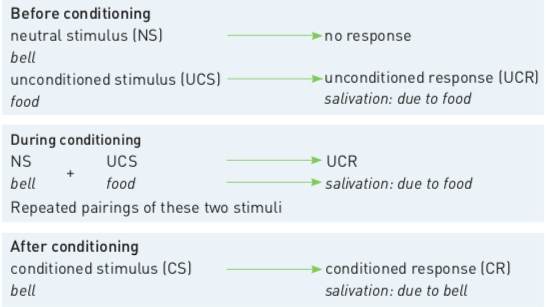
- As a three phase model
- Before Conditiong
- Unconditioned Response
- Involves a response to a stimulus that has not yet been conditioned. It is natural or automatic
- During Conditong
- Unconditioned stimulus
- Neutral Stimulus
- Involves the development of an association between the neutral stimulus (NS) and the unconditioned stimulus (UCS)
- After Conditiong
- Conditoned Stimulus
- Conditioned Response
- Results in the now conditioned stimulus (CS) producing a conditioned response (CR) as a result of its association with the unconditioned stimulus (UCS)
- Before Conditiong
- The Little Albert experiment
- Ethical Implications
- no physical or psychological harm must come to participants
- Little Albert came away from the study psychologically damaged, with a fear of rats among other furry creatures and objects
- informed consent
- Albert was too young to understand the terms of the experiment and permission was not sought from Albert’s mother on his behalf
- Debrief
- Watson failed to extinguish the conditioned response to fear white and fluffy objects.
- no physical or psychological harm must come to participants
- 1. Albert Played with the white rat
- 2. The White rat was paired with a loud banging noise
- 3. when the rat was presented but no noise sounded, Albert cried and tried to crawl away from it
- Ethical Implications
- Aversion Therapy
- Aversion therapy is an application of classical conditioning where a person with an unwanted behaviour learns to associate the unwanted behaviour with an unpleasant event
- As a three phase model
- Operant Conditiong
- Skinner (ABC) and the three phase model
- Antecedent
- the environment) that makes conditions right
- Behaviour
- Consequences
- Antecedent
- Elements of Operant conditioning
- Spontaneous Recovery
- the reappearance of an extinguished response after a rest period
- Extinction
- when the conditioned response disappears over time after reinforcement has ceased
- Stimulus Genralisation
- Behaviour is shown for a stimulus thet is similar to the original
- Simulus Discrimination
- Behaviour is only shown for the original stimulus
- Punishers
- Punishment or positive punishment
- a behaviour followed by a negative experience
- weakens or decreases the likelihood of a response
- Response Cost
- something desirable being removed
- Effective Punishment
- needs to be brief, immediate and linked to the undesired behaviour. Behaviour must be able to be developed to replace the negative behaviour.
- Punishment or positive punishment
- Reinforcers
- Positive Reinforcer
- providing a pleasant consequence
- Negative Reinforcer
- removal of an unpleasant stimulus
- strengthens or increases the likelihood of a response
- Effective Punishment
- Positive Reinforcer
- Spontaneous Recovery
- animals and people learn to operate on their environment to produce desired consequences. An operant is a response that occurs without any stimulus – this is a voluntary behaviour that acts upon the environment in the same way each time
- Skinner (ABC) and the three phase model
- Classical Conditiong
Memory
- The multistore model
- Atkinson–Shiffrin multi-store model of memory
- Sensory
- Iconic
- 0.3s duration, unlimited capacity
- Echoic
- 3-4s Duration, unlimited capacity
- memory within our sense organs, very brief
- Iconic
- Short-term memory
- limited store of actively conscious memory. Requires no interference
- Duration: 12-30s
- Capacity: 5+- 2 (3-9)
- Long-term memory
- Procedual
- 'How to’ memories
- Declarative
- Semantic
- Memories of facts (or knowledge)
- Episodic
- Personalised memories of events
- Memories of personal experiences (events) and facts
- different long-term declarative memories are stored in the different cortical areas generally according to where the type of information was processed
- Semantic
- virtually limitless capacity and duration. It needs retrieval to bring it back into conscious awareness. 'Forgetting' is due to poor retrieval cues
- Procedual
- Implicit memories
- unconscious; it does not require intentional, deliberate recall
- Amygdala plays a key role, mostly responsible for the emotional aspect of the memory
- Explicit memories
- conscious retrieval of memory. This includes recall and recognition
- responsibility of the hippocampus which has cells that are able to reproduce (unlike the rest of the brain)
- Sensory
- Atkinson–Shiffrin multi-store model of memory
- Reliability
- Methods of Retrival
- Recall
- Free recall
- Serial recall
- Cued Recall
- requires the person to retrieve stored information using a minimal amount of cues
- Recognition
- identifying the correct information among a list of incorrect pieces of information
- Relearning
- learning again something that has previously been committed to memory
- Reconstruction
- The way we can change a memory based on the way we recall it
- Recall
- Effects of brain trauma and neurodegenerative diseases
- Brain Trauma
- Amnesia
- Retrograde
- inability to recall previously stored memories
- Anterograde
- inability to encode and store new memories
- Retrograde
- Consolidation theory
- proposes memory is permanently stored through a process where there are physical changes to neuron, three conditions – physical change, no disruption and time in order to create a memory
- Amnesia
- Alzheimer's disease
- occurs mostly in old age and involves gradual, severe memory loss, confusion, impaired attention, disordered thinking and depression
- Amyloid plaques and neurofibrillary tangles are symptoms and are responsible for the death of brain cells
- Brain Trauma
- Methods of Retrival
- Retrival and Reconstruction
- Factors influencing memory
- Cues
- Context dependendent
- refer to the learner’s external environment (the context) in which the memory was formed
- State-dependent
- refer to the ‘internal environment’, which are factors within the person – in other words, the physiological and/or psychological state that they were in at the time of learning, such as their mood, level of anxiety, and whether they were intoxicated, medicated or sober
- Context dependendent
- Rehersal
- Elaborative
- we actively make meaningful associations between new information to be remembered and old or familiar information that is already in the long-term memory. Helps create cues to locate that information.
- Maintenance
- technique that helps keep the information in our immediate awareness (short-term memory) for a longer period of time. Requires repeating information over and over
- Elaborative
- Serial position effect
- Where the immediate free recall of items at the beginning or at the end of a list are remembered better than those in the middle of the list
- Cues
- Eye witness testimony
- Reconstruction of memory
- Leading questions
- A ‘leading question’ is a question that, because of the way it is phrased, suggests what the answer should be
- memory of the event is influenced by new information and we end up recalling not the original event, but our latest reconstruction of it
- Leading questions
- Reconstruction of memory
- Factors influencing memory
- The Process
- 1. Encoding
- putting information into a form which will allow it to be used, an electrochemical code
- 2. Storage
- keeping information in the brain so that we can use it later on
- 3. Retrival
- getting information back from memory so that we can use it, relies on the right cues
- 1. Encoding
- The multistore model
Images and files in the map
Information
- Description
- Year 11 Mind Map on Unit 3 AoS 2: Learning and Memory, created by Hannah Scallion on 25/10/2018.
- Created by
- Hannah Scallion
- Views
- 1
- Rating