
Mind map
Theory of mind
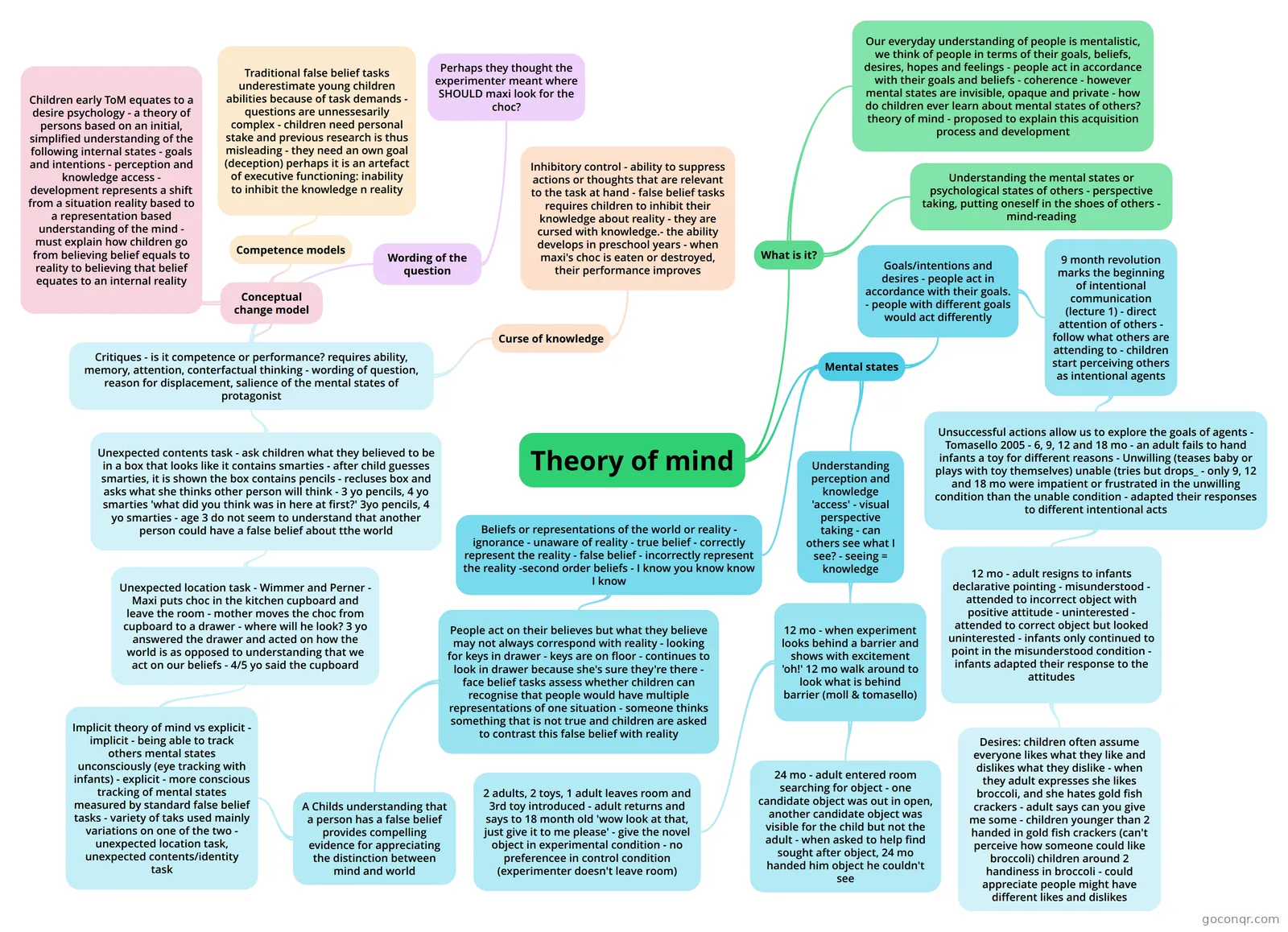
Mind map: Theory of mind
Map content
Theory of mind
What is it?
- Our everyday understanding of people is mentalistic, we think of people in terms of their goals, beliefs, desires, hopes and feelings - people act in accordance with their goals and beliefs - coherence - however mental states are invisible, opaque and private - how do children ever learn about mental states of others? theory of mind - proposed to explain this acquisition process and development
- Understanding the mental states or psychological states of others - perspective taking, putting oneself in the shoes of others - mind-reading
Mental states
- Goals/intentions and desires - people act in accordance with their goals. - people with different goals would act differently
- 9 month revolution marks the beginning of intentional communication (lecture 1) - direct attention of others - follow what others are attending to - children start perceiving others as intentional agents
- Unsuccessful actions allow us to explore the goals of agents - Tomasello 2005 - 6, 9, 12 and 18 mo - an adult fails to hand infants a toy for different reasons - Unwilling (teases baby or plays with toy themselves) unable (tries but drops_ - only 9, 12 and 18 mo were impatient or frustrated in the unwilling condition than the unable condition - adapted their responses to different intentional acts
- 12 mo - adult resigns to infants declarative pointing - misunderstood - attended to incorrect object with positive attitude - uninterested - attended to correct object but looked uninterested - infants only continued to point in the misunderstood condition - infants adapted their response to the attitudes
- Desires: children often assume everyone likes what they like and dislikes what they dislike - when they adult expresses she likes broccoli, and she hates gold fish crackers - adult says can you give me some - children younger than 2 handed in gold fish crackers (can't perceive how someone could like broccoli) children around 2 handiness in broccoli - could appreciate people might have different likes and dislikes
- 12 mo - adult resigns to infants declarative pointing - misunderstood - attended to incorrect object with positive attitude - uninterested - attended to correct object but looked uninterested - infants only continued to point in the misunderstood condition - infants adapted their response to the attitudes
- Unsuccessful actions allow us to explore the goals of agents - Tomasello 2005 - 6, 9, 12 and 18 mo - an adult fails to hand infants a toy for different reasons - Unwilling (teases baby or plays with toy themselves) unable (tries but drops_ - only 9, 12 and 18 mo were impatient or frustrated in the unwilling condition than the unable condition - adapted their responses to different intentional acts
- 9 month revolution marks the beginning of intentional communication (lecture 1) - direct attention of others - follow what others are attending to - children start perceiving others as intentional agents
- Understanding perception and knowledge 'access' - visual perspective taking - can others see what I see? - seeing = knowledge
- 12 mo - when experiment looks behind a barrier and shows with excitement 'oh!' 12 mo walk around to look what is behind barrier (moll & tomasello)
- 24 mo - adult entered room searching for object - one candidate object was out in open, another candidate object was visible for the child but not the adult - when asked to help find sought after object, 24 mo handed him object he couldn't see
- 2 adults, 2 toys, 1 adult leaves room and 3rd toy introduced - adult returns and says to 18 month old 'wow look at that, just give it to me please' - give the novel object in experimental condition - no preferencee in control condition (experimenter doesn't leave room)
- 12 mo - when experiment looks behind a barrier and shows with excitement 'oh!' 12 mo walk around to look what is behind barrier (moll & tomasello)
- Beliefs or representations of the world or reality - ignorance - unaware of reality - true belief - correctly represent the reality - false belief - incorrectly represent the reality -second order beliefs - I know you know know I know
- People act on their believes but what they believe may not always correspond with reality - looking for keys in drawer - keys are on floor - continues to look in drawer because she's sure they're there - face belief tasks assess whether children can recognise that people would have multiple representations of one situation - someone thinks something that is not true and children are asked to contrast this false belief with reality
- A Childs understanding that a person has a false belief provides compelling evidence for appreciating the distinction between mind and world
- Implicit theory of mind vs explicit - implicit - being able to track others mental states unconsciously (eye tracking with infants) - explicit - more conscious tracking of mental states measured by standard false belief tasks - variety of taks used mainly variations on one of the two - unexpected location task, unexpected contents/identity task
- Unexpected location task - Wimmer and Perner - Maxi puts choc in the kitchen cupboard and leave the room - mother moves the choc from cupboard to a drawer - where will he look? 3 yo answered the drawer and acted on how the world is as opposed to understanding that we act on our beliefs - 4/5 yo said the cupboard
- Unexpected contents task - ask children what they believed to be in a box that looks like it contains smarties - after child guesses smarties, it is shown the box contains pencils - recluses box and asks what she thinks other person will think - 3 yo pencils, 4 yo smarties 'what did you think was in here at first?' 3yo pencils, 4 yo smarties - age 3 do not seem to understand that another person could have a false belief about tthe world
- Critiques - is it competence or performance? requires ability, memory, attention, conterfactual thinking - wording of question, reason for displacement, salience of the mental states of protagonist
- Conceptual change model
- Children early ToM equates to a desire psychology - a theory of persons based on an initial, simplified understanding of the following internal states - goals and intentions - perception and knowledge access - development represents a shift from a situation reality based to a representation based understanding of the mind - must explain how children go from believing belief equals to reality to believing that belief equates to an internal reality
- Competence models
- Traditional false belief tasks underestimate young children abilities because of task demands - questions are unnessesarily complex - children need personal stake and previous research is thus misleading - they need an own goal (deception) perhaps it is an artefact of executive functioning: inability to inhibit the knowledge n reality
- Wording of the question
- Perhaps they thought the experimenter meant where SHOULD maxi look for the choc?
- Curse of knowledge
- Inhibitory control - ability to suppress actions or thoughts that are relevant to the task at hand - false belief tasks requires children to inhibit their knowledge about reality - they are cursed with knowledge.- the ability develops in preschool years - when maxi's choc is eaten or destroyed, their performance improves
- Conceptual change model
- Critiques - is it competence or performance? requires ability, memory, attention, conterfactual thinking - wording of question, reason for displacement, salience of the mental states of protagonist
- Unexpected contents task - ask children what they believed to be in a box that looks like it contains smarties - after child guesses smarties, it is shown the box contains pencils - recluses box and asks what she thinks other person will think - 3 yo pencils, 4 yo smarties 'what did you think was in here at first?' 3yo pencils, 4 yo smarties - age 3 do not seem to understand that another person could have a false belief about tthe world
- Unexpected location task - Wimmer and Perner - Maxi puts choc in the kitchen cupboard and leave the room - mother moves the choc from cupboard to a drawer - where will he look? 3 yo answered the drawer and acted on how the world is as opposed to understanding that we act on our beliefs - 4/5 yo said the cupboard
- Implicit theory of mind vs explicit - implicit - being able to track others mental states unconsciously (eye tracking with infants) - explicit - more conscious tracking of mental states measured by standard false belief tasks - variety of taks used mainly variations on one of the two - unexpected location task, unexpected contents/identity task
- A Childs understanding that a person has a false belief provides compelling evidence for appreciating the distinction between mind and world
- People act on their believes but what they believe may not always correspond with reality - looking for keys in drawer - keys are on floor - continues to look in drawer because she's sure they're there - face belief tasks assess whether children can recognise that people would have multiple representations of one situation - someone thinks something that is not true and children are asked to contrast this false belief with reality
- Goals/intentions and desires - people act in accordance with their goals. - people with different goals would act differently
Information
- Description
- Degree Developmental Psychology Mind Map on Theory of mind, created by Abbey Wrigley on 07/01/2019.
- Created by
- Abbey Wrigley
- Views
- 1
- Rating