
Mind map
Conceptual framework of financial information chapter 2
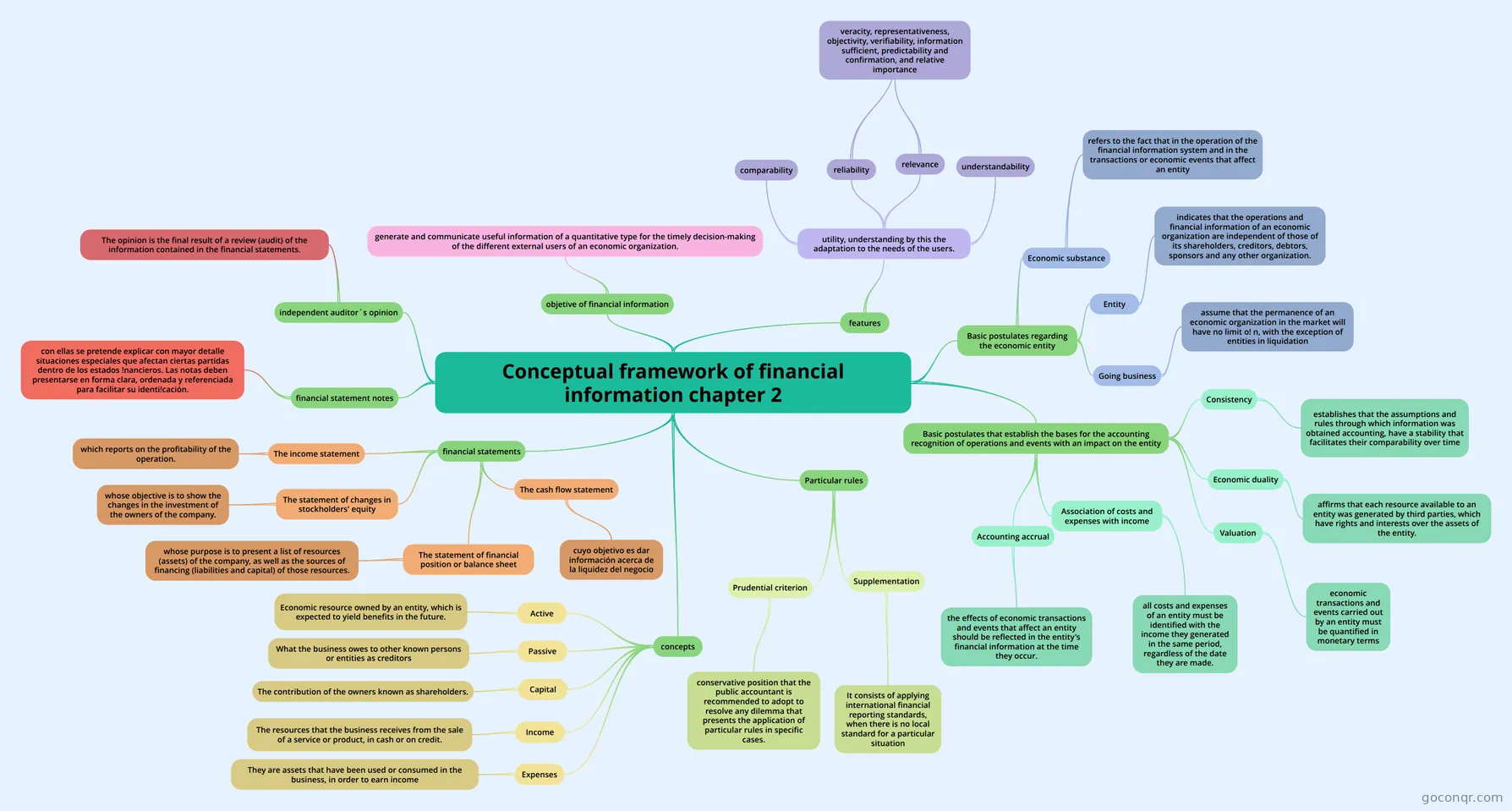
Mind map: Conceptual framework of financial information chapter 2
Map content
Conceptual framework of financial information chapter 2
objetive of financial information
- generate and communicate useful information of a quantitative type for the timely decision-making of the different external users of an economic organization.
features
- utility, understanding by this the adaptation to the needs of the users.
- reliability
- relevance
- veracity, representativeness, objectivity, verifiability, information sufficient, predictability and confirmation, and relative importance
- understandability
- comparability
- reliability
- utility, understanding by this the adaptation to the needs of the users.
Basic postulates regarding the economic entity
- Economic substance
- refers to the fact that in the operation of the financial information system and in the transactions or economic events that affect an entity
- Entity
- indicates that the operations and financial information of an economic organization are independent of those of its shareholders, creditors, debtors, sponsors and any other organization.
- Going business
- assume that the permanence of an economic organization in the market will have no limit o! n, with the exception of entities in liquidation
- Economic substance
concepts
- Active
- Economic resource owned by an entity, which is expected to yield benefits in the future.
- Passive
- What the business owes to other known persons or entities as creditors
- Capital
- The contribution of the owners known as shareholders.
- Income
- The resources that the business receives from the sale of a service or product, in cash or on credit.
- Expenses
- They are assets that have been used or consumed in the business, in order to earn income
- Active
financial statements
- The income statement
- which reports on the profitability of the operation.
- The statement of changes in stockholders' equity
- whose objective is to show the changes in the investment of the owners of the company.
- The statement of financial position or balance sheet
- whose purpose is to present a list of resources (assets) of the company, as well as the sources of financing (liabilities and capital) of those resources.
- The cash flow statement
- cuyo objetivo es dar información acerca de la liquidez del negocio
- The income statement
independent auditor´s opinion
- The opinion is the final result of a review (audit) of the information contained in the financial statements.
financial statement notes
- con ellas se pretende explicar con mayor detalle situaciones especiales que afectan ciertas partidas dentro de los estados !nancieros. Las notas deben presentarse en forma clara, ordenada y referenciada para facilitar su identi!cación.
Basic postulates that establish the bases for the accounting recognition of operations and events with an impact on the entity
- Accounting accrual
- the effects of economic transactions and events that affect an entity should be reflected in the entity's financial information at the time they occur.
- Association of costs and expenses with income
- all costs and expenses of an entity must be identified with the income they generated in the same period, regardless of the date they are made.
- Valuation
- economic transactions and events carried out by an entity must be quantified in monetary terms
- Economic duality
- affirms that each resource available to an entity was generated by third parties, which have rights and interests over the assets of the entity.
- Consistency
- establishes that the assumptions and rules through which information was obtained accounting, have a stability that facilitates their comparability over time
- Accounting accrual
Particular rules
- Prudential criterion
- conservative position that the public accountant is recommended to adopt to resolve any dilemma that presents the application of particular rules in specific cases.
- Supplementation
- It consists of applying international financial reporting standards, when there is no local standard for a particular situation
- Prudential criterion
Information
- Description
- resumen del capitulo 2
- Created by
- WENDY BERENICE GONZALEZ JUAREZ
- Views
- 22
- Tags
- Rating