
Mind map
Attachment
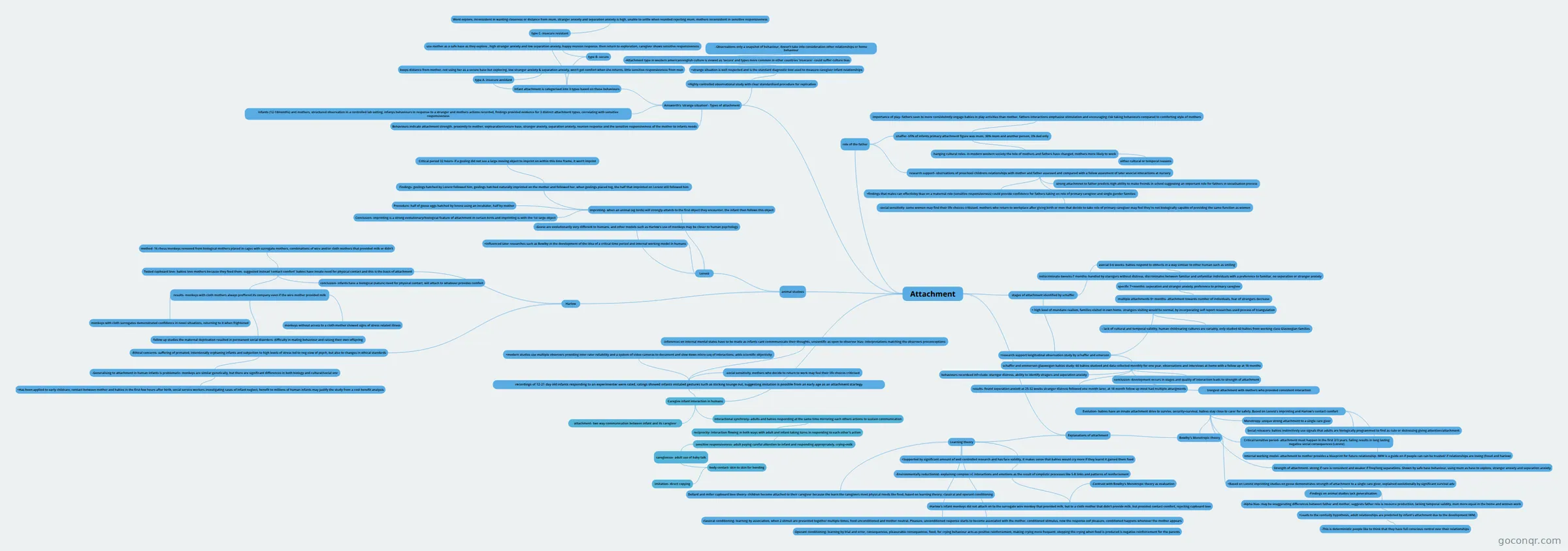
Mind map: Attachment psychology
Map content
Attachment
Caregive infant interaction in humans
- attachment- two way communication between infant and its caregiver
- interactional synchrony- adults and babies responding at the same time mirroring each others actions to sustain communication
- reciprocity- interaction flowing in both ways with adult and infant taking turns in responding to each other's action
- sensitive responsiveness- adult paying careful attention to infant and responding appropriately, crying=milk
- caregivesse- adult use of baby talk
- body contact- skin to skin for bonding
- imitation- direct copying
- body contact- skin to skin for bonding
- caregivesse- adult use of baby talk
- sensitive responsiveness- adult paying careful attention to infant and responding appropriately, crying=milk
- reciprocity- interaction flowing in both ways with adult and infant taking turns in responding to each other's action
- recordings of 12-21 day old infants responding to an experimenter were rated, ratings showed infants imitated gestures such as sticking tounge out, suggesting imitation is possible from an early age as an attachment startegy
- +modern studies use multiple observers providing inter rater reliability and a system of video cameras to document and slow down micro seq of interactions, adds scientific objectivity
- -inferences on internal mental states have to be made as infants cant commmunicate their thoughts, unsientific as open to observer bias- interpretations matching the observers preconceptions
- -social sensitivity, mothers who decide to return to work may feel their life choices criticised
stages of attachment identified by schaffer
- asocial 0-6 weeks- babies respond to obhects in a way similair to other human such as smiling
- indiscriminate 6weeks-7 months- handled by starngers without distress, discriminates between familiar and unfamiliar individuals with a preference to familiar, no seperation or stranger anxiety
- specific 7+months- seperation and stranger anxiety, preference to primary caregiver
- multiple attachments 9+ months- attachment towards number of individuals, fear of strangers decrease
- specific 7+months- seperation and stranger anxiety, preference to primary caregiver
- indiscriminate 6weeks-7 months- handled by starngers without distress, discriminates between familiar and unfamiliar individuals with a preference to familiar, no seperation or stranger anxiety
- +research support longitudinal observation study by schaffer and emerson
- schaffer and emmerson glasweigon babies study- 60 babies studoed and data collected monthly for one year, observations and interviews at home with a follow up at 18 months
- behaviours recordeed inf=clude- starnger distress, ability to identify stragers and seperation anxiety
- results- found seperation anxiett at 25-32 weeks stranger distress followed one month larer, at 18 month follow up most had multiple attacgments
- trongest attachment with mothers who provided consistent interaction
- conclusion- development occurs in stages and quality of interaction leads to strength of attachment
- + high level of mundane realism, families visited in own home, strangers visiting would be normal, by incorporating self report researches used process of triangulation
- - lack of cultural and temporal validity, human childrearing cultures are variably, only studied 60 babies from working class Glaswegian families
- schaffer and emmerson glasweigon babies study- 60 babies studoed and data collected monthly for one year, observations and interviews at home with a follow up at 18 months
- asocial 0-6 weeks- babies respond to obhects in a way similair to other human such as smiling
role of the father
- shaffer- 65% of infants primary attachment figure was mum, 30% mum and another person, 3% dad only
- hanging cultural roles- in modern western society the tole of mothers and fathers have changed, mothers more likely to work
- either cultural or temporal reasons
- importance of play- fathers seen to more consistebntly engage babies in play activities than mother, fathers interactions emphasise stimulation and encouraging risk taking behaviours compared to comforting style of mothers
- hanging cultural roles- in modern western society the tole of mothers and fathers have changed, mothers more likely to work
- research support- obsrrvations of preschool childrens relationships with mother and father assessed and compared with a follow assesment of later wsocial interactions at nursery
- strong attachmnet to father predicts high ability to make freinds in school suggesting an important role for fathers in socialisation process
- +findings that males can effectivley tkae on a maternal role (sensitive responsiveness) could provide confidence for fathers taking on role of primary caregiver and single gender families
- -social sensitivity- some women may find their life choices critisised, mothers who return to workplace after giving birth or men that decide to take role of primary caregiver may feel they're not biologically capable of providing the same function as women
- shaffer- 65% of infants primary attachment figure was mum, 30% mum and another person, 3% dad only
animal studoes
- Lorenz
- imprinting- when an animal (eg birds) will strongly attatcb to the first object they encounter, the infant then follows this object
- Procedure- half of goose eggs hatched by lorenz using an incubator, half by mother
- Findings- goslings hatched by Lorenz followed him, goslings hatched naturally imprinted on the mother and followed her, when goslings placed tog, the half that imprinted on Lorenz still followed him
- Critical period 32 hours- if a gosling did not see a large moving object to imprint on within this time frame, it won't imprint
- Conclusion- imprinting is a strong evolutionary/biological feature of attachment in certain birds and imprinting is with the 1st large object
- +Influenced later researches such as Bowlby in the development of the idea of a critical time period and internal working model in humans
- -Geese are evolutionarily very different to humans, and other models such as Harlow's use of monkeys may be closer to human psychology
- imprinting- when an animal (eg birds) will strongly attatcb to the first object they encounter, the infant then follows this object
- Harlow
- Tested cupboard love- babies love mothers because they feed them. suggested instead 'contact comfort' babies have innate need for physical contact and this is the basis of attachment
- method- 16 rheus monkeys removed from biological mothers placed in cages with surrogate mothers, combinations of wire and/or cloth mothers that provided milk or didn't
- results- monkeys with cloth mothers always preffered its company even if the wire mother provided milk
- monkeys with cloth surrogates demonstrated confidence in novel situations, returning to it when frightened
- monkeys without access to a cloth mother showed signs of stress related illness
- follow up studies the maternal deprivation resulted in permanent social disorders- difficulty in mating behaviour and raising their own offspring
- conclusion- infants have a biological (nature) need for physical contact, will attach to whatever provides comfort
- -Ethical concerns- suffering of primated, intentionally orphaning infants and subjection to high levels of stress led to neg view of psych, but also to changes in ethical standsrds
- -Generalising to attachment in human infants is problematic- monkeys are similar genetically, but there are significant differences in both biology and cultural/social env
- +Has been applied to early childcare, contact between mother and babies in the first few hours after birth, social service workers investigating cases of infant neglect, benefit to millions of human infants may justify the study from a cost benefit analysis
- -Generalising to attachment in human infants is problematic- monkeys are similar genetically, but there are significant differences in both biology and cultural/social env
- Tested cupboard love- babies love mothers because they feed them. suggested instead 'contact comfort' babies have innate need for physical contact and this is the basis of attachment
- Lorenz
Explanations of attachment
- Learning theory
- Dollard and miller cupboard love theory- children become attached to their caregiver because the learn the caregivers meet physical needs like food, based on learning theory; classical and operant conditioning
- classical conditioning- learning by association, when 2 stimuli are presented together multiple times, food unconditioned and mother neutral. Pleasure, unconditioned response starts to become associated with the mother, conditioned stimulus, now the response oof pleasure, conditioned happens whenever the mother appears
- Operant conditioning- learning by trial and error, consequences, pleasurable consequences, food, for crying behaviour acts as positive reinforcement, making crying more frequent. stopping the crying when food is produced is negative reinforcement for the parents
- +Supported by significant amount of well controlled research and has face validity, it makes sense that babies would cry more if they learnt it gained them food
- -Environmentally reductionist- explaining complex I-C interactions and emotions as the result of simplistic processes like S-R links and patterns of reinforcement
- -Harlow's infant monkeys did not attach on to the surrogate wire monkey that provided milk, but to a cloth mother that didn't provide milk, but provided contact comfort, rejecting cupboard love
- -Contrast with Bowlby's Monotropic theory as evaluation
- -Harlow's infant monkeys did not attach on to the surrogate wire monkey that provided milk, but to a cloth mother that didn't provide milk, but provided contact comfort, rejecting cupboard love
- -Environmentally reductionist- explaining complex I-C interactions and emotions as the result of simplistic processes like S-R links and patterns of reinforcement
- Bowlby's Monotropic theory
- Evolution- babies have an innate attachment drive to survive, security=survival, babies stay close to carer for safety. Based on Lorenz's imprinting and Harlow's contact comfort
- Critical/sensitive period- attachment must happen in the first 2/3 years, failing results in long lasting negative social consequences (Lorenz)
- Monotropy- unique strong attachment to a single care giver
- Internal working model- attachment to mother provides a blueprint for future relationship. IMW is a guide on if people can can be trusted/ if relationships are loving (freud and harlow)
- Strength of attachment- strong if care is consistent and weaker if freq/long separations. Shown by safe base behaviour, using mum as base to explore, stranger anxiety and seperation anxiety
- Social releasers- babies instinctively use signals that adults are biologically programmed to find as cute or distressing giving attention/attachment
- +Based on Lorenz imprinting studies on geese demonstrates strength of attachment to a single care giver, explained evolutionally by significant survival adv
- -Findings on animal studies lack generalisation
- -Alpha bias- may be exaggerating differences between father and mother, suggests father role is resource production, lacking temporal validity, men more equal in the home and women work
- +Leads to the contiuity hypothesis, adult relationships are predicted by infant's attachment due to the development IWM,
- -This is deterministic people like to think that they have full conscious control over their relationships
- +Leads to the contiuity hypothesis, adult relationships are predicted by infant's attachment due to the development IWM,
- -Alpha bias- may be exaggerating differences between father and mother, suggests father role is resource production, lacking temporal validity, men more equal in the home and women work
- -Findings on animal studies lack generalisation
- Evolution- babies have an innate attachment drive to survive, security=survival, babies stay close to carer for safety. Based on Lorenz's imprinting and Harlow's contact comfort
- Learning theory
Ainsworth's 'strange situation'- Types of attachment
- Behaviours indicate attachment strength. proximity to mother, exploaration/secure base, stranger anxiety, separation anxiety, reunion response and the sensitive responsiveness of the mother to infants needs
- Infant attachment is categorised into 3 types based on these behaviours
- type A- insecure avoidant
- keeps distance from mother, not using her as a secure base but exploring, low stranger anxiety & separation anxiety, won't get comfort when she returns, little sensitive responsiveness from mun
- type B- secure
- use mother as a safe base as they explore , high stranger anxiety and low separation anxiety, happy reunion response, then return to exploration, caregiver shows sensitive responsiveness
- type C- insecure resistant
- Wont explore, inconsistent in wanting closeness or distance from mum, stranger anxiety and separation anxiety is high, unable to settle when reunited rejecting mum, mothers inconsistent in sensitive responsiveness
- type A- insecure avoidant
- Infants (12-18months) and mothers, structured observation in a controlled lab setting, infanys behaviours in response to a stranger and mothers actions recorded, findings provided evidence for 3 distinct attachment types, correlating with sensitive responsiveness
- +Highly controlled observational study with clear standardised procedure for replication
- +strange situation is well respected and is the standard diagnostic tool used to measure caregiver infant relationships
- -Attachment type in western american/english culture is viewed as 'secure' and types more common in other countries 'insecure'- could suffer culture bias
- -Observations only a snapshot of behaviour, doesn't take into consideration other relationships or home behaviour
- -Attachment type in western american/english culture is viewed as 'secure' and types more common in other countries 'insecure'- could suffer culture bias
- +strange situation is well respected and is the standard diagnostic tool used to measure caregiver infant relationships
Information
- Description
- Mind Map on Attachment, created by debi alasi on 03/06/2021.
- Created by
- debi alasi
- Views
- 0
- Rating