
Mind map
PHS302 - Torticollis
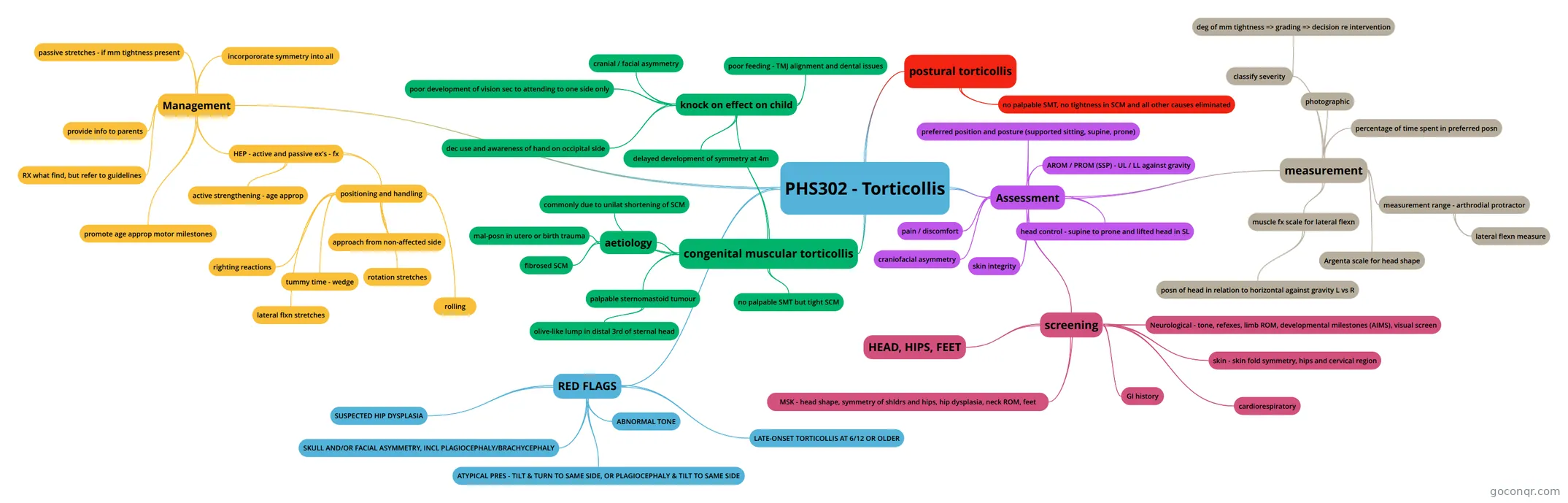
Mind map: Torticollis
Map content
PHS302 - Torticollis
congenital muscular torticollis
- palpable sternomastoid tumour
- olive-like lump in distal 3rd of sternal head
- no palpable SMT but tight SCM
- commonly due to unilat shortening of SCM
- aetiology
- mal-posn in utero or birth trauma
- fibrosed SCM
- knock on effect on child
- cranial / facial asymmetry
- poor development of vision sec to attending to one side only
- poor feeding - TMJ alignment and dental issues
- delayed development of symmetry at 4m
- dec use and awareness of hand on occipital side
- palpable sternomastoid tumour
postural torticollis
- no palpable SMT, no tightness in SCM and all other causes eliminated
Assessment
- preferred position and posture (supported sitting, supine, prone)
- AROM / PROM (SSP) - UL / LL against gravity
- head control - supine to prone and lifted head in SL
- pain / discomfort
- skin integrity
- craniofacial asymmetry
- measurement
- photographic
- percentage of time spent in preferred posn
- measurement range - arthrodial protractor
- lateral flexn measure
- muscle fx scale for lateral flexn
- posn of head in relation to horizontal against gravity L vs R
- Argenta scale for head shape
- classify severity
- deg of mm tightness => grading => decision re intervention
- screening
- MSK - head shape, symmetry of shldrs and hips, hip dysplasia, neck ROM, feet
- HEAD, HIPS, FEET
- Neurological - tone, refexes, limb ROM, developmental milestones (AIMS), visual screen
- skin - skin fold symmetry, hips and cervical region
- cardiorespiratory
- GI history
RED FLAGS
- SUSPECTED HIP DYSPLASIA
- SKULL AND/OR FACIAL ASYMMETRY, INCL PLAGIOCEPHALY/BRACHYCEPHALY
- ATYPICAL PRES - TILT & TURN TO SAME SIDE, OR PLAGIOCEPHALY & TILT TO SAME SIDE
- ABNORMAL TONE
- LATE-ONSET TORTICOLLIS AT 6/12 OR OLDER
Management
- provide info to parents
- RX what find, but refer to guidelines
- HEP - active and passive ex's - fx
- active strengthening - age approp
- positioning and handling
- righting reactions
- approach from non-affected side
- tummy time - wedge
- rotation stretches
- rolling
- lateral flxn stretches
- promote age approp motor milestones
- passive stretches - if mm tightness present
- incorpororate symmetry into all
Information
- Description
- Mind Map to describe Torticollis assessment and measurement
- Created by
- Louise Weir
- Views
- 23
- Tags
- Rating