
Mind map
Attachment
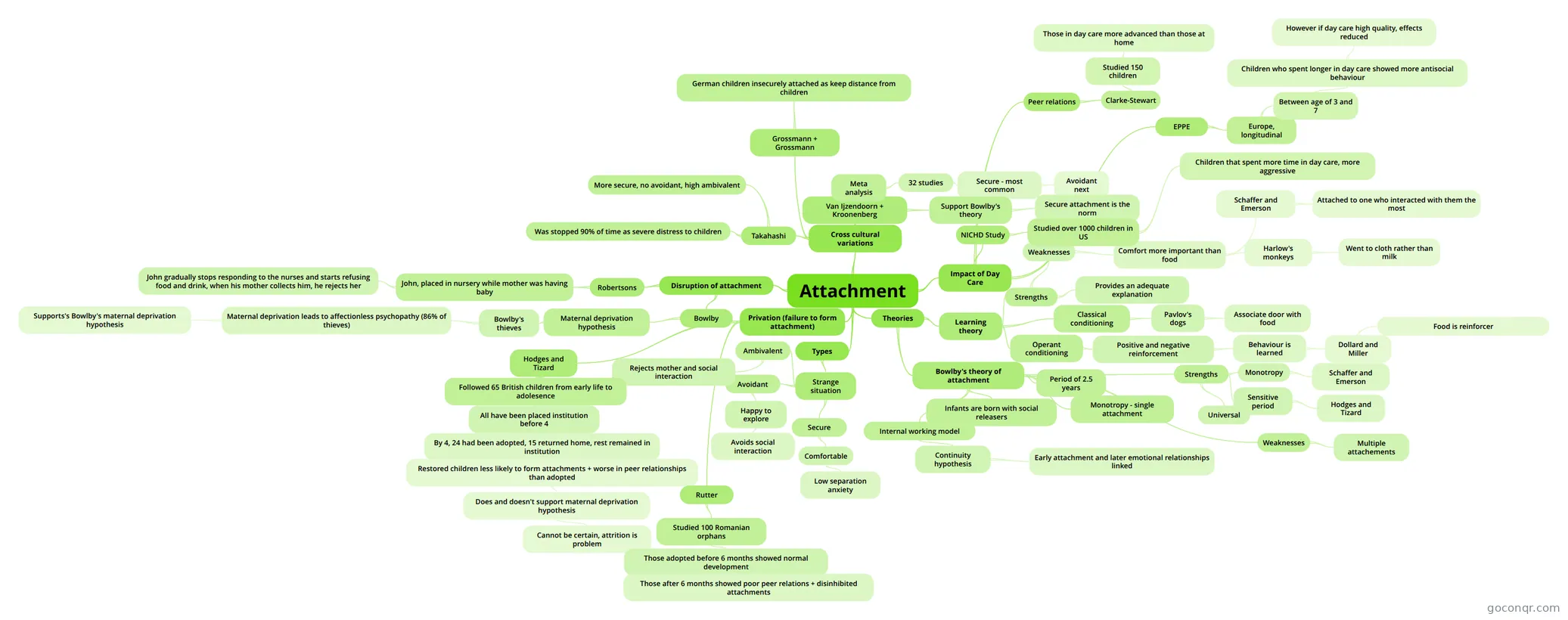
Mind map: Attachment psychology
Map content
Attachment
Theories
- Learning theory
- Classical conditioning
- Pavlov's dogs
- Associate door with food
- Pavlov's dogs
- Operant conditioning
- Positive and negative reinforcement
- Behaviour is learned
- Dollard and Miller
- Food is reinforcer
- Dollard and Miller
- Behaviour is learned
- Positive and negative reinforcement
- Strengths
- Provides an adequate explanation
- Weaknesses
- Comfort more important than food
- Harlow's monkeys
- Went to cloth rather than milk
- Schaffer and Emerson
- Attached to one who interacted with them the most
- Harlow's monkeys
- Comfort more important than food
- Classical conditioning
- Bowlby's theory of attachment
- Period of 2.5 years
- Infants are born with social releasers
- Monotropy - single attachment
- Internal working model
- Continuity hypothesis
- Early attachment and later emotional relationships linked
- Continuity hypothesis
- Strengths
- Sensitive period
- Hodges and Tizard
- Universal
- Monotropy
- Schaffer and Emerson
- Sensitive period
- Weaknesses
- Multiple attachements
- Learning theory
Types
- Strange situation
- Secure
- Comfortable
- Low separation anxiety
- Comfortable
- Avoidant
- Happy to explore
- Avoids social interaction
- Happy to explore
- Ambivalent
- Rejects mother and social interaction
- Secure
- Strange situation
Cross cultural variations
- Van Ijzendoorn + Kroonenberg
- Meta analysis
- 32 studies
- Secure - most common
- Avoidant next
- Secure - most common
- 32 studies
- Support Bowlby's theory
- Secure attachment is the norm
- Meta analysis
- Takahashi
- More secure, no avoidant, high ambivalent
- Was stopped 90% of time as severe distress to children
- Grossmann + Grossmann
- German children insecurely attached as keep distance from children
- Van Ijzendoorn + Kroonenberg
Disruption of attachment
- Robertsons
- John, placed in nursery while mother was having baby
- John gradually stops responding to the nurses and starts refusing food and drink, when his mother collects him, he rejects her
- John, placed in nursery while mother was having baby
- Bowlby
- Maternal deprivation hypothesis
- Bowlby's thieves
- Maternal deprivation leads to affectionless psychopathy (86% of thieves)
- Supports's Bowlby's maternal deprivation hypothesis
- Maternal deprivation leads to affectionless psychopathy (86% of thieves)
- Bowlby's thieves
- Maternal deprivation hypothesis
- Robertsons
Privation (failure to form attachment)
- Hodges and Tizard
- Followed 65 British children from early life to adolesence
- All have been placed institution before 4
- By 4, 24 had been adopted, 15 returned home, rest remained in institution
- Restored children less likely to form attachments + worse in peer relationships than adopted
- Does and doesn't support maternal deprivation hypothesis
- Cannot be certain, attrition is problem
- Does and doesn't support maternal deprivation hypothesis
- Restored children less likely to form attachments + worse in peer relationships than adopted
- By 4, 24 had been adopted, 15 returned home, rest remained in institution
- All have been placed institution before 4
- Followed 65 British children from early life to adolesence
- Rutter
- Studied 100 Romanian orphans
- Those adopted before 6 months showed normal development
- Those after 6 months showed poor peer relations + disinhibited attachments
- Those adopted before 6 months showed normal development
- Studied 100 Romanian orphans
- Hodges and Tizard
Impact of Day Care
- NICHD Study
- Studied over 1000 children in US
- Children that spent more time in day care, more aggressive
- Studied over 1000 children in US
- EPPE
- Europe, longitudinal
- Between age of 3 and 7
- Children who spent longer in day care showed more antisocial behaviour
- However if day care high quality, effects reduced
- Children who spent longer in day care showed more antisocial behaviour
- Between age of 3 and 7
- Europe, longitudinal
- Peer relations
- Clarke-Stewart
- Studied 150 children
- Those in day care more advanced than those at home
- Studied 150 children
- Clarke-Stewart
- NICHD Study
Information
- Description
- Mind Map on Attachment, created by ranvir7 on 04/05/2013.
- Created by
- ranvir7
- Views
- 38
- Rating