
Mind map
Gray's RST and the FFM
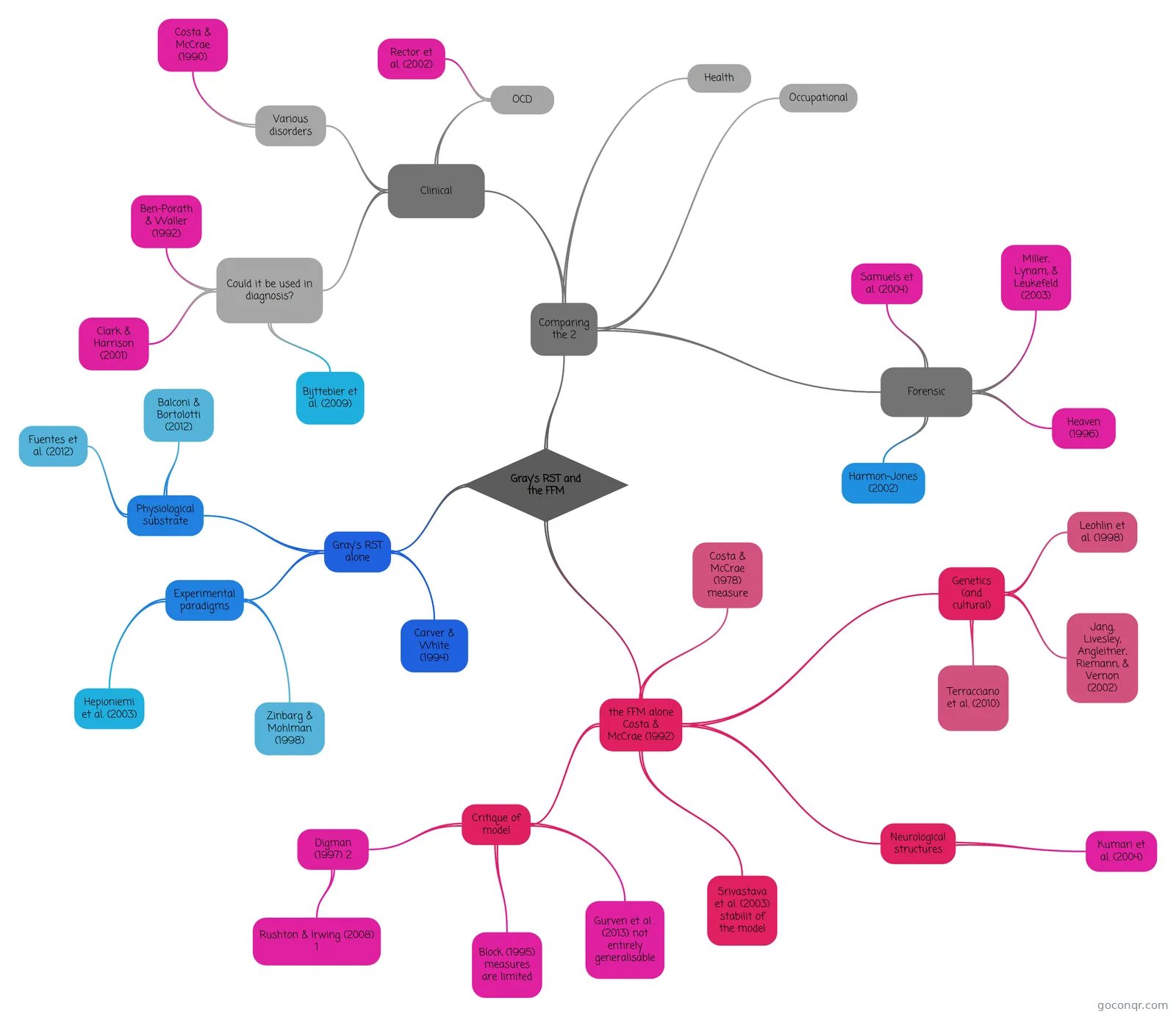
Mind map: Gray's RST and the FFM
Map content
Gray's RST and the FFM
the FFM alone Costa & McCrae (1992)
- developed the Five Factor Model, a hierarchical model of traits in which individual ‘behaviours’ make up ‘facets’ which then make up the ‘domains’ (Openness, Conscientiousness, Extraversion, Agreeableness and Neuroticism). It assumes that traits are derived from a biological (neurological) process that have a genetic bases ad are stable across time & cultures (universals). These traits can be measured through questionnaires that attempt to identify the traits at facet level, then compute the facets that underlie the domains.
- Domains: - Openness (Fantasy, aesthetics, imagination, feelings, actions, ideas), HIGH = curious, wide range of interests, independence, LOW = practical, conventional, prefers routine. - Conscientiousness (competence, order, self-discipline, goal-driven, thoughtfulness), HIGH = hardworking, dependable, organised, LOW = impulsive, careless, disorganised. - Extroversion (sociability, assertiveness, emotional expression), HIGH = outgoing, warm, seeks adventure, LOW = Quiet, reserved, withdrawn. - Agreeableness (cooperative, trustworthy, good-natured), HIGH = helping, trusting, empathetic, LOW = critical, uncooperative, suspicious. - Neuroticism (tendency toward unstable emotions), HIGH = anxious, unhappy, prone to negative emotions, LOW = calm, even-tempered, & secure.
- Genetics (and cultural)
- Leohlin et al. (1998)
- Used 3 different measures of the 5 personality traits on a sample of twins: trait self-rating scales, personality inventory items, and an adjective checklist. Behavioural-genetic models were fit to what the 3 measures had in common, and to the various distance of each. The results support that the five personality traits can be equally heritable, with little or no contribution of shared family environment. The heritability of males & females did not differ significantly.
- Jang, Livesley, Angleitner, Riemann, & Vernon (2002)
- Multivariate genetic analyses were applied to the 5 personality domains found using the NEO-PI within a sample of 253 identical and 207 fraternal twin pairs from Canada, and 526 identical and 269 fraternal pairs from Germany. Results showed that each of the NEO-PI-R domains is composed of multiple genetic and environmental factors common to the FFM domains. Differences between the German and Canadian sample appeared limited to the magnitude of the genetic and environmental effects on each facet, but not the number or type of genetic and environmental influences.
- Terracciano et al. (2010)
- Conducted a genome-wide association study and found that Neuroticism is linked to a region on the same genome as ASHD and psychiatric disorders, Openness is linked to the same genes that are linked to Autism and complex schizophrenia phenotype (makes sense because openness & creativity, seeking new sensations~), Conscientiousness is linked to same genome associated to Alzheimers and Downs syndrome.
- Leohlin et al. (1998)
- Neurological structures
- Neurological structures are linked to personality traits~ how do these parts of the brain change in function when linked to expression of those traits?
- Kumari et al. (2004)
- found that as extraversion increases, cortical activity decreases (resting levels) thus supporting Eysenck’s predictions of neuro-activity in relation to Extraversion i.e. he predicted that extraverts require more external stimulation because their resting levels are much lower. Kumari found that when brain is activated, those high in E increase their signal to a greater extent than those low in E.
- Critique of model
- Gurven et al . (2013) not entirely generalisable
- Stated that western, educated, industrialised, rich, democratic populations are usually the ones being tested, so can the FFM really be cross-cultural and generalise universally? Gurven et al examined the FFM is the Tsimane forager-horticulturalist tribes in Bolivia and found NO evidence of the FFM in its families/villages.
- Block (1995) measures are limited
- Studies supporting FFM are only finding evidence of the FFM because that is what they are testing for, the tests are limited to 5 due to selective function. If you test based on materials that reflect the 5 factors then you will find those 5 factors to some degree~ - Also this doesn’t even support that the 5 are the top of the personality hierarchy i.e. there might be just one or two factors at the top required to describe human personality: Digman’s Alpha & Beta,or Rushton’s GFP.
- Digman (1997) 2
- proposes that at a basic level personality can be reduced to 2 super-factors, alpha and beta. Alpha is composed of Agreeableness, Conscientiousness, and emotional stability, beta splits into Extraversion and intellect. Alpha seems to represent socialisation and beta seems to represent learning, so these 2 factors underlie how we develop as a person in society.
- Rushton & Irwing (2008) 1
- suggest that alpha and beta even converge to form one superior general factor of personality (GFP). Used structural equation models to test hypotheses. Found that GFP explained 45% of the reliable variance in a model that contained the big 5 to the big 2 to the big 1 across 14 studies of inter-scale correlations. A higher order factor Alpha was defined by Conscientiousness, Emotional stability, and Agreeableness, and Beta was defined by Openness and Extraversion. In turn, the GFP was defined by alpha and beta 0.67. In a second study this GFP explained 44% of the reliable variance in a similar model.
- Gurven et al . (2013) not entirely generalisable
- Costa & McCrae (1978) measure
- NEO Personality Inventory (NEO-PI) Comprises of 60 items (12 per each domain) used to assess for the domains used in the five factor model of personality.
- Srivastava et al. (2003) stabilit of the model
- stability of the traits across lifetime (balancing gender) Openness men tend to be more open than women BUT both genders decline as they grow older Conscientiousness both genders increase across life although women show dip right before 60 Extraversion similar patterns although women tend to have higher levels across life Agreeableness both genders peak in 40’s/50’s & dip down again towards 60 Neuroticism men stay relatively stable across lifetime, whereas women do not
Gray's RST alone
- Gray hypothesised 3 systems: - Behavioural activation system (BAS)responsive to conditioned and unconditioned reward cues. BAS regulates approach behaviours (reward system). People with higher BAS tend to be more impulsive and may have difficulty inhibiting their behaviour when approaching a goal. - Behavioural inhibition system (BIS) is responsive to punishment, novelty, uncertainty, and non-rewarding stimuli. BIS regulates avoidance behaviours and is often referred to as the punishment system. People higher in BIS are more vulnerable to negative emotions including frustration, anxiety, fear and sadness. - Fight flight freeze system (FFFS) reactions of rage and panic, flight versus fight and us sensitive to unconditioned aversive stimuli. The threat system. - those high in BAS (impulsivity) = higher extra version and neuroticism - those high in BIS (anxious) = higher introversion and neuroticism
- Experimental paradigms
- Zinbarg & Mohlman (1998)
- Predicted through previous research that BAS (and thus trait impulsivity) is positively related to the speed of acquisition of reward expectancies and BIS(and thus trait anxiety) is positively related to speed of acquisition of punishment expectancies. Used a standard approach-avoidance discrimination task with self-report measures of expectancies. Found that those higher in anxiety were faster/better at identifying the punishment cues, less so if they were assessed to be impulsive.
- Hepioniemi et al. (2003)
- Investigated relation of BIS/BAS to emotions and induced stress experienced in laboratory setting. 95 randomly selected 21-36 year old men and women were tested using Carver and White’s BIS/BAS scales. Stressors were then introduced in the form of: the aversive startle task, the appetitive mental arithmetic task and the aversive choice-deadline reaction time task. The main finding was that BAS sensitivity is generally associate with pleasant affects, BIS sensitivity was associate with unpleasant affects with a great increased urging unpleasant tasks. A conclusion was that BIS sensitivity could predispose a person to emotional distress in stressful situations and probably, to a higher stress vulnerability with its somatic end points.
- Zinbarg & Mohlman (1998)
- Physiological substrate
- Gray's RST can be empirically demonstrated through physiological measures i.e. Skin conductance responses and heart rate measures in response to BIS/BAS related stimuli (avoiding negative and steering towards positive)
- Fuentes et al. (2012)
- The Behavioural Inhibition System (BIS) mediates anxiety, thought that amygdaloid should be involved in BIS (previous research). This study aimed to study BIS-related individual differences and their relationship with brain regional volume. BIS sensitivity was assessed through BIS/BAS questionnaire in sample of male Pts, and score were correlated with brain regional volume. Results show negative correlation between BIS and volume of right and medial orbitofrontal critics. Results suggest that individual differences in anxiety-related personality traits and their related psychopathology may be associated with reduced brain volume in certain structures relating to emotional control (e.g. The orbitofrontal cortex) and self-consciousness.
- Balconi & Bortolotti (2012)
- Recorded Pts across 4 measures: autonomic behaviour(skin conductance, SCR, and heart rate, HR), empathetic scales (BEES), approach/withdrawal attitudes (BIS/BAS), and verbal self-report measures. Pts were presented with different interpersonal scene types (cooperation, conflict & indifference) and they were required to empathise with them. Different autonomic response patterns were found as a direct function of the interpersonal situations: high BAS subjects were more responsive to positive cooperative situations, whereas BIS empathised higher with negative conflicts all situations.
- Shows direct influence that levels of BIS has on how we interpret environment (affect behaviour) and one way we can demonstrate measures of BIS/BAS.
- Carver & White (1994)
- Devised a questionnaire that used a set of scales to estimate a person’s levels of BIS/BAS. Each item of the questionnaire is a statement that a person must respond to by indicating how much they either agree with or disagree with. The questionnaire actually measures 3 scales of BAS: BAS drive, BAS FUN-seeking, and BAS reward-responsiveness, but only one scale of BIS. Measure3 scales of BAS because it was indicated by previous research that there are diverse manifestations of the BAS that focus on different aspects of incentive sensitivity. Fun-seeking for example is thought to have elements of impulsiveness that the other scales do no. BAS drive --> When I want something I usually go all-out to get it. BAS fun-seeking --> I often act on spur of the moment. BAS reward-responsiveness --> When I get something I want, I feel excited and energised. BIS --> Feel pretty worried/upset when I think or know someone is angry with me.
Comparing the 2
- Health
- Occupational
- Clinical
- How well do the models predict/link to clinical personality disorders? -personality traits - enduring patterns of perceiving, relating to, and thinking about the environment and oneself that are exhibited across a wide range of social and personal contexts. Classified by the DSM-IV. - When these traits are inflexible, maladaptive, and cause functional impairment and/or distress = personality disorder. A. Inflexible and pervasive across contexts. B. Leads to significant distress or impairment across social, occupational or other areas of life. C. Is stable and can be traced back to adolescence or before. D. Is not better accounted for by another disorder. E. Is not due to physiological effects of substance or general medical condition.
- OCD
- Rector et al. (2002)
- Examined personality differences in patients with a primary diagnosis of OCD or major depression using the domains and facets of the FFM. Patients completed self-report questionnaire (revised NEO PI-R). Patients with OCD were found were found to differ across the domains (and facets) of neuroticism, extraversion, and conscientiousness, and the facets of openness & agreeableness. When compared to depression patients, those with OCD were found to be more extroverted, agreeable, conscientious, and less neurotic. With exception of conscientiousness domain (and facets), these significant differences were maintained even after controlling for depression severity. These results highlight the unique associations between trait domains and facets of the FFM and OCD.
- Rector et al. (2002)
- Could it be used in diagnosis?
- Gray’s RST is thought to presuppose individual differences in the sensitivity of basic brain systems that respond to punishing and reinforcing stimuli. These differences are thought to underlie the personality dimensions of anxiety and impulsivity, and to have relevance for psychopathology.
- Ben-Porath & Waller (1992)
- also investigated if FFM could be used in clinical assessment Suggest that the FFM (and similar measures) that do not directly focus on psychopathology (like the DSM) should be required to demonstrate that they are aligned with data produced from ones that are, to “incrementally procure diagnostic information beyond that which is currently obtained from current clinical measures.
- Clark & Harrison (2001)
- reported a meta-analysis that included 17 studies in which correlations between an FFM measure and personality disorder oriented instrument (such as DSM-IV). They found that the FFM generally could extend the diagnostic tools, although supplementary scales may be needed to provide more complete coverage.
- Bijttebier et al. (2009)
- Review RST-based research on personality-psychopathology associations. First, the link between RST systems and personality dimensions is discussed, second, studies investigating associations between RST systems and specific types of psychopathology are summarised. The available research yields a rather consistent picture with respect to the constellations of BIS/BAS sensitivity that are associated with specific types of psychopathology. - Research suggests that levels of BIS can determine different personality disorders i.e. anxiety disorders (^), Depression (^), primary and secondary psychopathy (^). Bas is found to be linked to: depression (¯), mania, symptoms surrounding substance abuse, and bipolar.
- Various disorders
- Costa & McCrae (1990)
- combined data from participants using self-reports, spouse ratings, and peer ratings of the NEO personality inventory (NEO-PI), a measure of the 5 basic factors of personality, and results from MMPI personality scales. Found that the five-factor model encompasses dimensions of both normal and abnormal personality. Because of this Costa and McCrae suggest that personality could be integrated into models of psychiatric disorders diagnoses. - Paranoid PD links to Neuroticism (.43) and Agreeableness (-.53) - Borderline PD links to Neuroticism (.67), Openness (.26) and Agreeableness (-.36) - Antisocial PD links to Extroversion (.38), Openness (.26), and Agreeableness (-.37)
- Costa & McCrae (1990)
- Forensic
- Hard to assess direct link between personality factors and likelihood of arrest/crime but it is possible to investigate link between personality factors and behaviours relating to offending such as aggression and anger. - suggesting FFM better predictor for offending behaviours?
- Miller, Lynam, & Leukefeld (2003)
- Examined relationship between FFM and a range of antisocial activities. They found that Neuroticism, Agreeableness, and Conscientiousness predicted the stability/variety and onset of aggression, and symptoms of antisocial personality disorder of a sample of individuals in the community. Agreeableness most consistently related to all 5 antisocial and aggressive facets: self-reported criminal activity and aggression, interests in weapons , alcohol-violence expectancies, or sexual offending.
- Heaven (1996)
- Measured five factors and offending behaviours using self reported questionnaires and found that low Agreeableness, low Conscientiousness and high Neuroticism linked to self reported violence/vandalism/theft in delinquent cohort.
- Samuels et al. (2004)
- 611 Pts assessed in 1981 and reassessed 12 to 18 years later, were evaluated using DSM-IV criteria for personality disorders Malone with the full NEO-PI-R. This enabled sub facets of particular trait dimensions to be considered, not just the overall traits themselves. Criminal activity was defined by official state criminal records, rather than self-report. Persons with antisocial, paranoid, borderline, and narcissistic personality disorders were significantly more likely to have been arrested. Previously arrested people were more likely to be high in N (attributable to facets of angry hostility, depression & impulsiveness). - No overall difference in E however non-offenders were higher on the warmth facet of E and offenders were higher on the excitement-seeking facet of E. - People lower in A were more likely to have been arrested, and arrestees were lower on the A facets of trust, straightforwardness, compliance, and modesty. - Results suggest that the FFM is an effective predictor of antisocial behaviour and is not simply a proxy for personality disorder although overlaps are clearly apparent.
- Harmon-Jones (2002)
- BAS assessed through Carver & White’s (1994) scale, was positively related to trait anger as assessed through a separate aggression questionnaire based on one used by Buss & Perry (1992). BAS was positively correlated with physical aggression (BIS was negatively correlated).
Information
- Description
- - Second year mind maps (Personality) Mind Map on Gray's RST and the FFM, created by Rachael Jones on 14/12/2016.
- Created by
- Rachael Jones
- Views
- 6
- Rating