
Mind map
3 types of coevolution - contribution to biodiversity
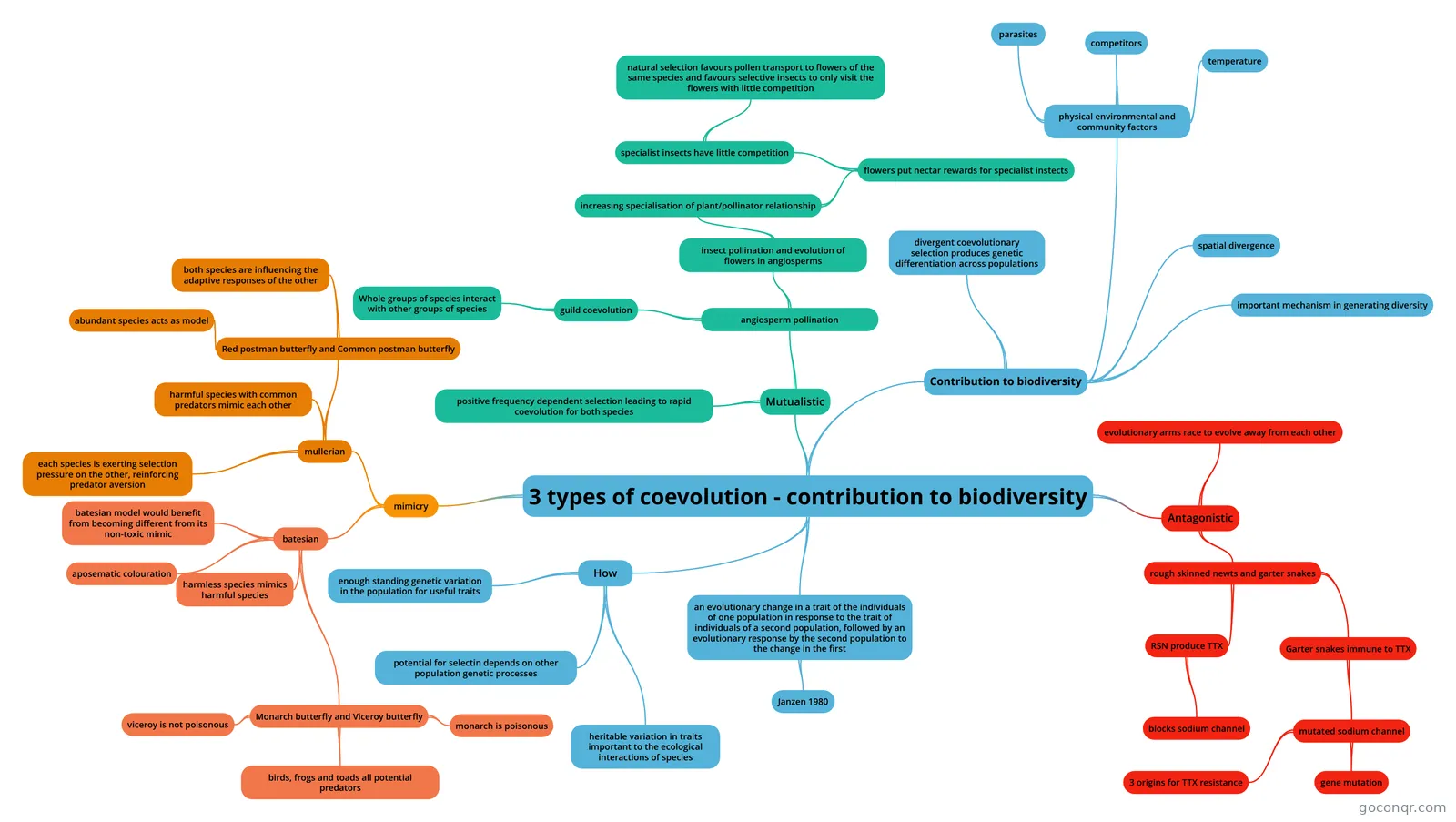
Mind map: 3 types of coevolution and biodiversity
Map content
3 types of coevolution - contribution to biodiversity
an evolutionary change in a trait of the individuals of one population in response to the trait of individuals of a second population, followed by an evolutionary response by the second population to the change in the first
- Janzen 1980
Antagonistic
- evolutionary arms race to evolve away from each other
- rough skinned newts and garter snakes
- RSN produce TTX
- blocks sodium channel
- Garter snakes immune to TTX
- mutated sodium channel
- gene mutation
- 3 origins for TTX resistance
- mutated sodium channel
- RSN produce TTX
Mutualistic
- positive frequency dependent selection leading to rapid coevolution for both species
- angiosperm pollination
- guild coevolution
- Whole groups of species interact with other groups of species
- insect pollination and evolution of flowers in angiosperms
- increasing specialisation of plant/pollinator relationship
- flowers put nectar rewards for specialist instects
- specialist insects have little competition
- natural selection favours pollen transport to flowers of the same species and favours selective insects to only visit the flowers with little competition
- specialist insects have little competition
- flowers put nectar rewards for specialist instects
- increasing specialisation of plant/pollinator relationship
- guild coevolution
mimicry
- batesian
- harmless species mimics harmful species
- batesian model would benefit from becoming different from its non-toxic mimic
- Monarch butterfly and Viceroy butterfly
- viceroy is not poisonous
- monarch is poisonous
- birds, frogs and toads all potential predators
- aposematic colouration
- mullerian
- harmful species with common predators mimic each other
- each species is exerting selection pressure on the other, reinforcing predator aversion
- Red postman butterfly and Common postman butterfly
- abundant species acts as model
- both species are influencing the adaptive responses of the other
- batesian
How
- heritable variation in traits important to the ecological interactions of species
- enough standing genetic variation in the population for useful traits
- potential for selectin depends on other population genetic processes
Contribution to biodiversity
- divergent coevolutionary selection produces genetic differentiation across populations
- physical environmental and community factors
- temperature
- competitors
- parasites
- important mechanism in generating diversity
- spatial divergence
Information
- Description
- undergraduate Zoology (evolution) Mind Map on 3 types of coevolution - contribution to biodiversity, created by Choon Fuller on 16/05/2017.
- Created by
- Choon Fuller
- Views
- 0
- Rating