
Mapa mental
AGGRESSION
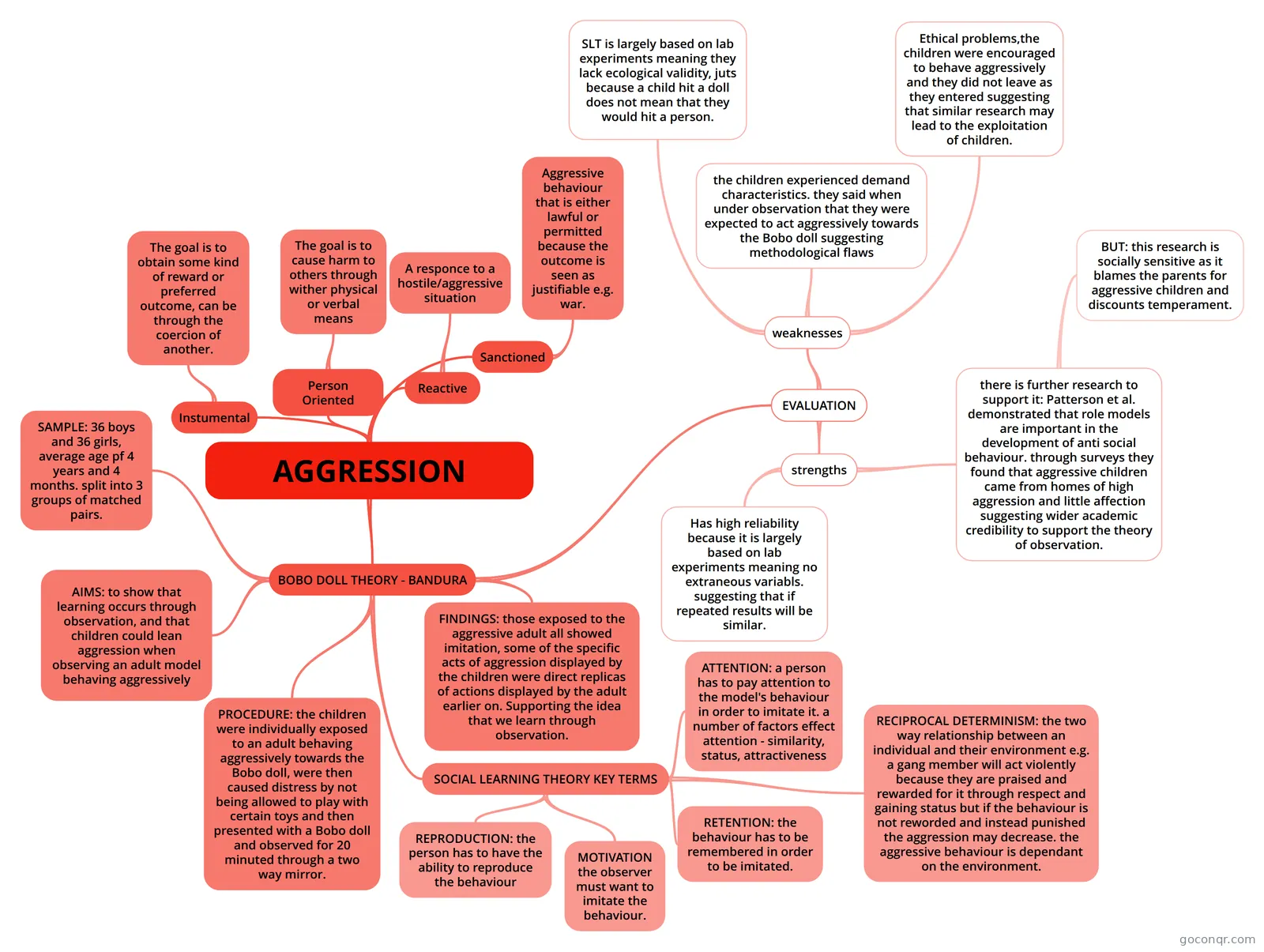
Mind map: aggression psychology
Conteúdo do mapa
AGGRESSION
Person Oriented
- The goal is to cause harm to others through wither physical or verbal means
Instumental
- The goal is to obtain some kind of reward or preferred outcome, can be through the coercion of another.
Reactive
- A responce to a hostile/aggressive situation
Sanctioned
- Aggressive behaviour that is either lawful or permitted because the outcome is seen as justifiable e.g. war.
BOBO DOLL THEORY - BANDURA
- AIMS: to show that learning occurs through observation, and that children could lean aggression when observing an adult model behaving aggressively
- PROCEDURE: the children were individually exposed to an adult behaving aggressively towards the Bobo doll, were then caused distress by not being allowed to play with certain toys and then presented with a Bobo doll and observed for 20 minuted through a two way mirror.
- SAMPLE: 36 boys and 36 girls, average age pf 4 years and 4 months. split into 3 groups of matched pairs.
- FINDINGS: those exposed to the aggressive adult all showed imitation, some of the specific acts of aggression displayed by the children were direct replicas of actions displayed by the adult earlier on. Supporting the idea that we learn through observation.
- EVALUATION
- weaknesses
- SLT is largely based on lab experiments meaning they lack ecological validity, juts because a child hit a doll does not mean that they would hit a person.
- the children experienced demand characteristics. they said when under observation that they were expected to act aggressively towards the Bobo doll suggesting methodological flaws
- Ethical problems,the children were encouraged to behave aggressively and they did not leave as they entered suggesting that similar research may lead to the exploitation of children.
- strengths
- there is further research to support it: Patterson et al. demonstrated that role models are important in the development of anti social behaviour. through surveys they found that aggressive children came from homes of high aggression and little affection suggesting wider academic credibility to support the theory of observation.
- BUT: this research is socially sensitive as it blames the parents for aggressive children and discounts temperament.
- Has high reliability because it is largely based on lab experiments meaning no extraneous variabls. suggesting that if repeated results will be similar.
- there is further research to support it: Patterson et al. demonstrated that role models are important in the development of anti social behaviour. through surveys they found that aggressive children came from homes of high aggression and little affection suggesting wider academic credibility to support the theory of observation.
- weaknesses
- SOCIAL LEARNING THEORY KEY TERMS
- ATTENTION: a person has to pay attention to the model's behaviour in order to imitate it. a number of factors effect attention - similarity, status, attractiveness
- RETENTION: the behaviour has to be remembered in order to be imitated.
- REPRODUCTION: the person has to have the ability to reproduce the behaviour
- MOTIVATION the observer must want to imitate the behaviour.
- RECIPROCAL DETERMINISM: the two way relationship between an individual and their environment e.g. a gang member will act violently because they are praised and rewarded for it through respect and gaining status but if the behaviour is not reworded and instead punished the aggression may decrease. the aggressive behaviour is dependant on the environment.
Informações
- Descrição
- bobo doll, slt, basic aggression facts and eval.
- Criado por
- madeleinejacobs
- Visualizações
- 11
- Avaliação