
Flashcards
C1 AQA (9-1) GCSE Revision
Cards in this deck (45)
- 1What is an element?A substance that cannot be broken down chemically
- 2How many elements are there?115 (Textbook says around 100)
- 3What is an exothermic and an endothermic reaction?Exothermic = A reaction that gives off heat
Endothermic = A reaction that takes in heat - 4What does "ide" represent when at the end of a compound name? e.g Sodium ChlorIDEThe two elements (sodium and chlorine) are joined together with no other elements involved
- 5What does "ate" represent when at the end of a compound name? e.g Potassium NitrateThe compound has the two elements (potassium and nitrogen) joined together along with the third element of oxygen
- 6What happens when two or more atoms join?They form a molecule
- 7Balance the following equation Mg + O2 = MgO2Mg + O2 = 2MgO2
(Add a two in front of the magnesium and product) - 8Why do we balance equations?To guarantee that it follows the law of conservation of mass
- 9What are mixtures?Solutions containing two or more chemicals not chemically joined
- 10What methods can we use to separate mixtures?Filtration, Crystallization, Simple distillation, fractional distillation and chromotography
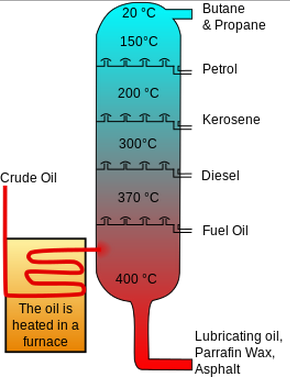
- 11What is fraction distillation used to separate?More than two liquids with different boiling points.
- 12How does fractional distillation work?The mixture is heated and then the various different components evaporate and then condense again on tubes that become gradually cooler the further up you go
- 13Fractional distillation diagram
- 14What did the Greek philosopher theorize in 400BCHe described materials being made of small particles called atoms which could not be divided
- 15What did John Dalton suggest?He said that atoms were spherical shapes, like billiard balls, that could not be divided
- 16What did J.J Thompson discover?He discovered the existence of electrons and proposed that negative electrons were embedded in a positively charged pudding shaped atom
- 17What did Ernest Rutherford's team discover?Through the gold leaf experiments, where they sent a beam of alpha particles through a gold leaf, they discovered that the atom had a positively charged nucleus and they created the nuclear model
- 18What did Niels Bohr discover?Niels Bohr create the Bohr model (GCSE one) and stated that electrons were placed on energy levels at set distances
- 19What did James Chadwick discover?He discovered the existence of neutrons in the nucleus
- 20What are the relative atomic masses of protons, neutrons and electrons?Proton = 1
Neutron = 1
1
Electron = ------ (0)
1836 - 21What is the normal radius of atoms and how does this get bigger?The normal radius is 1nm
It gets larger the further down the table you go (the more shells you get) - 22Which number is always bigger in an element, the relative mass or the atomic number?Relative mass
- 23How do you calculate the number of protons OR electronsUse the atomic number
- 24How do you calculate the number of neutrons?Subtract the atomic number from the atomic mass
- 25What are the charges of protons and electrons?Proton = +1
Electron = -1 - 26What is are isotopes?Atoms with different numbers of neutrons
- 27What is the formula for relative abundance?Ar = (mass of first isotope x % of isotope) x (mass of second isotope x % of isotope)
All are divided by 100 - 28What do column numbers in the periodic table represent?Number of valence (outer shell) electrons
- 29What do the row numbers represent in the periodic table?Number of shells
- 30How many electrons can each shell hold (in order)2, 8 , 8 , 2
- 31What forms when you react group 1 and 7?A salt
- 32What is the proper word for group 8 being non-reactive?Inert
- 33What did Mendeleev do that previous table developers had not done?He arranged based on properties and he left gaps based on predictions for future elements
- 34What are the main properties of metals?Lustrous, hard, high density, high strength, high melting/boiling point, good heat conductors, good electrical conductors
- 35What are the main properties of non-metals?Dull, Soft/brittle, low density, low melting point/boiling point, poor-no thermal conduction, poor-no conductors of electricity
- 36What happens when you react a metal and non-metal?The metal will lose electrons (becoming a positive ion) and the non-metal will gain electrons (becoming a negative ion)
- 37What are outer electrons called?Valence Electrons
- 38What makes an atom stable?A full outer shell
- 39What happens if an atom has an unstable number of electrons (3/4/5)?It will share electrons with another element
(any more than this and it gains electrons and any less and it loses) - 40How do boiling points change as you go down group 8?They decrease
- 41What is the key property of any group 1 element?It is highly reactive with water
- 42What gas do group 1 metals give off when they react with water?Hydrogen
- 43What is an ion?An atom with and positive or negative charge (it has lost/gained electrons)
- 44What happens to reactivity as you go down group 7?It decreases
- 45—
Information
- Description
- GCSE Chemistry GCSE (Paper 1) Flashcards on C1 AQA (9-1) GCSE Revision, created by Oliver Faragher on 24/04/2018.
- Created by
- Oliver Faragher
- Views
- 148
- Tags
- Rating