
Mind map
Language & Gender Theorists
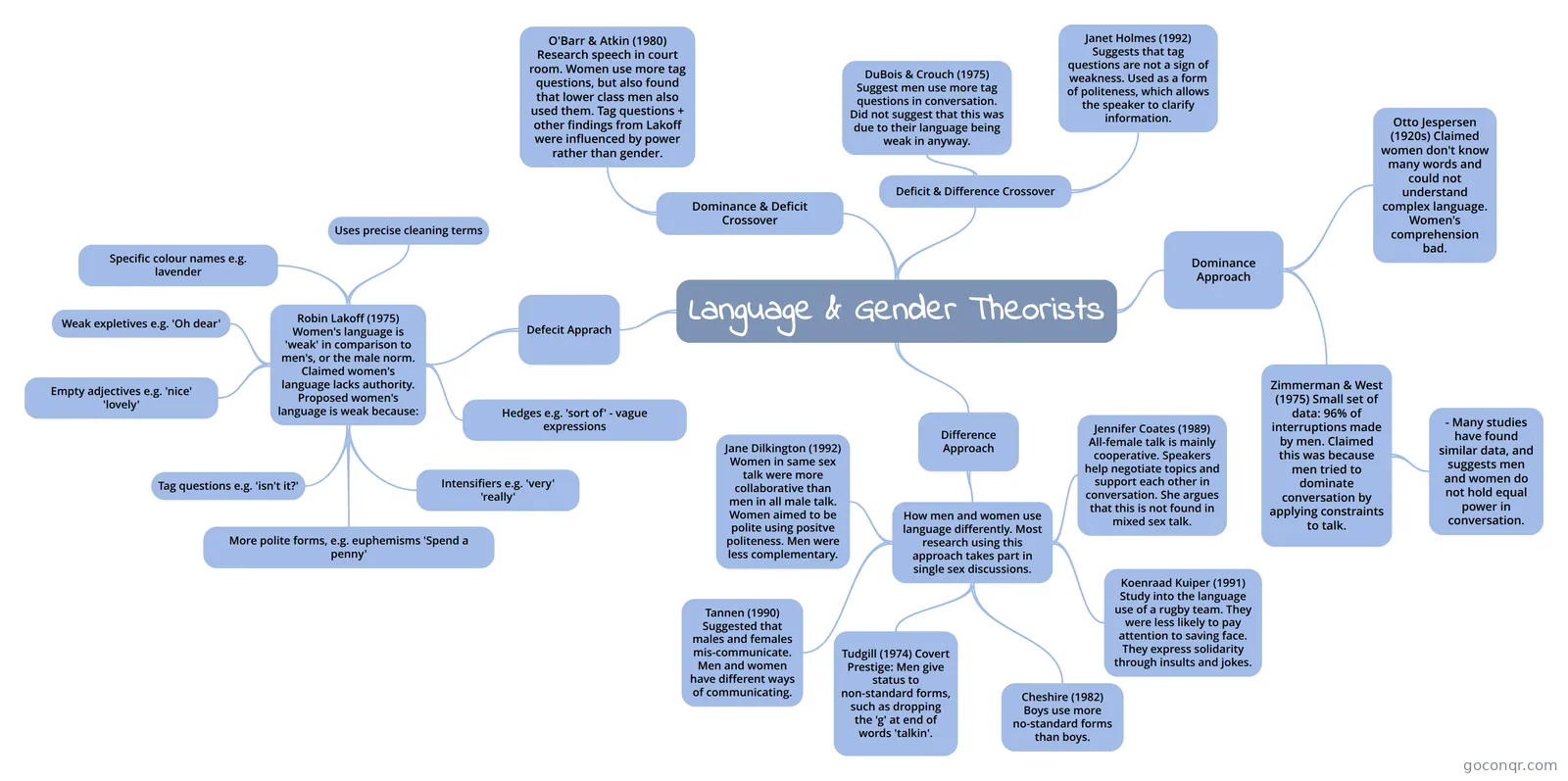
Mind map: Language & gender theorists
Map content
Language & Gender Theorists
Dominance Approach
- Otto Jespersen (1920s) Claimed women don't know many words and could not understand complex language. Women's comprehension bad.
- Zimmerman & West (1975) Small set of data: 96% of interruptions made by men. Claimed this was because men tried to dominate conversation by applying constraints to talk.
- - Many studies have found similar data, and suggests men and women do not hold equal power in conversation.
Defecit Apprach
- Robin Lakoff (1975) Women's language is 'weak' in comparison to men's, or the male norm. Claimed women's language lacks authority. Proposed women's language is weak because:
- Intensifiers e.g. 'very' 'really'
- Tag questions e.g. 'isn't it?'
- Weak expletives e.g. 'Oh dear'
- Specific colour names e.g. lavender
- Empty adjectives e.g. 'nice' 'lovely'
- Uses precise cleaning terms
- Hedges e.g. 'sort of' - vague expressions
- More polite forms, e.g. euphemisms 'Spend a penny'
- Robin Lakoff (1975) Women's language is 'weak' in comparison to men's, or the male norm. Claimed women's language lacks authority. Proposed women's language is weak because:
Difference Approach
- How men and women use language differently. Most research using this approach takes part in single sex discussions.
- Jennifer Coates (1989) All-female talk is mainly cooperative. Speakers help negotiate topics and support each other in conversation. She argues that this is not found in mixed sex talk.
- Jane Dilkington (1992) Women in same sex talk were more collaborative than men in all male talk. Women aimed to be polite using positve politeness. Men were less complementary.
- Koenraad Kuiper (1991) Study into the language use of a rugby team. They were less likely to pay attention to saving face. They express solidarity through insults and jokes.
- Tannen (1990) Suggested that males and females mis-communicate. Men and women have different ways of communicating.
- Tudgill (1974) Covert Prestige: Men give status to non-standard forms, such as dropping the 'g' at end of words 'talkin'.
- Cheshire (1982) Boys use more no-standard forms than boys.
- How men and women use language differently. Most research using this approach takes part in single sex discussions.
Dominance & Deficit Crossover
- O'Barr & Atkin (1980) Research speech in court room. Women use more tag questions, but also found that lower class men also used them. Tag questions + other findings from Lakoff were influenced by power rather than gender.
Deficit & Difference Crossover
- Janet Holmes (1992) Suggests that tag questions are not a sign of weakness. Used as a form of politeness, which allows the speaker to clarify information.
- DuBois & Crouch (1975) Suggest men use more tag questions in conversation. Did not suggest that this was due to their language being weak in anyway.
Information
- Description
- A level English Language (Language & Gender) Mind Map on Language & Gender Theorists, created by chardurtnall on 13/03/2015.
- Created by
- chardurtnall
- Views
- 28
- Rating
More on Language and Gender Theories and Theorists