
Mind map
Attachment
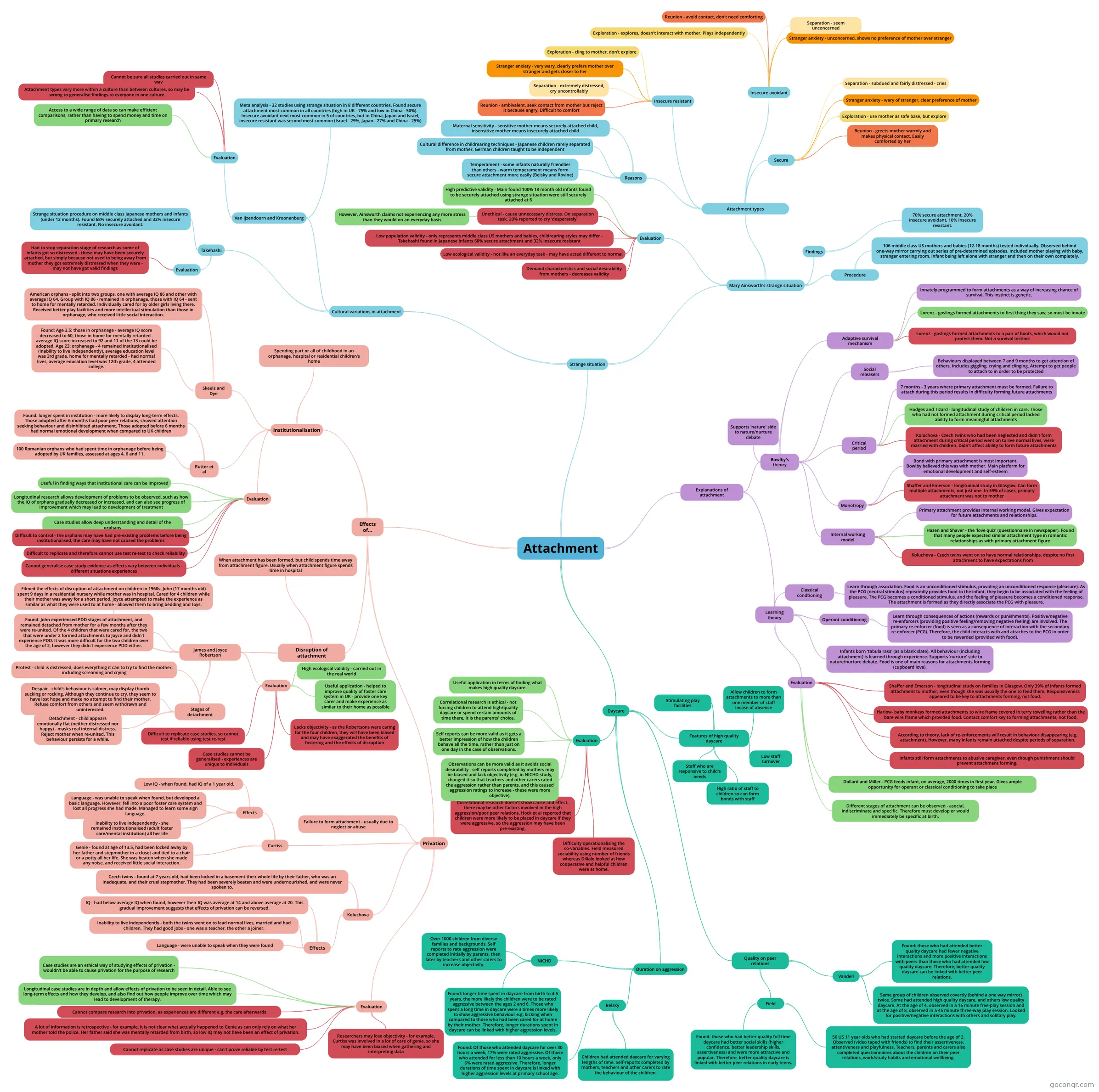
Mind map: Attachment psychology
Map content
Attachment
Explanations of attachment
- Bowlby's theory
- Adaptive survival mechanism
- Innately programmed to form attachments as a way of increasing chance of survival. This instinct is genetic.
- Lorenz - goslings formed attachments to first thing they saw, so must be innate
- Lorenz - goslings formed attachments to a pair of boots, which would not protect them. Not a survival instinct
- Social releasers
- Behaviours displayed between 7 and 9 months to get attention of others. Includes giggling, crying and clinging. Attempt to get people to attach to in order to be protected
- Critical period
- 7 months - 3 years where primary attachment must be formed. Failure to attach during this period results in difficulty forming future attachments
- Hodges and Tizard - longitudinal study of children in care. Those who had not formed attachment during critical period lacked ability to form meaningful attachments
- Koluchova - Czech twins who had been neglected and didn't form attachment during critical period went on to live normal lives, were married with children. Didn't affect ability to form future attachments
- Monotropy
- Bond with primary attachment is most important. Bowlby believed this was with mother. Main platform for emotional development and self-esteem
- Shaffer and Emerson - longitudinal study in Glasgow. Can form multiple attachments, not just one. In 39% of cases, primary attachment was not to mother
- Internal working model
- Primary attachment provides internal working model. Gives expectation for future attachments and relationships.
- Hazen and Shaver - the 'love quiz' (questionnaire in newspaper). Found that many people expected similar attachment type in romantic relationships as with primary attachment figure
- Koluchova - Czech twins went on to have normal relationships, despite no first attachment to have expectations from
- Supports 'nature' side to nature/nurture debate
- Adaptive survival mechanism
- Learning theory
- Infants born 'tabula rasa' (as a blank slate). All behaviour (including attachment) is learned through experience. Supports 'nurture' side to nature/nurture debate. Food is one of main reasons for attachments forming (cupboard love).
- Operant conditioning
- Learn through consequences of actions (rewards or punishments). Positive/negative re-enforcers (providing positive feeling/removing negative feeling) are involved. The primary re-enforcer (food) is seen as a consequence of interaction with the secondary re-enforcer (PCG). Therefore, the child interacts with and attaches to the PCG in order to be rewarded (provided with food).
- Classical condtioning
- Learn through association. Food is an unconditioned stimulus, providing an unconditioned response (pleasure). As the PCG (neutral stimulus) repeatedly provides food to the infant, they begin to be associated with the feeling of pleasure. The PCG becomes a conditioned stimulus, and the feeling of pleasure becomes a conditioned response. The attachment is formed as they directly associate the PCG with pleasure.
- Evaluation
- Dollard and Miller - PCG feeds infant, on average, 2000 times in first year. Gives ample opportunity for operant or classical conditioning to take place
- Different stages of attachment can be observed - asocial, indiscriminate and specific. Therefore must develop or would immediately be specific at birth.
- Harlow- baby monkeys formed attachments to wire frame covered in terry towelling rather than the bare wire frame which provided food. Contact comfort key to forming attachments, not food.
- Shaffer and Emerson - longitudinal study on families in Glasgow. Only 39% of infants formed attachment to mother, even though she was usually the one to feed them. Responsiveness appeared to be key to attachments forming, not food.
- According to theory, lack of re-enforcements will result in behaviour disappearing (e.g. attachment). However, many infants remain attached despite periods of separation.
- Infants still form attachments to abusive caregiver, even though punishment should prevent attachment forming.
- Bowlby's theory
Daycare
- Duration on aggression
- NICHD
- Over 1000 children from diverse families and backgrounds. Self reports to rate aggression were completed initially by parents, then later by teachers and other carers to increase objectivity.
- Found: longer time spent in daycare from birth to 4.5 years, the more likely the children were to be rated aggressive between the ages 2 and 6. Those who spent a long time in daycare were 3 times more likely to show aggressive behaviour e.g. kicking when compared to those who had been cared for at home by their mother. Therefore, longer durations spent in daycare can be linked with higher aggression levels.
- Belsky
- Children had attended daycare for varying lengths of time. Self-reports completed by mothers, teachers and other carers to rate the behaviour of the children.
- Found: Of those who attended daycare for over 30 hours a week, 17% were rated aggressive. Of those who attended for less than 10 hours a week, only 6% were rated aggressive. Therefore, longer durations of time spent in daycare is linked with higher aggression levels at primary school age.
- NICHD
- Quality on peer relations
- Field
- 56 US 11 year olds who had started daycare before the age of 2. Observed (video taped with friends) to find their assertiveness, attentiveness and playfulness. Teachers, parents and carers also completed questionnaires about the children on their peer relations, work/study habits and emotional wellbeing.
- Found: those who had better quality full time daycare had better social skills (higher confidence, better leadership skills, assertiveness) and were more attractive and popular. Therefore, better quality daycare is linked with better peer relations in early teens.
- Vandell
- Same group of children observed covertly (behind a one way mirror) twice. Some had attended high quality daycare, and others low quality daycare. At the age of 4, observed in a 16 minute free-play session and at the age of 8, observed in a 45 minute three-way play session. Looked for positive/negative interactions with others and solitary play.
- Found: those who had attended better quality daycare had fewer negative interactions and more positive interactions with peers than those who had attended low quality daycare. Therefore, better quality daycare can be linked with better peer relations.
- Field
- Evaluation
- Correlational research is ethical - not forcing children to attend high/quality daycare or spend certain amounts of time there, it is the parents' choice.
- Correlational research doesn't show cause and effect. there may be other factors involved in the high aggression/poor peer relations. Hock et al reported that children were more likely to be placed in daycare if they were aggressive, so the aggression may have been pre-existing.
- Useful application in terms of finding what makes high quality daycare.
- Self reports can be more valid as it gets a better impression of how the children behave all the time, rather than just on one day in the case of observations.
- Observations can be more valid as it avoids social desirability - self reports completed by mothers may be biased and lack objectivity (e.g. in NICHD study, changed it so that teachers and other carers rated the aggression rather than parents, and this caused aggression ratings to increase - these were more objective).
- Difficulty operationalising the co-variables. Field measured sociability using number of friends whereas Dillalo looked at how cooperative and helpful children were at home.
- Features of high quality daycare
- Low staff turnover
- Stimulating play facilities
- High ratio of staff to children so can form bonds with staff
- Allow children to form attachments to more than one member of staff incase of absence
- Staff who are responsive to child's needs
- Duration on aggression
Strange situation
- Mary Ainsworth's strange situation
- Procedure
- 106 middle class US mothers and babies (12-18 months) tested individually. Observed behind one-way mirror carrying out series of pre-determined episodes. Included mother playing with baby, stranger entering room, infant being left alone with stranger and then on their own completely.
- Findings
- 70% secure attachment, 20% insecure avoidant, 10% insecure resistant.
- Attachment types
- Secure
- Exploration - use mother as safe base, but explore
- Stranger anxiety - wary of stranger, clear preference of mother
- Separation - subdued and fairly distressed - cries
- Reunion - greets mother warmly and makes physical contact. Easily comforted by her
- Insecure avoidant
- Exploration - explores, doesn't interact with mother. Plays independently
- Stranger anxiety - unconcerned, shows no preference of mother over stranger
- Separation - seem unconcerned
- Reunion - avoid contact, don't need comforting
- Insecure resistant
- Exploration - cling to mother, don't explore
- Stranger anxiety - very wary, clearly prefers mother over stranger and gets closer to her
- Separation - extremely distressed, cry uncontrollably
- Reunion - ambivalent, seek contact from mother but reject it because angry. Difficult to comfort
- Reasons
- Maternal sensitivity - sensitive mother means securely attached child, insensitive mother means insecurely attached child
- Cultural difference in childrearing techniques - Japanese children rarely separated from mother, German children taught to be independent
- Temperament - some infants naturally friendlier than others - warm temperament means form secure attachment more easily (Belsky and Rovine)
- Secure
- Evaluation
- Unethical - cause unnecessary distress. On separation task, 20% reported to cry 'desperately'
- However, Ainsworth claims not experiencing any more stress than they would on an everyday basis
- High predictive validity - Main found 100% 18 month old infants found to be securely attached using strange situation were still securely attached at 6
- Demand characteristics and social desirability from mothers - decreases validity
- Low population validity - only represents middle class US mothers and babies, childrearing styles may differ - Takehashi found in Japanese infants 68% secure attachment and 32% insecure resistant
- Low ecological validity - not like an everyday task - may have acted different to normal
- Unethical - cause unnecessary distress. On separation task, 20% reported to cry 'desperately'
- Procedure
- Cultural variations in attachment
- Van Ijzendoorn and Kroonenburg
- Meta analysis - 32 studies using strange situation in 8 different countries. Found secure attachment most common in all countries (high in UK - 75% and low in China - 50%). Insecure avoidant next most common in 5 of countries, but in China, Japan and Israel, insecure resistant was second most common (Israel - 29%, Japan - 27% and China - 25%)
- Evaluation
- Cannot be sure all studies carried out in same way
- Access to a wide range of data so can make efficient comparisons, rather than having to spend money and time on primary research
- Attachment types vary more within a culture than between cultures, so may be wrong to generalise findings to everyone in one culture
- Takehashi
- Strange situation procedure on middle class Japanese mothers and infants (under 12 months). Found 68% securely attached and 32% insecure resistant. No insecure avoidant.
- Evaluation
- Had to stop separation stage of research as some of infants got so distressed - these may have been securely attached, but simply because not used to being away from mother they got extremely distressed when they were - may not have got valid findings
- Van Ijzendoorn and Kroonenburg
- Mary Ainsworth's strange situation
Effects of...
- Privation
- Curtiss
- Genie - found at age of 13.5, had been locked away by her father and stepmother in a closet and tied to a chair or a potty all her life. She was beaten when she made any noise, and received little social interaction.
- Effects
- Low IQ - when found, had IQ of a 1 year old.
- Language - was unable to speak when found, but developed a basic language. However, fell into a poor foster care system and lost all progress she had made. Managed to learn some sign language.
- Inability to live independently - she remained institutionalised (adult foster care/mental institution) all her life
- Failure to form attachment - usually due to neglect or abuse
- Koluchova
- Czech twins - found at 7 years old, had been locked in a basement their whole life by their father, who was an inadequate, and their cruel stepmother. They had been severely beaten and were undernourished, and were never spoken to.
- Effects
- Language - were unable to speak when they were found
- IQ - had below average IQ when found, however their IQ was average at 14 and above average at 20. This gradual improvement suggests that effects of privation can be reversed.
- Inability to live independently - both the twins went on to lead normal lives, married and had children. They had good jobs - one was a teacher, the other a joiner.
- Evaluation
- Case studies are an ethical way of studying effects of privation - wouldn't be able to cause privation for the purpose of research
- A lot of information is retrospective - for example, it is not clear what actually happened to Genie as can only rely on what her mother told the police. Her father said she was mentally retarded from birth, so low IQ may not have been an effect of privation.
- Researchers may lose objectivity - for example, Curtiss was involved in a lot of care of genie, so she may have been biased when gathering and interpreting data
- Cannot compare research into privation, as experiences are different e.g. the care afterwards
- Cannot replicate as case studies are unique - can't prove reliable by test re-test
- Longitudinal case studies are in depth and allow effects of privation to be seen in detail. Able to see long-term effects and how they develop, and also find out how people improve over time which may lead to development of therapy.
- Curtiss
- Disruption of attachment
- When attachment has been formed, but child spends time away from attachment figure. Usually when attachment figure spends time in hospital
- James and Joyce Robertson
- Filmed the effects of disruption of attachment on children in 1960s. John (17 months old) spent 9 days in a residential nursery while mother was in hospital. Cared for 4 children while their mother was away for a short period. Joyce attempted to make the experience as similar as what they were used to at home - allowed them to bring bedding and toys.
- Stages of detachment
- Protest - child is distressed, does everything it can to try to find the mother, including screaming and crying
- Despair - child's behaviour is calmer, may display thumb sucking or rocking. Although they continue to cry, they seem to have lost hope and make no attempt to find their mother. Refuse comfort from others and seem withdrawn and uninterested.
- Detachment - child appears emotionally flat (neither distressed nor happy) - masks real internal distress. Reject mother when re-united. This behaviour persists for a while.
- Found: John experienced PDD stages of attachment, and remained detached from mother for a few months after they were re-united. Of the 4 children that were cared for, the two that were under 2 formed attachments to Joyce and didn't experience PDD. It was more difficult for the two children over the age of 2, however they didn't experience PDD either.
- Evaluation
- Case studies cannot be generalised - experiences are unique to individuals
- Difficult to replicate case studies, so cannot test if reliable using test re-rest
- Useful application - helped to improve quality of foster care system in UK - provide one key carer and make experience as similar to their home as possible
- Lacks objectivity - as the Robertsons were caring for the four children, they will have been biased and may have exaggerated the benefits of fostering and the effects of disruption
- High ecological validity - carried out in the real world
- Institutionalisation
- Spending part or all of childhood in an orphanage, hospital or residential children's home
- Skeels and Dye
- American orphans - split into two groups, one with average IQ 86 and other with average IQ 64. Group with IQ 86 - remained in orphanage, those with IQ 64 - sent to home for mentally retarded. Individually cared for by older girls living there. Received better play facilities and more intellectual stimulation than those in orphanage, who received little social interaction.
- Found: Age 3.5: those in orphanage - average IQ score decreased to 60, those in home for mentally retarded - average IQ score increased to 92 and 11 of the 13 could be adopted. Age 23: orphanage - 4 remained institutionalised (inability to live independently), average education level was 3rd grade, home for mentally retarded - had normal lives, average education level was 12th grade, 4 attended college.
- Rutter et al
- 100 Romanian orphans who had spent time in orphanage before being adopted by UK families, assessed at ages 4, 6 and 11.
- Found: longer spent in institution - more likely to display long-term effects. Those adopted after 6 months had poor peer relations, showed attention seeking behaviour and disinhibited attachment. Those adopted before 6 months had normal emotional development when compared to UK children
- Evaluation
- Useful in finding ways that institutional care can be improved
- Longitudinal research allows development of problems to be observed, such as how the IQ of orphans gradually decreased or increased, and can also see progress of improvement which may lead to development of treatment
- Case studies allow deep understanding and detail of the orphans
- Difficult to control - the orphans may have had pre-existing problems before being institutionalised, the care may have not caused the problems
- Difficult to replicate and therefore cannot use test re-test to check reliability
- Cannot generalise case study evidence as effects vary between individuals - different situations experiences
- Privation
Information
- Description
- Mind Map on Attachment, created by emilyh_ on 08/04/2015.
- Created by
- emilyh_
- Views
- 0
- Rating