
Mind map
Chapter 6
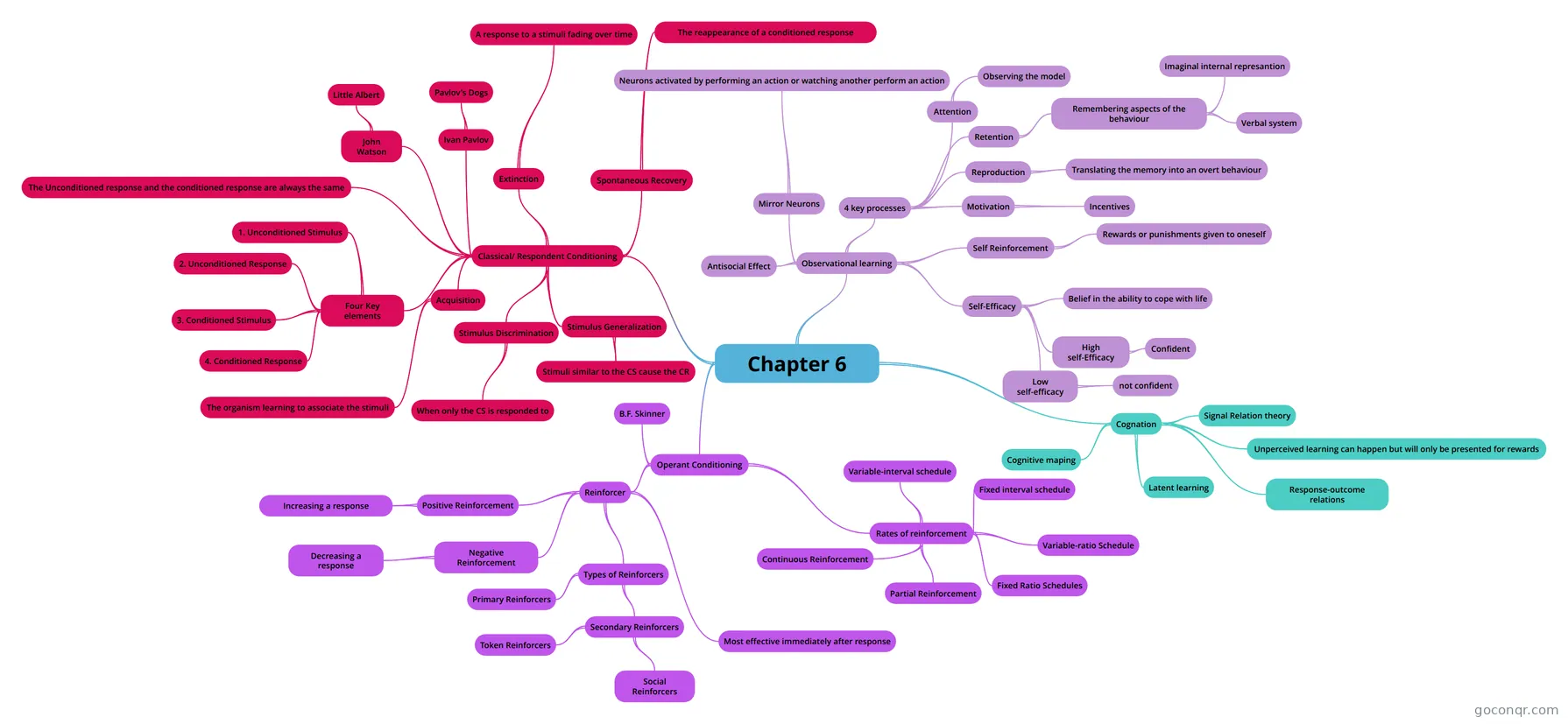
Mind map: Classical and operant conditioning
Map content
Chapter 6
Classical/ Respondent Conditioning
- Ivan Pavlov
- Pavlov's Dogs
- John Watson
- Little Albert
- Four Key elements
- 1. Unconditioned Stimulus
- 2. Unconditioned Response
- 3. Conditioned Stimulus
- 4. Conditioned Response
- Acquisition
- The organism learning to associate the stimuli
- Extinction
- A response to a stimuli fading over time
- The Unconditioned response and the conditioned response are always the same
- Spontaneous Recovery
- The reappearance of a conditioned response
- Stimulus Discrimination
- When only the CS is responded to
- Stimulus Generalization
- Stimuli similar to the CS cause the CR
- Ivan Pavlov
Operant Conditioning
- B.F. Skinner
- Reinforcer
- Positive Reinforcement
- Increasing a response
- Negative Reinforcement
- Decreasing a response
- Types of Reinforcers
- Primary Reinforcers
- Secondary Reinforcers
- Token Reinforcers
- Social Reinforcers
- Most effective immediately after response
- Positive Reinforcement
- Rates of reinforcement
- Continuous Reinforcement
- Partial Reinforcement
- Fixed Ratio Schedules
- Variable-ratio Schedule
- Fixed interval schedule
- Variable-interval schedule
Cognation
- Cognitive maping
- Latent learning
- Unperceived learning can happen but will only be presented for rewards
- Signal Relation theory
- Response-outcome relations
Observational learning
- 4 key processes
- Attention
- Observing the model
- Retention
- Remembering aspects of the behaviour
- Imaginal internal represantion
- Verbal system
- Remembering aspects of the behaviour
- Reproduction
- Translating the memory into an overt behaviour
- Motivation
- Incentives
- Attention
- Self Reinforcement
- Rewards or punishments given to oneself
- Self-Efficacy
- Belief in the ability to cope with life
- High self-Efficacy
- Confident
- Low self-efficacy
- not confident
- Mirror Neurons
- Neurons activated by performing an action or watching another perform an action
- Antisocial Effect
- 4 key processes
Information
- Description
- My concept map for chapter 6
- Created by
- Kathryn Boyde
- Views
- 29
- Tags
- Rating
More on Classical and operant conditioning