
Mind map
Narrative Theory
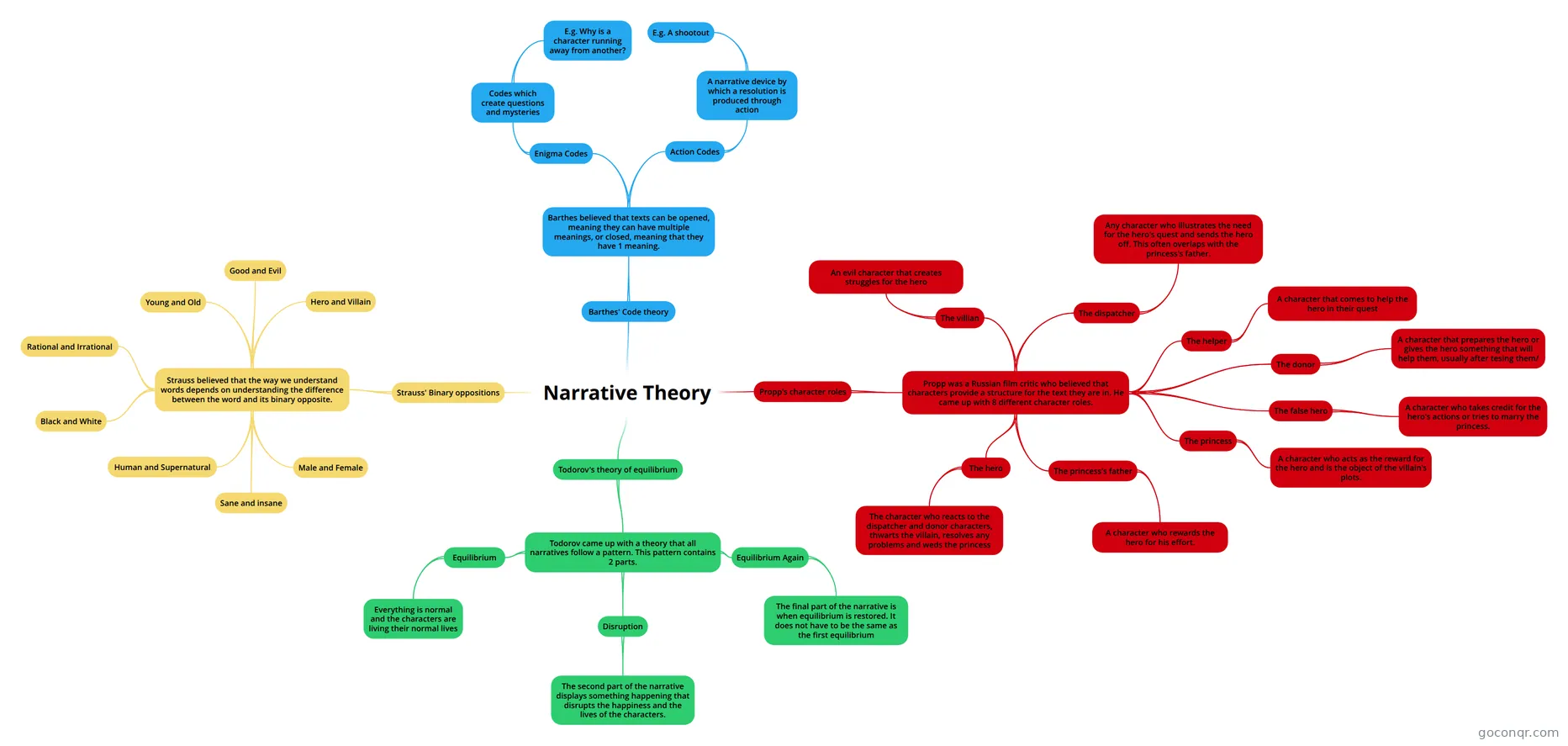
Mind map: Narrative theory
Map content
Narrative Theory
Todorov's theory of equilibrium
- Todorov came up with a theory that all narratives follow a pattern. This pattern contains 2 parts.
- Equilibrium
- Everything is normal and the characters are living their normal lives
- Disruption
- The second part of the narrative displays something happening that disrupts the happiness and the lives of the characters.
- Equilibrium Again
- The final part of the narrative is when equilibrium is restored. It does not have to be the same as the first equilibrium
- Equilibrium
- Todorov came up with a theory that all narratives follow a pattern. This pattern contains 2 parts.
Barthes' Code theory
- Barthes believed that texts can be opened, meaning they can have multiple meanings, or closed, meaning that they have 1 meaning.
- Enigma Codes
- Codes which create questions and mysteries
- E.g. Why is a character running away from another?
- Codes which create questions and mysteries
- Action Codes
- A narrative device by which a resolution is produced through action
- E.g. A shootout
- A narrative device by which a resolution is produced through action
- Enigma Codes
- Barthes believed that texts can be opened, meaning they can have multiple meanings, or closed, meaning that they have 1 meaning.
Propp's character roles
- Propp was a Russian film critic who believed that characters provide a structure for the text they are in. He came up with 8 different character roles.
- The villian
- An evil character that creates struggles for the hero
- The dispatcher
- Any character who illustrates the need for the hero's quest and sends the hero off. This often overlaps with the princess's father.
- The helper
- A character that comes to help the hero in their quest
- The princess
- A character who acts as the reward for the hero and is the object of the villain's plots.
- The princess's father
- A character who rewards the hero for his effort.
- The hero
- The character who reacts to the dispatcher and donor characters, thwarts the villain, resolves any problems and weds the princess
- The donor
- A character that prepares the hero or gives the hero something that will help them, usually after tesing them/
- The false hero
- A character who takes credit for the hero's actions or tries to marry the princess.
- The villian
- Propp was a Russian film critic who believed that characters provide a structure for the text they are in. He came up with 8 different character roles.
Strauss' Binary oppositions
- Strauss believed that the way we understand words depends on understanding the difference between the word and its binary opposite.
- Hero and Villain
- Good and Evil
- Young and Old
- Male and Female
- Sane and insane
- Human and Supernatural
- Black and White
- Rational and Irrational
- Strauss believed that the way we understand words depends on understanding the difference between the word and its binary opposite.
Information
- Description
- AS - Level Media Studies Mind Map on Narrative Theory, created by Liam Duggan on 01/03/2017.
- Created by
- Liam Duggan
- Views
- 3
- Rating