
Mind map
METHOD
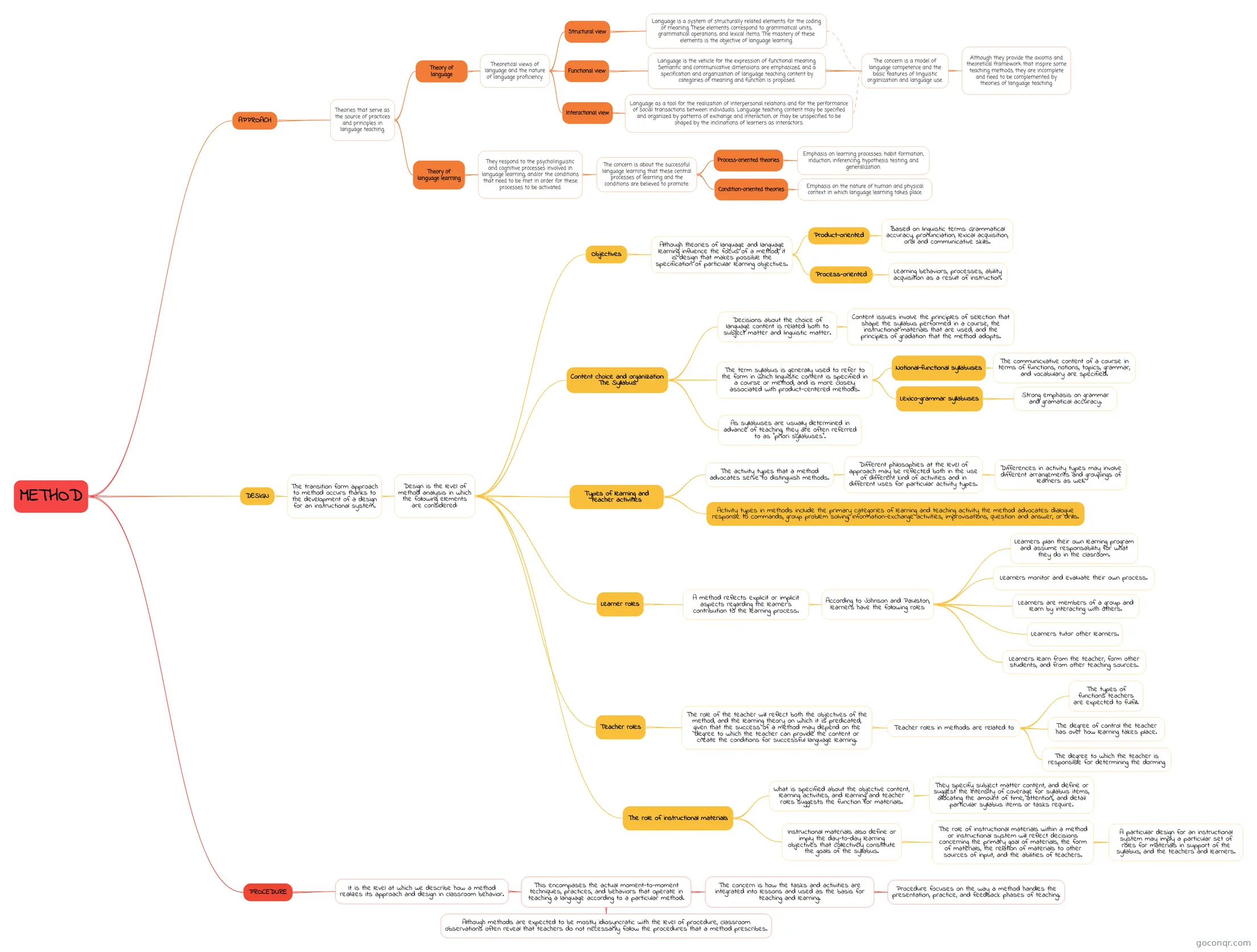
Mind map: Method in language teaching
Map content
METHOD
APPROACH
- Theories that serve as the source of practices and principles in language teaching.
- Theory of language
- Theoretical views of language and the nature of language proficiency.
- Structural view
- Language is a system of structurally related elements for the coding of meaning. These elements correspond to grammatical units, grammatical operations, and lexical items. The mastery of these elements is the objective of language learning.
- Functional view
- Language is the vehicle for the expression of functional meaning. Semantic and communicative dimensions are emphasized, and a specification and organization of language teaching content by categories of meaning and function is proposed.
- The concern is a model of language competence and the basic features of linguistic organization and language use.
- Although they provide the axioms and theoretical framework that inspire some teaching methods, they are incomplete and need to be complemented by theories of language teaching.
- The concern is a model of language competence and the basic features of linguistic organization and language use.
- Language is the vehicle for the expression of functional meaning. Semantic and communicative dimensions are emphasized, and a specification and organization of language teaching content by categories of meaning and function is proposed.
- Interactional view
- Language as a tool for the realization of interpersonal relations and for the performance of social transactions between individuals. Language teaching content may be specified and organized by patterns of exchange and interaction, or may be unspecified to be shaped by the inclinations of learners as interactors.
- Structural view
- Theoretical views of language and the nature of language proficiency.
- Theory of language learning
- They respond to the psycholinguistic and cognitive processes involved in language learning, and/or the conditions that need to be met in order for these processes to be activated.
- The concern is about the successful language learning that these central processes of learning and the conditions are believed to promote.
- Process-oriented theories
- Emphasis on learning processes: habit formation, induction, inferencing, hypothesis testing, and generalization.
- Condition-oriented theories
- Emphasis on the nature of human and physical context in which language learning takes place.
- Process-oriented theories
- The concern is about the successful language learning that these central processes of learning and the conditions are believed to promote.
- They respond to the psycholinguistic and cognitive processes involved in language learning, and/or the conditions that need to be met in order for these processes to be activated.
- Theory of language
- Theories that serve as the source of practices and principles in language teaching.
DESIGN
- The transition form approach to method occurs thanks to the development of a design for an instructional system.
- Design is the level of method analysis in which the following elements are considered::
- Objectives
- Although theories of language and language learning influence the focus of a method, it is design that makes possible the specification of particular learning objectives.
- Product-oriented
- Based on linguistic terms: Grammatical accuracy, pronunciation, lexical acquisition, oral and communicative skills.
- Process-oriented
- Learning behaviors, processes, ability acquisition as a result of instruction.
- Product-oriented
- Although theories of language and language learning influence the focus of a method, it is design that makes possible the specification of particular learning objectives.
- Content choice and organization: The Syllabus
- Decisions about the choice of language content is related both to subject matter and linguistic matter.
- Content issues involve the principles of selection that shape the syllabus performed in a course, the instructional materials that are used, and the principles of gradation that the method adopts.
- The term syllabus is generally used to refer to the form in which linguistic content is specified in a course or method, and is more closely associated with product-centered methods.
- Notional-functional syllabuses
- The communicxative content of a course in terms of functions, notions, topics, grammar, and vocabulary are specified.
- Lexico-grammar syllabuses
- Strong emphasis on grammar and gramatical accuracy.
- Notional-functional syllabuses
- As syllabuses are usually determined in advance of teaching, they are often referred to as "priori syllabuses".
- Decisions about the choice of language content is related both to subject matter and linguistic matter.
- Types of learning and teacher activities
- The activity types that a method advocates serve to distinguish methods.
- Different philosophies at the level of approach may be reflected both in the use of different kind of activities and in different uses for particular activity types.
- Differences in activity types may involve different arrangements and groupings of learners as well.
- Different philosophies at the level of approach may be reflected both in the use of different kind of activities and in different uses for particular activity types.
- Activity types in methods include the primary categories of learning and teaching activity the method advocates: dialogue response to commands, group problem solving, information-exchange activities, improvisations, question and answer, or drills.
- The activity types that a method advocates serve to distinguish methods.
- Learner roles
- A method reflects explicit or implicit aspects regarding the learner's contribution to the learning process.
- According to Johnson and Paulston, learners have the following roles:
- Learners plan their own learning program and assume responsability for what they do in the clasroom.
- Learners monitor and evaluate their own process.
- Learners are members of a group and learn by interacting with others.
- Learners tutor other learners.
- Learners learn from the teacher, form other students, and from other teaching sources.
- According to Johnson and Paulston, learners have the following roles:
- A method reflects explicit or implicit aspects regarding the learner's contribution to the learning process.
- Teacher roles
- The role of the teacher will reflect both the objectives of the method, and the learning theory on which it is predicated, given that the success of a method may depend on the degree to which the teacher can provide the content or create the conditions for successful language learning.
- Teacher roles in methods are related to
- The types of functions teachers are expected to fulfill.
- The degree of control the teacher has over how learning takes place.
- The degree to which the teacher is responsible for determining the dorming
- Teacher roles in methods are related to
- The role of the teacher will reflect both the objectives of the method, and the learning theory on which it is predicated, given that the success of a method may depend on the degree to which the teacher can provide the content or create the conditions for successful language learning.
- The role of instructional materials
- What is specified about the objective content, learning activities, and learning and teacher roles suggests the function for materials.
- They specify subject matter content, and define or suggest the intensity of coverage for syllabus items, allocating the amount of time, attention,, and detail particular syllabus items or tasks require.
- Instructional materials also define or imply the day-to-day learning objectives that collectively constitute the goals of the syllabus.
- The role of instructional materials within a method or instructional system will reflect decisions concerning the primary goal of materials, the form of materials, the relation of materials to other sources of input, and the abilities of teachers.
- A particular design for an instructional system may imply a particular set of roles for materials in support of the syllabus, and the teachers and learners.
- The role of instructional materials within a method or instructional system will reflect decisions concerning the primary goal of materials, the form of materials, the relation of materials to other sources of input, and the abilities of teachers.
- What is specified about the objective content, learning activities, and learning and teacher roles suggests the function for materials.
- Objectives
- Design is the level of method analysis in which the following elements are considered::
- The transition form approach to method occurs thanks to the development of a design for an instructional system.
PROCEDURE
- It is the level at which we describe how a method realizes its approach and design in classroom behavior.
- This encompases the actual moment-to-moment techniques, practices, and behaviors that operate in teaching a language according to a particular method.
- The concern is how the tasks and activities are integrated into lessons and used as the basis for teaching and learning.
- Procedure focuses on the way a method handles the presentation, practice, and feedback phases of teaching.
- Although methods are expected to be mostly idiosyncratic with the level of procedure, classroom observations often reveal that teachers do not necessarily follow the procedures that a method prescribes.
- The concern is how the tasks and activities are integrated into lessons and used as the basis for teaching and learning.
- This encompases the actual moment-to-moment techniques, practices, and behaviors that operate in teaching a language according to a particular method.
- It is the level at which we describe how a method realizes its approach and design in classroom behavior.
Information
- Description
- Mind Map on METHOD, created by Luisa Fernanda Murillo Garcia on 25/10/2020.
- Created by
- Luisa Fernanda Murillo Garcia
- Views
- 0
- Rating
More on Language Teaching Approaches and Methods