
Mind map
The learning theory: social learning theory
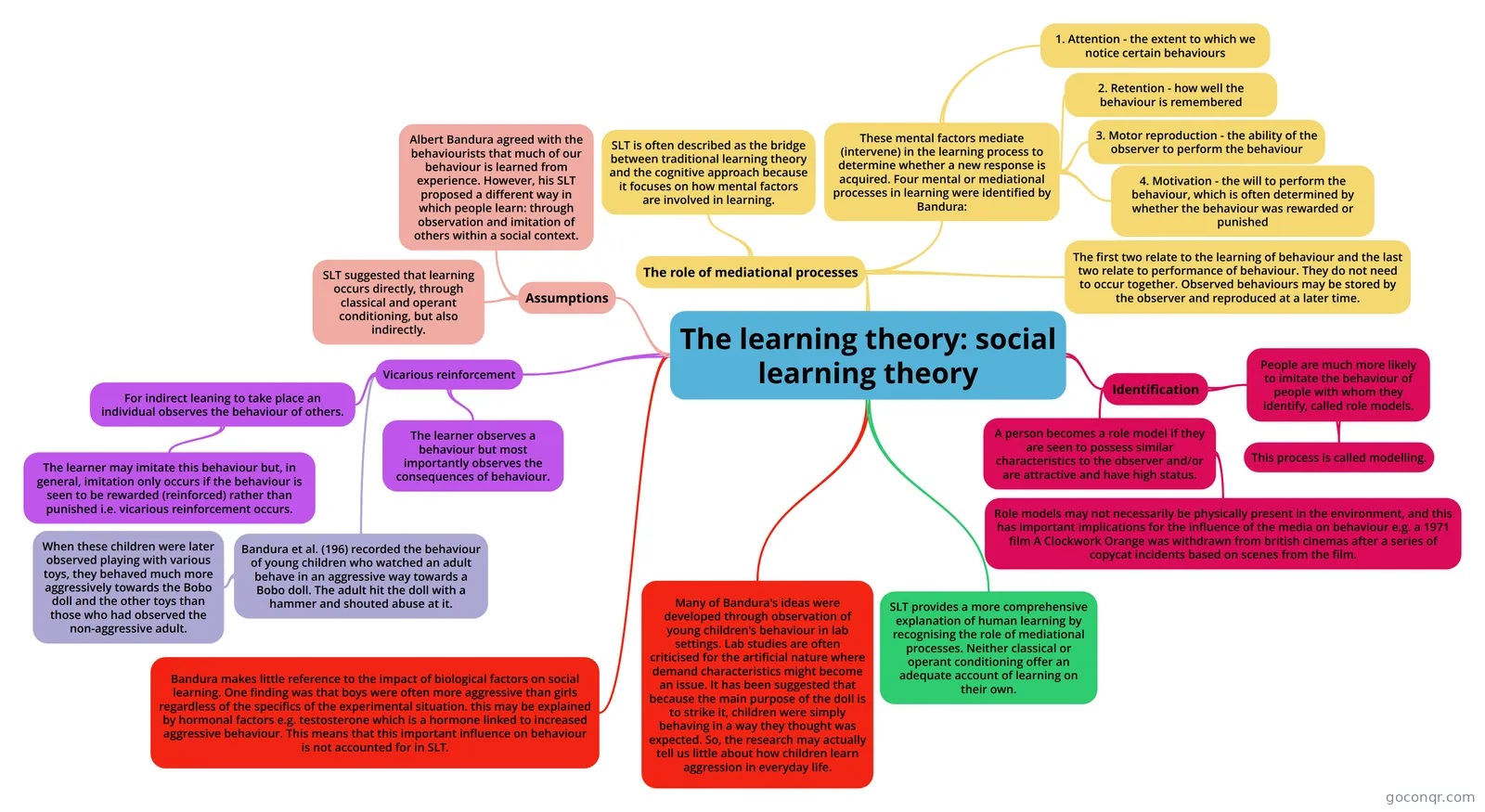
Mind map: The learning theory: social learning theory
Map content
The learning theory: social learning theory
Assumptions
- Albert Bandura agreed with the behaviourists that much of our behaviour is learned from experience. However, his SLT proposed a different way in which people learn: through observation and imitation of others within a social context.
- SLT suggested that learning occurs directly, through classical and operant conditioning, but also indirectly.
Vicarious reinforcement
- For indirect leaning to take place an individual observes the behaviour of others.
- The learner may imitate this behaviour but, in general, imitation only occurs if the behaviour is seen to be rewarded (reinforced) rather than punished i.e. vicarious reinforcement occurs.
- The learner observes a behaviour but most importantly observes the consequences of behaviour.
- Bandura et al. (196) recorded the behaviour of young children who watched an adult behave in an aggressive way towards a Bobo doll. The adult hit the doll with a hammer and shouted abuse at it.
- When these children were later observed playing with various toys, they behaved much more aggressively towards the Bobo doll and the other toys than those who had observed the non-aggressive adult.
- For indirect leaning to take place an individual observes the behaviour of others.
The role of mediational processes
- SLT is often described as the bridge between traditional learning theory and the cognitive approach because it focuses on how mental factors are involved in learning.
- These mental factors mediate (intervene) in the learning process to determine whether a new response is acquired. Four mental or mediational processes in learning were identified by Bandura:
- 1. Attention - the extent to which we notice certain behaviours
- 2. Retention - how well the behaviour is remembered
- 3. Motor reproduction - the ability of the observer to perform the behaviour
- 4. Motivation - the will to perform the behaviour, which is often determined by whether the behaviour was rewarded or punished
- The first two relate to the learning of behaviour and the last two relate to performance of behaviour. They do not need to occur together. Observed behaviours may be stored by the observer and reproduced at a later time.
Identification
- People are much more likely to imitate the behaviour of people with whom they identify, called role models.
- This process is called modelling.
- A person becomes a role model if they are seen to possess similar characteristics to the observer and/or are attractive and have high status.
- Role models may not necessarily be physically present in the environment, and this has important implications for the influence of the media on behaviour e.g. a 1971 film A Clockwork Orange was withdrawn from british cinemas after a series of copycat incidents based on scenes from the film.
- People are much more likely to imitate the behaviour of people with whom they identify, called role models.
SLT provides a more comprehensive explanation of human learning by recognising the role of mediational processes. Neither classical or operant conditioning offer an adequate account of learning on their own.
Many of Bandura's ideas were developed through observation of young children's behaviour in lab settings. Lab studies are often criticised for the artificial nature where demand characteristics might become an issue. It has been suggested that because the main purpose of the doll is to strike it, children were simply behaving in a way they thought was expected. So, the research may actually tell us little about how children learn aggression in everyday life.
Bandura makes little reference to the impact of biological factors on social learning. One finding was that boys were often more aggressive than girls regardless of the specifics of the experimental situation. this may be explained by hormonal factors e.g. testosterone which is a hormone linked to increased aggressive behaviour. This means that this important influence on behaviour is not accounted for in SLT.
Information
- Description
- AS - Level Psychology (Approaches in psychology) Mind Map on The learning theory: social learning theory, created by Lucy Garland on 18/04/2016.
- Created by
- Lucy Garland
- Views
- 0
- Rating