
Mind map
Lecture 3 - Development of Memory, Attention and Exec Function
Map content
Lecture 3 - Development of Memory, Attention and Exec Function
Intro
- All aspects of cognitive processing. A step up from perception. Understanding perception and cognition as information processing.
History of cognitive development research
- Piaget - Stage Theory. Emphasis on qualitative changes in children's capabilities and mental operations: what they can vs cannot do at each stage. Most contemporary research takes an information processing approach - breaking down the task the child is trying to solve into its elements, understanding it as a computational problem. Emphasis on quantitative changes and task demands (check that failures in something complex are not due to something more basic)
- Two of Piaget's influential findings
- 1. Object permanence. Children below about 8 months do not search for a hidden object. “Out of sight, out of mind”, for infants when the object is hidden it no longer exists. More recent studies show evidence that much younger infants do keep track of hidden objects, when performance demands are reduced. Measure looking behaviour instead of searching responses. e.g. Baillargeon et al, Cognition 1985- 5-month-olds look longer at the impossible event. Habituate to object moving. Place box in way. Then show a possible event of object moving and stopping at box, or impossible event of object moving through box. Infants look longer at impossible one. They know the box is there even though they cant see it.
- 2. The "A not B error" (to about 10 months). Hide something at A, infant searches at A. Do this many times. Then hide at B, infant looks at A. Piaget: infants believe they make the object appear by searching for it. But looking time studies show that much younger infants keep track of where hidden objects are. Many alternative accounts of the AB error based on specific cognitive abilities, including memory, inhibition, motor control. Specific experimental tasks address these individual abilities.
- Two of Piaget's influential findings
- Piaget and others on early memory. Piaget (1952) – children under 18 months incapable of mentally representing objects and events, live in a “here and now” world = “Infantile amnesia” (Pillemer & White, 1989). But we will see that once specialised methods were developed to assess early memories, research showed infants to have similar kinds of memory abilities to adults. This suggests that the major developmental changes are quantitative (capacity, duration)
- Piaget - Stage Theory. Emphasis on qualitative changes in children's capabilities and mental operations: what they can vs cannot do at each stage. Most contemporary research takes an information processing approach - breaking down the task the child is trying to solve into its elements, understanding it as a computational problem. Emphasis on quantitative changes and task demands (check that failures in something complex are not due to something more basic)
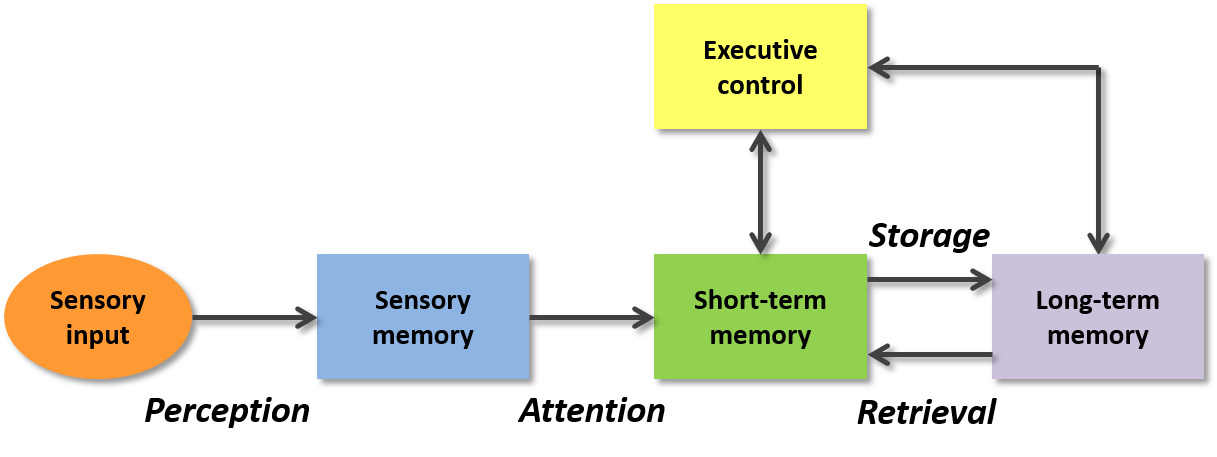
Modal Memory model - Atkinson and Shiffrin 1968. Perception = information acquisition. Attention = information selection. Memory = information storage. Exec function = Control and coordination of information processing.
Memory
- STM = capacity limited, quick to learn, quick to forget.
- Development of STM in infancy - delayed response
- Interest ppt in a stimulus, hide it, test after how long an interval it is correctly found --> estimate of duration of working memory (STM). Devised by Hunter (1917). Tests with infants show development of STM with age. Diamond & Doar, 1989- this is proposed to relate to development of prefrontal cortex --> shown in patient and animal studies to be crucial for this kind of memory. Here also related to performance on the “A not B” task (Piaget) – implies similar mechanism involved in both
- Development of STM in childhood: digit span
- Digit span was: 8 for college students, 6-7 for 12-year-olds, 4 for 5-year-olds (Starr, 1923, Brener, 1940) Major changes in STM capacity? Many other factors: items of interest remembered better, development of chunking strategies, development of rehearsal strategies!
- Development of STM in infancy - delayed response
- LTM = practically unlimited, slow to learn, slow to forget.
- Development of infant LTM
- Rovee-Collier et al 1999. Infants learn that kicking makes the mobile move. Do they remember? Expt: test again with trained vs novel mobile. Used to measure properties of infant memory, e.g.: 3-month olds remember after 2 week delay. Given the same number of training sessions, max length of retention increases linearly with age. But having more training sessions can extend the retention interval even at younger ages
- Another widely used test of nonverbal recall: deferred imitation / elicited imitation (Meltzoff, Bauer). Preverbal infants recall action sequences many months later. This is a form of explicit memory. As with the Rovee-Collier mobile kicking studies, older age --> longer recall and more repetitions --> longer recall. Also: importance of “post-encoding” processes (consolidation)
- Development of episodic memory
- “Infantile amnesia”? Most adults have few memories of events below age 3. And from 3-7 years have fewer memories than would be predicted by forgetting alone. However, it is not true that children below 3 cannot form episodic memories. 2- to 3-year-olds remember specific events over long time periods: studied by asking children to recall events that happened to them – e.g. visit to Disney World, birth of a sibling, trip to hospital (Fivush et al 1987). But there must be some differences in infant vs older episodic memory - why do we have so few under-7 (and even fewer under-3) memories?
- Bauer et al 2007 - Studied 7- to 10-year-old children’s autobiographical memories using cue words (e.g. ice cream) to recall events. Graph distribution of events in time. Forgetting curve differs from that usually found in studies with adults: In adults, power function --> over time, forgetting slows, presumably as a result of consolidation. In children, exponential function --> forgetting continues at a constant rate. Lack of early memories not because they were not laid down, but because more likely to be forgotten. More forgetting perhaps because of development and change and reorganisation in memory networks in the brain.
- “Infantile amnesia”? Most adults have few memories of events below age 3. And from 3-7 years have fewer memories than would be predicted by forgetting alone. However, it is not true that children below 3 cannot form episodic memories. 2- to 3-year-olds remember specific events over long time periods: studied by asking children to recall events that happened to them – e.g. visit to Disney World, birth of a sibling, trip to hospital (Fivush et al 1987). But there must be some differences in infant vs older episodic memory - why do we have so few under-7 (and even fewer under-3) memories?
- Development of infant LTM
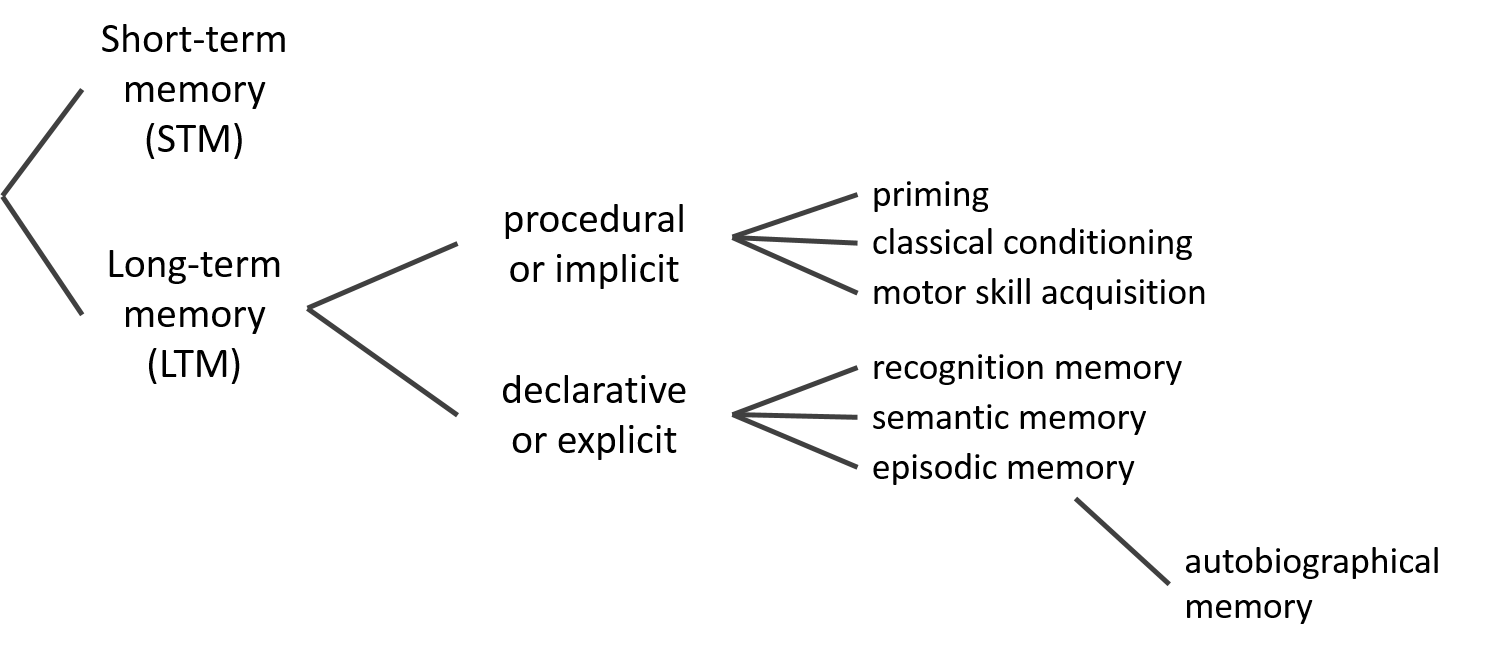
- Some brain areas involved: Frontal lobes = stm tasks; PFC and parts of temporal lobes = efficient encoding of words and pictures; Hippocampus = formation of long term declarative memories, binds together diverse elements of memory so it can be retrieved as a coherent entity; Cerebellum = formation and retention of simple classically conditioned responses; Cerebral cortex = Storage of LTM
- Summary - Evidence for all major kinds of memory, early in infancy. But major quantitative changes in memory capabilities, e.g. interval over which an item can be held in STM (2s at 7mo --> 10s at 12mo) interval over which an action is remembered in LTM (2wks at 6mo --> 13wks at 18mo) changes in rate of forgetting for autobiographical memories. Also development of use of memory strategies, on which adults strongly rely
- Relating changes in memory capabilities to brain development
- Hippocampus, esp. dentate gyrus, developing significantly to age 4-5 years. Hippocampus continues to increase in volume into adolescence. Major prefrontal cortex development, including synaptic growth, in first 2 years, further development, including synaptic pruning, through childhood and into adolescence
- Direct correlations between brain activity and memory abilities in development
- Bell & Fox, 1992. EEG differences in 7-12 month old infants who can vs those who cannot solve the A not B task after a long (13 second) delay: Power of EEG signal at frontal electrodes and Coherence of EEG signal between front and back electrodes. Individual differences in brain activity (related to maturation of PFC) explain some of the individual differences in A not B performance
- STM = capacity limited, quick to learn, quick to forget.
Attention and Executive function
- Defintions
- Defining attention precisely has been contentious, but attention is now generally held to include: altertness (maintain attention), orienting (Attend to targets in space) and exec control of action.
- Executive function = An interrelated set of “high level” cognitive skills, including planning, reasoning, working memory, inhibition and cognitive flexibility. Executive control of other cognitive processes. AKA “cognitive control” (Posner). Tower of London is classic test of planning (Shallice 1982). A not B included elements of working memory and inhibition. PFC crucial.
- Development of attention
- Basic orienting
- Exogenously-driven orienting: “automatic” response to an external signal. Newborns and young infants move their eyes and head towards visual and auditory targets (Bronson, 1974) –based on sub-cortical mechanisms. The system greatly improves in precision - includes major improvement in control of eye movements.
- Voluntary orienting and disengagement
- Voluntary (endogenous) control – select which target to orient to. Important when there are multiple competing targets. Ability to disengage from one target and fixate another develops at 3-4 months (Atkinson et al, 1992). Simple sub-cortical control of orienting --> more flexible, cortical control. Later development in infants with neurological damage
- Atkinson et al 1992 - Taken together, the results of these experiments demonstrate the greater disruption of fixation-shift behaviour in 1-month-olds compared with 3-month-olds when competing visual stimuli are used. This developmental change is explained in terms of maturation of executive cortical orienting systems over the first months of life.
- Voluntary (endogenous) control – select which target to orient to. Important when there are multiple competing targets. Ability to disengage from one target and fixate another develops at 3-4 months (Atkinson et al, 1992). Simple sub-cortical control of orienting --> more flexible, cortical control. Later development in infants with neurological damage
- Basic orienting
- Development of executive function
- Working memory
- Working memory = short term memory for holding items need for an ongoing task. “Working memory” is described as an aspect of executive function, but it is also described as an aspect of memory. Diamond & Doar, 1989 - Increasing retention interval for spatial location proposed to relate to development of prefrontal cortex
- Cognitive flexibility
- Dimensional Change Card Sort Task, Zelazo et al 1996- Sort the same cards in two different ways, e.g. first by shape, then by colour (similar to Wisconsin card sorting test for adults, used to test EF and frontal lobe dysfunction). Typically developing children can switch by 4 years, younger children have difficulties switching. Provides a measure of EF, is impaired in children with ADHD and autism
- Planning
- Tower of Hanoi task – Klahr & Robinson, 1981, “Formal Assessment of Problem-Solving and Planning Processes in Preschool Children”. Major improvements in the ability to plan ahead as they get older. Older children more likely to pursue long term goals, could keep more subgoals in mind.
- Inhibition
- Inhibiting a routine or familiar response – also a crucial EF / prefrontal cortex function. E.g. A simplified (child appropriate) version of the classic Stroop task or "day and night” task – Gerstadt et al, 1994. 70% correct at 3.5 years --> 90% correct at age 7 years
- Children tested on a task that requires inhibitory control of action plus learning and remembering two rules. They were asked to say “day” whenever a black card with the moon and stars appeared and to say “night” when shown a white card with a bright sun. Children <5 years had great difficulty. They started out performing well, but could not sustain this over the course of the 16-trial session. Children <4.5 years performed well when they took very long to respond. We conclude that the requirement to learn and remember two rules is not in itself sufficient to account for the poor performance of the younger children in the experimental condition.
- Inhibiting a routine or familiar response – also a crucial EF / prefrontal cortex function. E.g. A simplified (child appropriate) version of the classic Stroop task or "day and night” task – Gerstadt et al, 1994. 70% correct at 3.5 years --> 90% correct at age 7 years
- Brain development
- Prefrontal cortex (PFC) is crucial for EF in adults. Major prefrontal cortex development, inc synaptic growth, in first 2 years, further development inc synaptic through childhood and into adolescence. PFC among last areas to mature: changes in grey matter density from MRI (Gogtay et al, 2004). Synaptic pruning --> decrease in density. Also, direct evidence that developmental changes in PFC function accompany changes in executive function. Example: Moriguchi et al, 2009 - experiment design = children do card sorting task while brain activity is recorded via NIRS. Nearly all ages 5 but only 75% aged 3 could successfully switch rules. There was change in blood oxygenation in prefrontal areas between control phase and study. 3 and 5 year olds who pass have higher response than 3 year olds who fail.
- Atypical development of exec function
- Several disorders of childhood onset, including ASD (autism spectrum disorders), ADHD (attention deficit hyperactivity disorder) and Tourette syndrome, are associated with impairments in EF. But not all children who meet clinical diagnosis for ASD or ADHD show EF impairment, so EF impairment alone is not enough to explain these disorders. Also some evidence for EF impairment contributing to reading difficulty, specific language impairment, and predicting behavioural problems.
- Working memory
- Defintions
Summary
- Cognitive development and cognition as information processing. Experimental tasks have been developed to test aspects of information processing even in young infants. Components of memory are in place early, but there are major quantitative changes (e.g. in retention interval) in the early years. Components of attention and EF develop in the first years of life, and mature significantly over childhood, adolescence and the lifespan. Some developmental disorders are linked to problems with EF.
Images and files in the map
Information
- Description
- Uni Year 2 Developmental Psychology Mind Map on Lecture 3 - Development of Memory, Attention and Exec Function, created by Issy de Silva on 27/04/2016.
- Created by
- Issy de Silva
- Views
- 0
- Rating