
Mind map
Attachment
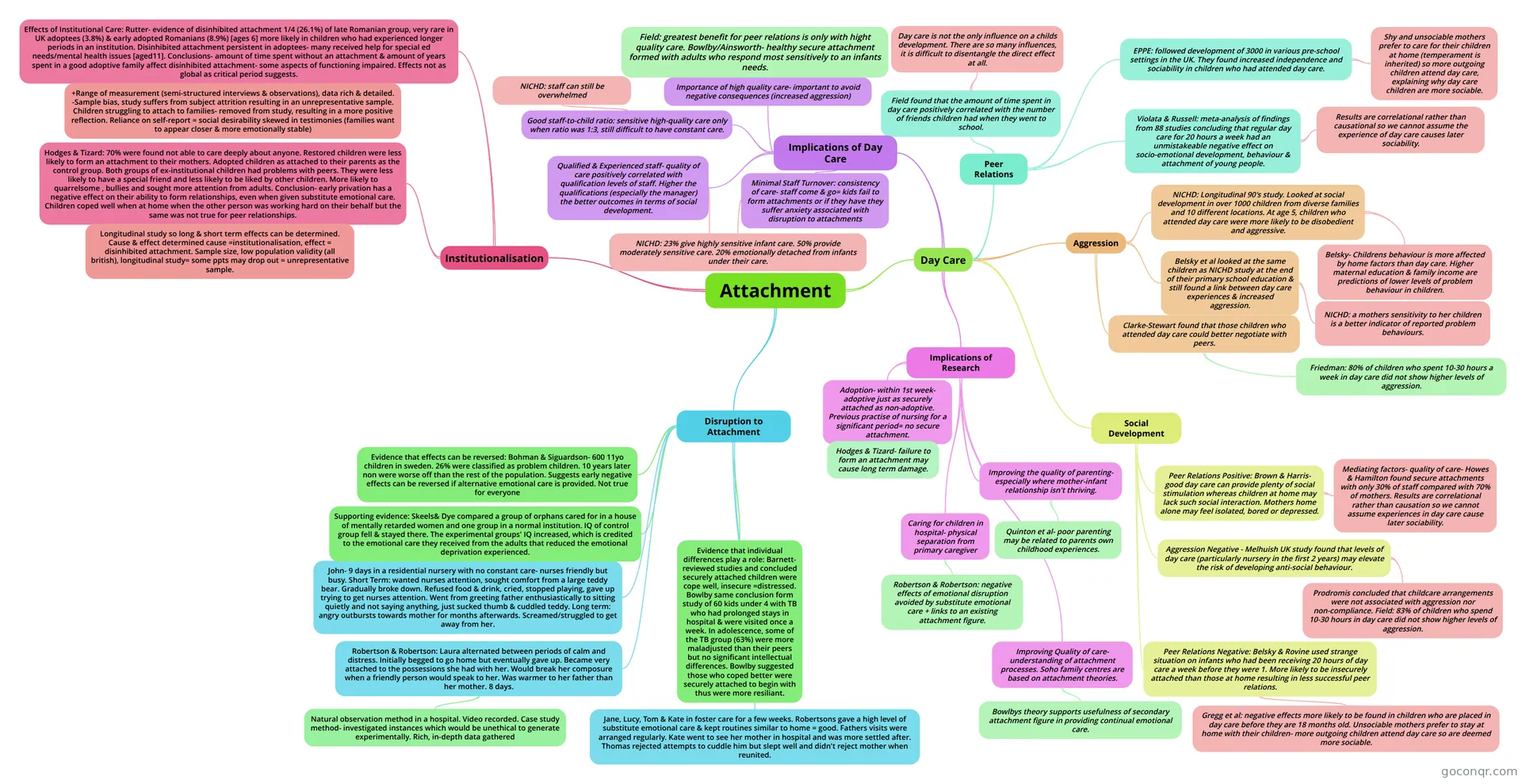
Mind map: Attachment
Map content
Attachment
Day Care
- Peer Relations
- Field found that the amount of time spent in day care positively correlated with the number of friends children had when they went to school.
- Day care is not the only influence on a childs development. There are so many influences, it is difficult to disentangle the direct effect at all.
- Violata & Russell: meta-analysis of findings from 88 studies concluding that regular day care for 20 hours a week had an unmistakeable negative effect on socio-emotional development, behaviour & attachment of young people.
- Results are correlational rather than causational so we cannot assume the experience of day care causes later sociability.
- EPPE: followed development of 3000 in various pre-school settings in the UK. They found increased independence and sociability in children who had attended day care.
- Shy and unsociable mothers prefer to care for their children at home (temperament is inherited) so more outgoing children attend day care, explaining why day care children are more sociable.
- Field found that the amount of time spent in day care positively correlated with the number of friends children had when they went to school.
- Aggression
- NICHD: Longitudinal 90's study. Looked at social development in over 1000 children from diverse families and 10 different locations. At age 5, children who attended day care were more likely to be disobedient and aggressive.
- Belsky- Childrens behaviour is more affected by home factors than day care. Higher maternal education & family income are predictions of lower levels of problem behaviour in children.
- Clarke-Stewart found that those children who attended day care could better negotiate with peers.
- Friedman: 80% of children who spent 10-30 hours a week in day care did not show higher levels of aggression.
- Belsky et al looked at the same children as NICHD study at the end of their primary school education & still found a link between day care experiences & increased aggression.
- NICHD: a mothers sensitivity to her children is a better indicator of reported problem behaviours.
- NICHD: Longitudinal 90's study. Looked at social development in over 1000 children from diverse families and 10 different locations. At age 5, children who attended day care were more likely to be disobedient and aggressive.
- Social Development
- Aggression Negative - Melhuish UK study found that levels of day care (particularly nursery in the first 2 years) may elevate the risk of developing anti-social behaviour.
- Prodromis concluded that childcare arrangements were not associated with aggression nor non-compliance. Field: 83% of children who spend 10-30 hours in day care did not show higher levels of aggression.
- Peer Relations Negative: Belsky & Rovine used strange situation on infants who had been receiving 20 hours of day care a week before they were 1. More likely to be insecurely attached than those at home resulting in less successful peer relations.
- Gregg et al: negative effects more likely to be found in children who are placed in day care before they are 18 months old. Unsociable mothers prefer to stay at home with their children- more outgoing children attend day care so are deemed more sociable.
- Peer Relations Positive: Brown & Harris- good day care can provide plenty of social stimulation whereas children at home may lack such social interaction. Mothers home alone may feel isolated, bored or depressed.
- Mediating factors- quality of care- Howes & Hamilton found secure attachments with only 30% of staff compared with 70% of mothers. Results are correlational rather than causation so we cannot assume experiences in day care cause later sociability.
- Aggression Negative - Melhuish UK study found that levels of day care (particularly nursery in the first 2 years) may elevate the risk of developing anti-social behaviour.
- Implications of Research
- Improving Quality of care- understanding of attachment processes. Soho family centres are based on attachment theories.
- Bowlbys theory supports usefulness of secondary attachment figure in providing continual emotional care.
- Caring for children in hospital- physical separation from primary caregiver
- Robertson & Robertson: negative effects of emotional disruption avoided by substitute emotional care + links to an existing attachment figure.
- Adoption- within 1st week- adoptive just as securely attached as non-adoptive. Previous practise of nursing for a significant period= no secure attachment.
- Hodges & Tizard- failure to form an attachment may cause long term damage.
- Improving the quality of parenting- especially where mother-infant relationship isn't thriving.
- Quinton et al- poor parenting may be related to parents own childhood experiences.
- Improving Quality of care- understanding of attachment processes. Soho family centres are based on attachment theories.
- Implications of Day Care
- Importance of high quality care- important to avoid negative consequences (increased aggression)
- Field: greatest benefit for peer relations is only with hight quality care. Bowlby/Ainsworth- healthy secure attachment formed with adults who respond most sensitively to an infants needs.
- Good staff-to-child ratio: sensitive high-quality care only when ratio was 1:3, still difficult to have constant care.
- NICHD: staff can still be overwhelmed
- Minimal Staff Turnover: consistency of care- staff come & go= kids fail to form attachments or if they have they suffer anxiety associated with disruption to attachments
- NICHD: 23% give highly sensitive infant care. 50% provide moderately sensitive care. 20% emotionally detached from infants under their care.
- Qualified & Experienced staff- quality of care positively correlated with qualification levels of staff. Higher the qualifications (especially the manager) the better outcomes in terms of social development.
- Importance of high quality care- important to avoid negative consequences (increased aggression)
- Peer Relations
Disruption to Attachment
- Robertson & Robertson: Laura alternated between periods of calm and distress. Initially begged to go home but eventually gave up. Became very attached to the possessions she had with her. Would break her composure when a friendly person would speak to her. Was warmer to her father than her mother. 8 days.
- Natural observation method in a hospital. Video recorded. Case study method- investigated instances which would be unethical to generate experimentally. Rich, in-depth data gathered
- Jane, Lucy, Tom & Kate in foster care for a few weeks. Robertsons gave a high level of substitute emotional care & kept routines similar to home = good. Fathers visits were arranged regularly. Kate went to see her mother in hospital and was more settled after. Thomas rejected attempts to cuddle him but slept well and didn't reject mother when reunited.
- John- 9 days in a residential nursery with no constant care- nurses friendly but busy. Short Term: wanted nurses attention, sought comfort from a large teddy bear. Gradually broke down. Refused food & drink, cried, stopped playing, gave up trying to get nurses attention. Went from greeting father enthusiastically to sitting quietly and not saying anything, just sucked thumb & cuddled teddy. Long term: angry outbursts towards mother for months afterwards. Screamed/struggled to get away from her.
- Supporting evidence: Skeels& Dye compared a group of orphans cared for in a house of mentally retarded women and one group in a normal institution. IQ of control group fell & stayed there. The experimental groups' IQ increased, which is credited to the emotional care they received from the adults that reduced the emotional deprivation experienced.
- Evidence that effects can be reversed: Bohman & Siguardson- 600 11yo children in sweden. 26% were classified as problem children. 10 years later non were worse off than the rest of the population. Suggests early negative effects can be reversed if alternative emotional care is provided. Not true for everyone
- Evidence that individual differences play a role: Barnett- reviewed studies and concluded securely attached children were cope well, insecure =distressed. Bowlby same conclusion form study of 60 kids under 4 with TB who had prolonged stays in hospital & were visited once a week. In adolescence, some of the TB group (63%) were more maladjusted than their peers but no significant intellectual differences. Bowlby suggested those who coped better were securely attached to begin with thus were more resiliant.
- Robertson & Robertson: Laura alternated between periods of calm and distress. Initially begged to go home but eventually gave up. Became very attached to the possessions she had with her. Would break her composure when a friendly person would speak to her. Was warmer to her father than her mother. 8 days.
Institutionalisation
- Effects of Institutional Care: Rutter- evidence of disinhibited attachment 1/4 (26.1%) of late Romanian group, very rare in UK adoptees (3.8%) & early adopted Romanians (8.9%) [ages 6] more likely in children who had experienced longer periods in an institution. Disinhibited attachment persistent in adoptees- many received help for special ed needs/mental health issues [aged11]. Conclusions- amount of time spent without an attachment & amount of years spent in a good adoptive family affect disinhibited attachment- some aspects of functioning impaired. Effects not as global as critical period suggests.
- +Range of measurement (semi-structured interviews & observations), data rich & detailed. -Sample bias, study suffers from subject attrition resulting in an unrepresentative sample. Children struggling to attach to families- removed from study, resulting in a more positive reflection. Reliance on self-report = social desirability skewed in testimonies (families want to appear closer & more emotionally stable)
- Hodges & Tizard: 70% were found not able to care deeply about anyone. Restored children were less likely to form an attachment to their mothers. Adopted children as attached to their parents as the control group. Both groups of ex-institutional children had problems with peers. They were less likely to have a special friend and less likely to be liked by other children. More likely to quarrelsome , bullies and sought more attention from adults. Conclusion- early privation has a negative effect on their ability to form relationships, even when given substitute emotional care. Children coped well when at home when the other person was working hard on their behalf but the same was not true for peer relationships.
- Longitudinal study so long & short term effects can be determined. Cause & effect determined cause =institutionalisation, effect = disinhibited attachment. Sample size, low population validity (all british), longitudinal study= some ppts may drop out = unrepresentative sample.
- Effects of Institutional Care: Rutter- evidence of disinhibited attachment 1/4 (26.1%) of late Romanian group, very rare in UK adoptees (3.8%) & early adopted Romanians (8.9%) [ages 6] more likely in children who had experienced longer periods in an institution. Disinhibited attachment persistent in adoptees- many received help for special ed needs/mental health issues [aged11]. Conclusions- amount of time spent without an attachment & amount of years spent in a good adoptive family affect disinhibited attachment- some aspects of functioning impaired. Effects not as global as critical period suggests.
Information
- Description
- Mind Map on Attachment, created by Hannah Wood on 13/05/2014.
- Created by
- Hannah Wood
- Views
- 27
- Rating