
Data Preparation and Preprocessing
54 resources created by 46 users
This Data Preparation and Preprocessing page on GoConqr gathers community-made mind maps, quizzes, flashcards and notes, from data cleaning and missing values to data reduction, sampling, binning and principal component analysis. It's built for university students and professional candidates working through the topic, and for teachers after ready-made material, with school students mentioned only in passing. There are over 50 resources here, including more than 40 mind maps and 3 quizzes. Pick a map, then test yourself with a quiz.
Top Data Preparation and Preprocessing resources
-
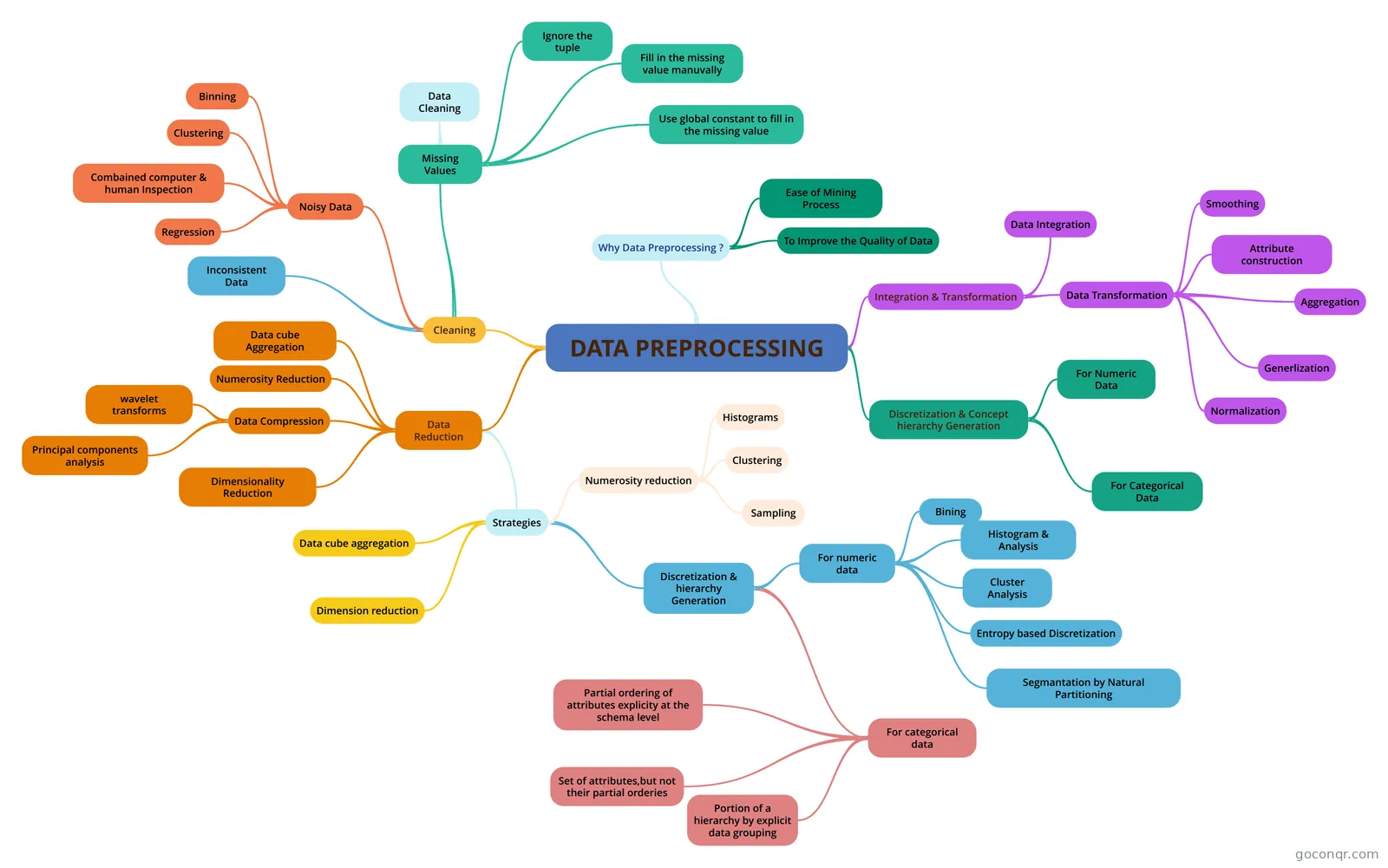 Mind map DATA PREPROCESSING
-
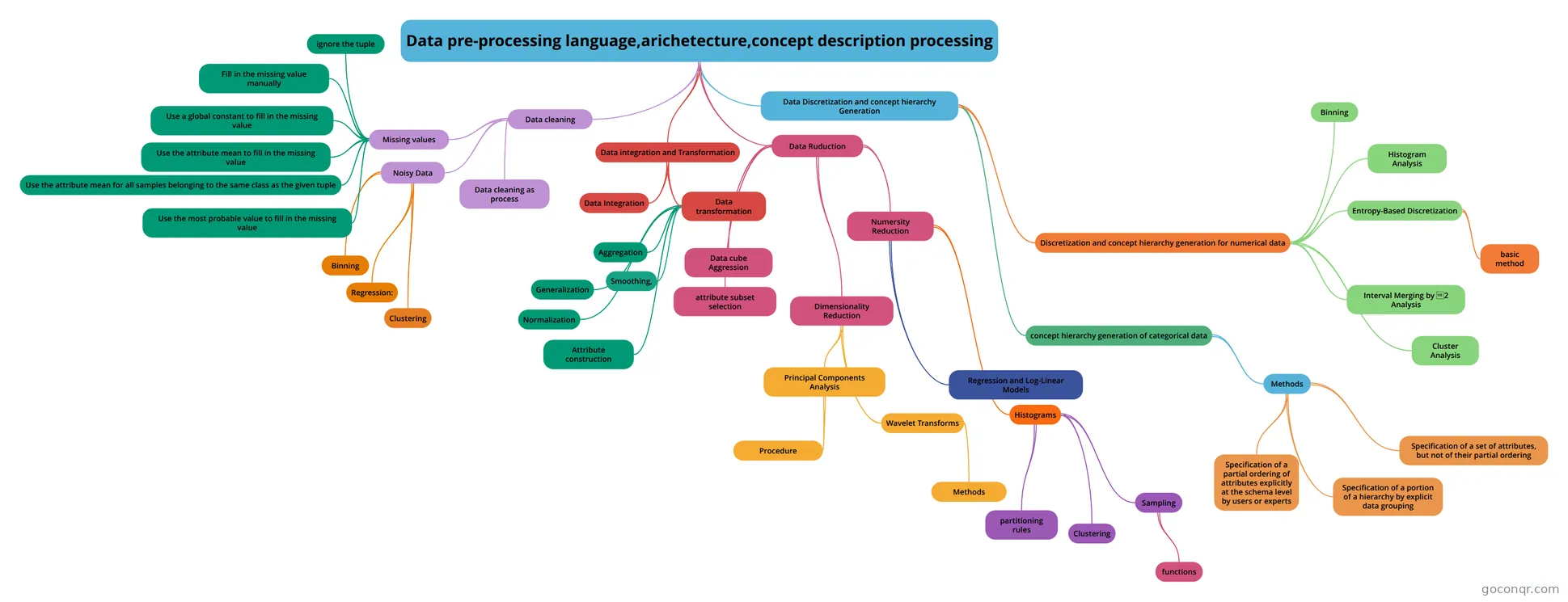 Mind map Data pre-processing language,arichetecture,concept description processing
-
16 questionsAccessing Data You are building an ADO.NET EF application. You need to add a property of type NVARCHAR(50) named Notes to ...
-
Mind map DATA PREPROCESSING
-
15 cardsData
-
Mind map DR by Principal Component Analysis
-
Mind map DATA CLEANING
-
Mind map Data Encoding Tecniques
Quizzes
Mind maps
See all 42 mind mapsFlashcards
Flowcharts
Notes
Slides
Topics in Data Preparation and Preprocessing
More Databases and data science topics
About Data Preparation and Preprocessing
GoConqr OriginalWhat the resources cover
Most of this page is mind maps, and they follow the usual stages of getting data ready for analysis. Several maps, such as DATA PREPROCESSING and Data Preprocessing_1, lay out the whole picture: cleaning, integration, transformation, reduction and discretisation. Others zoom in on one job at a time.
Where to start
Begin with one of the overview maps. The one that opens with the question Why Preprocess the Data? and covers descriptive data summarisation is a gentle way in. Then move to the detail maps in this order:
- DATA CLEANING: why values go missing, such as data not recorded at the source or a system failing to capture records, and what to do about it.
- Data Reduction: the aim of shrinking a dataset while keeping its integrity, so analysis on the reduced data gives similar results.
- Data reduction by sampling: why sampling improves runtime, and the types of sample, including stratified and systematic 1-in-n sampling.
- DR by BINNING: turning continuous attributes into categorical ones with fewer values.
- DR by Principal Component Analysis: cutting the number of attributes while keeping as much information as possible.
Using quizzes and maps together
Read a map, then close it and try to rebuild its branches from memory. After that, take a quiz such as Accessing Data or DATA MINING to see what stuck. The flashcard deck Getting Clean Data suits short revision sessions on the cleaning ideas.
Wider topics nearby
Some maps step beyond preprocessing into related ground, including Data Wrangling, Data Encoding Tecniques, EDA and Batch vs Streaming. They help you see how preparation fits into the wider work of data science and analytics, within Databases and data science.
Make it your own
Once you have worked through a few maps, draw your own version of a technique you found tricky, and add flashcards for the terms. Teachers can pick a map to put on screen or set as pre-reading.
Frequently asked questions
Which resource should I open first?
Start with an overview mind map such as DATA PREPROCESSING, which sets out cleaning, reduction and discretisation together. Once you can see the stages, move on to the detail maps on data cleaning, data reduction, sampling, binning and principal component analysis, then try a quiz.
What do the mind maps on this page cover?
They cover missing values, noisy and inconsistent data, integration and transformation, and data reduction. Reduction is split into sampling, binning, data cube aggregation, attribute subset selection and principal component analysis. A few maps also touch on neighbouring topics such as data wrangling and encoding.
Are the resources free to use?
Yes. Every resource listed here is free to open, study and take, with no account needed. They were made by GoConqr users, not by GoConqr itself, so it is worth checking a map against your own course notes.
Who is this page for?
It mainly suits university students and professional candidates who want to learn or revise how data is prepared for analysis. Teachers can use the maps as ready-made material for lessons. A few resources may also be readable for school students.
Are there quizzes and flashcards?
Yes. There are over 2 quizzes in the list, including Accessing Data and DATA MINING, plus flashcard decks such as Getting Clean Data. Mind maps are the bulk of the page, so use quizzes to check what you have read.
What if I cannot find a topic I need?
Try a related map first, such as Data Wrangling or Data Cleaning, as they may cover it in a branch. If it is still missing, a free account lets you save quiz scores and make your own maps, flashcards and notes on it.