
Big Data, Hadoop and Spark
298 resources created by 219 users
This Big Data, Hadoop and Spark page on GoConqr gathers community-made quizzes, mind maps, flashcards, flowcharts and notes, from the 3 Vs and NoSQL to Hadoop, Pig, Hive, Sqoop and Spark DataFrames. It's built for university students testing their understanding and teachers after ready-made material. There are over 290 resources here, including more than 20 quizzes and over 190 mind maps, mostly at university level. Pick a topic, try a quiz to find your gaps, then make your own maps to fill them.
Select topic
- Big Data History and Evolution14
- Big Data Concepts and Characteristics44
- Big Data Architecture and Engineering16
- Big Data Storage and NoSQL12
- Big Data Analytics18
- Data Analytics Lifecycle9
- Big Data Applications in Business13
- Cloud Computing for Big Data15
- Hadoop Architecture and Ecosystem57
- Hadoop MapReduce5
- Big Data Processing Tools10
- Apache Spark11
Top Big Data, Hadoop and Spark resources
-
49 cardsCHAPTER 14: BIG DATA ANALYTICS AND NOSQL 1. Much ambiguity exists in defining Big Data. a. True b. False
-
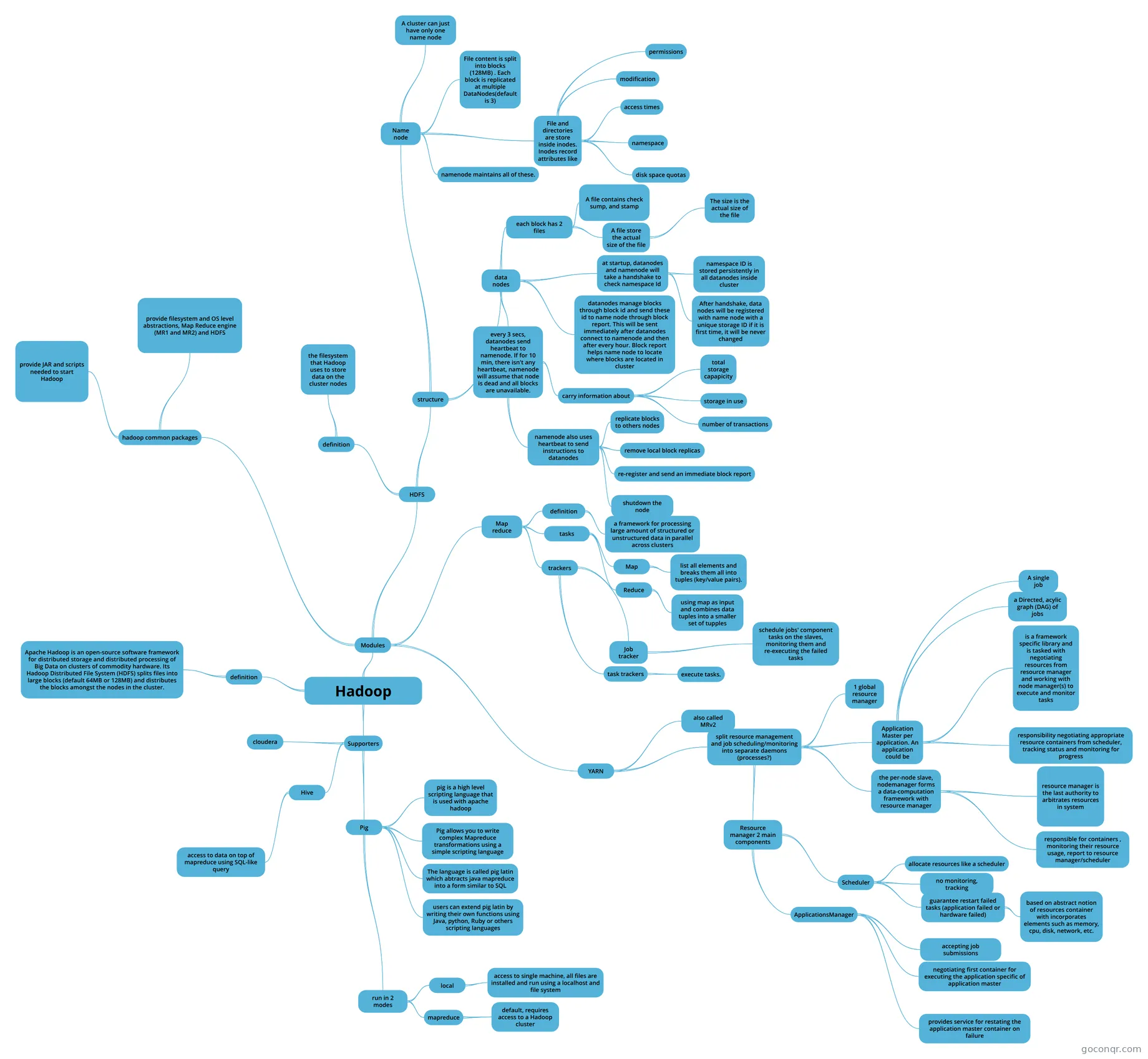 Mind map Hadoop Introduction to hadoop
-
15 questionsCHAPTER 14: BIG DATA ANALYTICS AND NOSQL 1. Much ambiguity exists in defining Big Data.
-
200 questionsModulo 10 - Fundamental Big Data Architect Big Data Architech
-
Mind map BIG DATA
-
14 cardsChapter 10 Key Terms These are the critical words for Chapter 10.
-
Mind map Conceptual Map: Big data Step 1 Recognition of Knowledge, Activity 1 Conceptual Map
-
18 questionsHadoop - HDFS - Level 1 What does HDFS stands for?
Quizzes
See all 22 quizzes-
15 questionsCHAPTER 14: BIG DATA ANALYTICS AND NOSQL 1. Much ambiguity exists in defining Big Data.
-
200 questionsModulo 10 - Fundamental Big Data Architect Big Data Architech
-
18 questionsHadoop - HDFS - Level 1 What does HDFS stands for?
-
200 questionsModulo 2 - Big Data Analysis & Technology Concepts Big Data Analysis
-
200 questionsP1-Modulo 2 : Big data analysis y technology concepts Big data analysis differs from trditional data analysis primary because
-
89 questionsP2-Modulo 2 : Big data analysis y technology concepts Text analytics generally involves two steps:
-
25 questionsData Architecture test What's the right data timing classification to keep in mind when choosing a data ingestion tool?
-
9 questionsCloudera Hadoop Developer Combiners increase the efficiency of a MapReduce program because
Mind maps
See all 200 mind mapsFlashcards
See all 18 flashcards-
49 cardsCHAPTER 14: BIG DATA ANALYTICS AND NOSQL 1. Much ambiguity exists in defining Big Data. a. True b. False
-
14 cardsChapter 10 Key Terms These are the critical words for Chapter 10.
-
162 cardsBig Data Technologies Was ist ein zentrales Problem im Big Data Bereich
-
126 cardsBig Data Management
-
23 cardsBig Data What are the 3 shifts that take place towards "big data" world?
-
53 cardsBig Data Rev Database Life Cycle
-
29 cardsApache Spark Concepts Apache Spark or MapReduce
-
23 cardsBig Data- Pig and Hive Week 8 Problems with mapreduce?
Flowcharts
See all 36 flowcharts
Notes
See all 18 notes-
BIG DATA - created from Mind Map ORIGIN IMPLICATIONS MAIN DEFINITIONS
-
Spark learning Strongly typed language and week typed:- The difference between a strongly typed language and a weakly typed language is basically that a strongly typed language checks the type of a variable before performi...
-
FIRST CHAPTER FACTS - CLASS 2 - There are 2.5 quintillion data per day being generated; - 90% of the data generated on the planet was generated in the last two years; - 80% of data is unstructured or in different formats;...
-
BIG DATA - creado desde un Mapa Mental Origin of Big Data Main Definitions Motivations
-
Big Data - created from Mind Map Scale out, not up limits of large shared-memory machines Move processing to the data cluster have limited bandwidth Process data sequentially, avoid random access Seamless scalability  ...
-
Filter and Map Filter data //create person.txt Name, Age Vinayak, 35 Nilesh, 37 Raju, 30 Karthik, 28 Shreshta,1 Siddhish, 2 val personfile = sc.textFile("C:/Users/Redirection/pateln7/Downloads/SPARK/person.txt") val fi...
-
Big Data Examples - Volume Banking- Billions of transactions per year take place and full details of every transaction must be tracked and stored in order to create an audit trail for possible fraud investigation. Mobile phone...
-
Sqoop - creado desde un Mapa Mental The traditional application management system, that is, the interaction of applications with relational database using RDBMS, is one of the sources that generate Big Data. Sqoop Import - imports individual tables from...
Slides
Topics in Big Data, Hadoop and Spark
More Databases and data science topics
About Big Data, Hadoop and Spark
GoConqr OriginalWhat the resources cover
The page opens with the basics of Big Data. The mind maps Conceptual Map: Big data and BIG DATA trace origins, the 3 Vs, veracity, and technologies such as massively parallel processing, stream processing and column-oriented databases. Others link Big Data analytics to cloud computing, covering IoT sensors, social media and mobile devices as data sources.
Hadoop and its tools
The Hadoop mind map breaks the framework into HDFS, MapReduce and YARN, then shows supporting tools such as Pig and Hive. It notes that Pig lets you write complex MapReduce transformations in a simple scripting language. You will also find flowcharts on Hadoop and YARN, a flashcard deck on Pig and Hive, and notes on Sqoop.
Spark and data processing
For Spark, look at the mind map on RDD-based programming, the deck Apache Spark Concepts, and the slides comparing the DataSet API and the DataFrame API. Short notes on Filter and Map and on Joins help with the practical side. A flowchart on Kafka and another on data processing engines widen the picture.
A suggested order
- Start with a general Big Data mind map to get the vocabulary.
- Take the quiz on Big Data analytics and NoSQL, which asks true or false questions on definitions and scaling out.
- Move to the Hadoop maps and flowcharts.
- Finish with the Spark decks and slides, then retake a quiz.
Where it fits
This unit sits in the Data Management and Engineering strand of Databases and data science. Use maps to see how ideas connect, then quizzes to check what stuck. Open a map, try a quiz, and build your own flashcards for the terms you missed.
Frequently asked questions
Which resource should I open first?
Begin with one of the general Big Data mind maps, such as Conceptual Map: Big data, to learn the 3 Vs and the main technologies. Then try the quiz on Big Data analytics and NoSQL to see which definitions you still need to review.
What do the Hadoop resources cover?
The Hadoop mind map covers HDFS, MapReduce and YARN, plus supporting tools like Pig and Hive. There are also several Hadoop flowcharts, a Hadoop Yarn for Big Data flowchart, an introductory flashcard deck and notes on Sqoop, so you can revisit the same ideas in different formats.
Is there anything on Spark?
Yes. You will find a mind map on RDD-based programming, a flashcard deck called Apache Spark Concepts, notes on Filter and Map and on Joins, and slides comparing the DataSet API and the DataFrame API. Together they give you concepts and short worked ideas.
Who are these resources for?
Most are at university level, so they suit university students revising concepts or checking their understanding. Teachers can also use the ready-made quizzes, maps and flashcards. They were made by GoConqr users, not by GoConqr, so compare them with your own course material.
Do I have to pay or sign up to use them?
Every resource listed here is free to open, study and take, with no account needed. If you want to save quiz scores or make your own quizzes, mind maps, flashcards and notes, you can create a free account.
What if a topic I need is missing?
Check the notes, flowcharts and flashcard decks, as a topic may sit in a different format from the one you expected. If it is still missing, you can build your own mind map or quiz on it and use it for revision.