
Deviance and Labelling Theory
12 resources created by 11 users
This Deviance and Labelling Theory page on GoConqr gathers community-made mind maps, flashcards, quizzes, flowcharts and notes, from Becker's Outsiders and Jock Young's marijuana study to folk devils and moral panics. It's built for university students and professional candidates, school students, and teachers after ready-made material, and it helps them practise essay plans, key terms and evaluation. There are more than 50 resources here, including 32 mind maps and 16 flashcard decks, mostly at university level. Try a quiz to find your gaps, then build your own.
Top Deviance and Labelling Theory resources
-
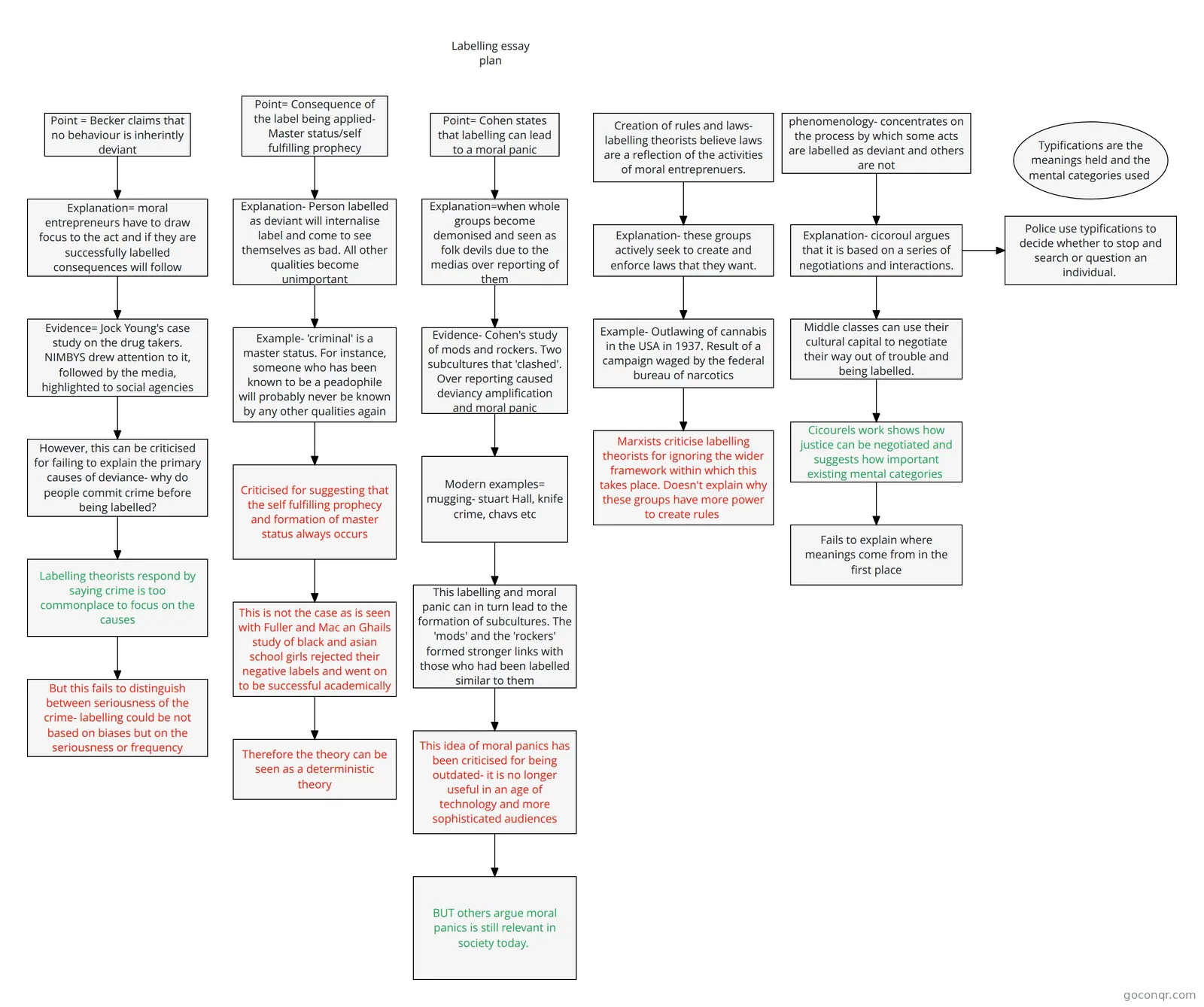 Flowchart Labelling Crime and Deviance Essay plan in form of a flowchart
-
33 cardsStudy Guide Part 2 Study guide for part 2 of Constructions of deviance.
-
43 cardsDeviant Behavior Study Guide 2 biological and psychological theories
-
37 cardsWeek 4 Study Guide Week 4 Study Guide
-
38 cardsPart 1 - Key Terms Key Terms to Part 1 Chapters 1-5
-
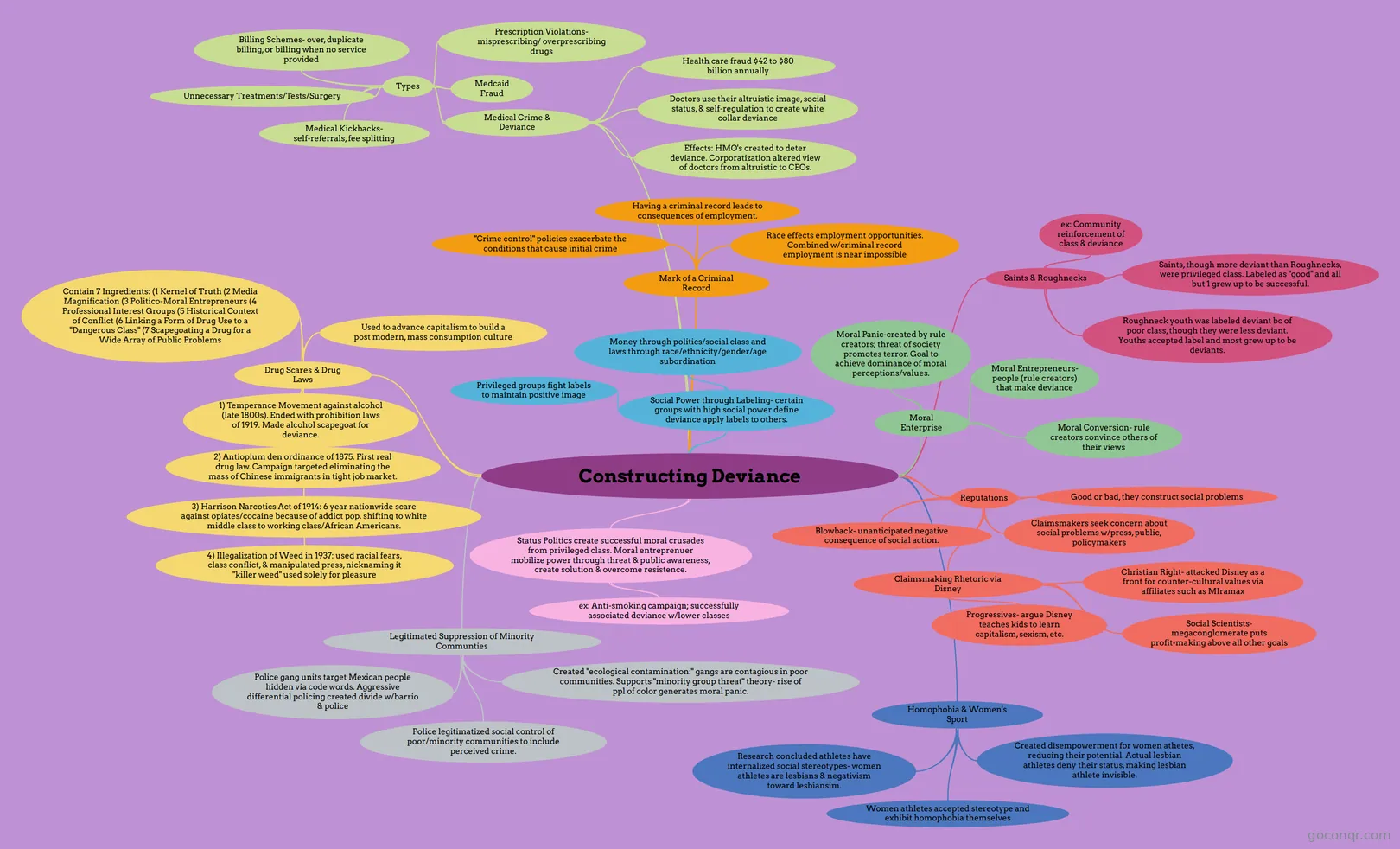 Mind map Constructing Deviance Part IV
-
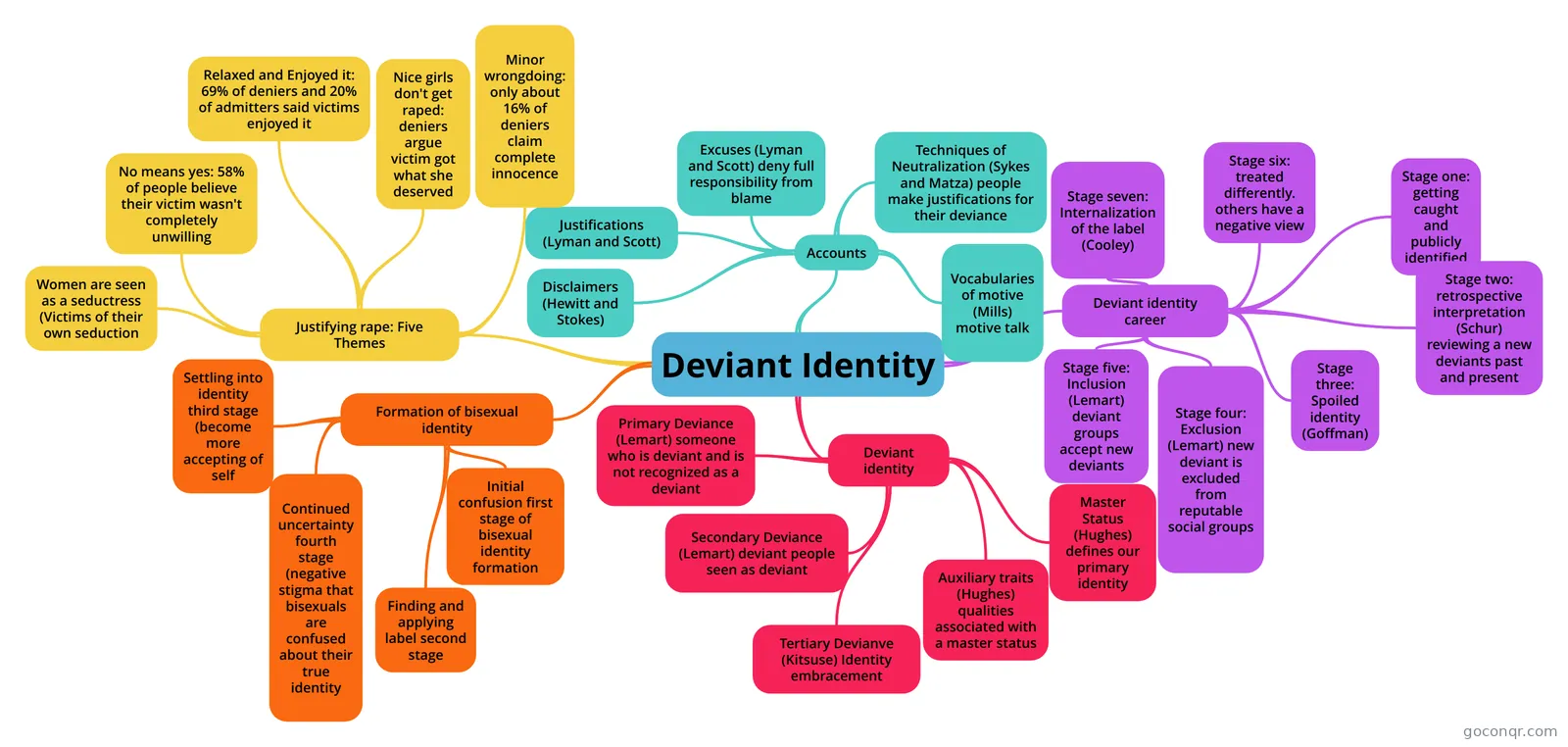 Mind map Deviant Identity deviant identity
-
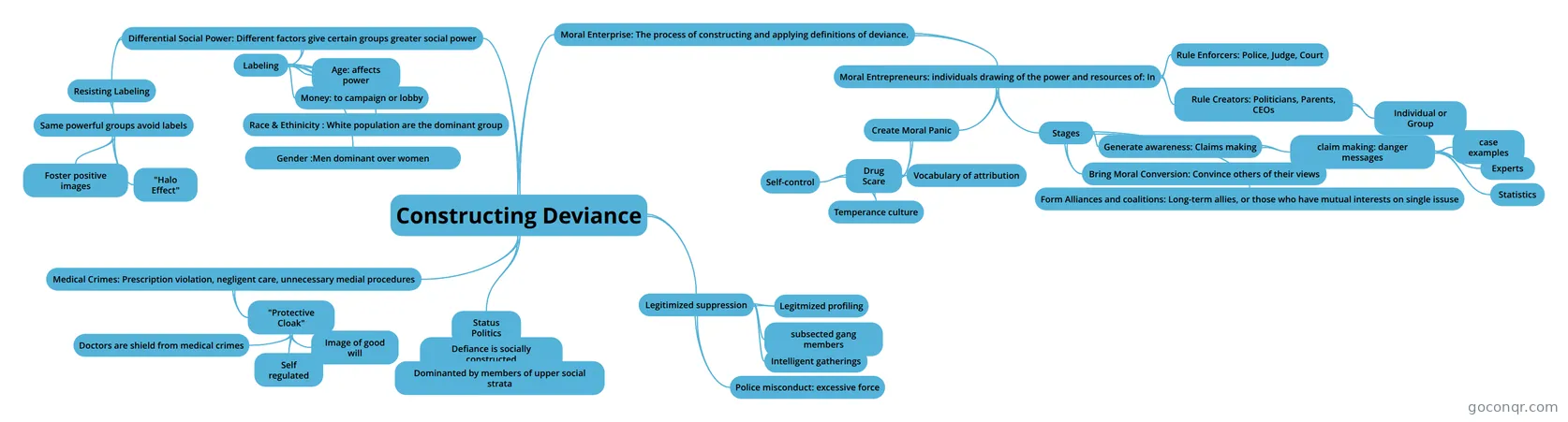 Mind map Constructing Deviance
Mind maps
Flashcards
-
33 cardsStudy Guide Part 2 Study guide for part 2 of Constructions of deviance.
-
43 cardsDeviant Behavior Study Guide 2 biological and psychological theories
-
37 cardsWeek 4 Study Guide Week 4 Study Guide
-
38 cardsPart 1 - Key Terms Key Terms to Part 1 Chapters 1-5
-
11 cardsStudy Guide Part 1 (pages 1-14) What are field researchers?
Flowcharts
Notes
-
Beckers social response (15) Exam Prep Three segments explaining criminal behaviour with Becker's social response approach (15) Social response approach is a labelling perspective, which forms part of the/a response strategy. &n...
-
Applying an Integrated Typology of Deviance to Middle-Class Norms
Slides
More Criminology topics
About Deviance and Labelling Theory
GoConqr OriginalWhat this unit covers
This unit sits in the Theories of Crime strand of Criminology. It collects material on how society reacts to deviance, not only on why people offend. The Labelling approach mind map is a good overview. It lists Kai Erikson, Howard Becker, Edwin Lemert, Goffman on stigma, Wilkins on deviancy amplification, Merton's self-fulfilling prophecy and Braithwaite on shaming.
Where to start
- Open the Labelling Crime and Deviance flowchart. It sets out a labelling essay plan, starting with Becker's claim that no behaviour is inherently deviant and moral entrepreneurs who draw attention to an act.
- Move to the Labelling Theory flashcards. They remind you that not everyone who commits crime is punished, and they cover Piliavin and Briar on agents of social control.
- Read the Jock Young - Labelling & Marijuana Users mind map, a 1971 study of hippie marijuana users in Notting Hill, London. It looks at the meanings behind the police view of them.
Widening the picture
The INTERACTIONALIST mind map explains why interactionists distrust official statistics and treat crime and deviance as socially constructed. British advances on the society of deviance. compares subcultural theory, which explains social action, with labelling theory, which explains social reactions. There are also notes on folk devils and moral panics, a Marxism and crime map, and a Strain Theory map for contrast.
Using quizzes and maps together
Read a mind map first, then test yourself. The Labelling quiz and the Saints and Roughnecks quiz check whether you can apply the ideas. The Theories of Deviance quiz goes back to Lombroso and biological explanations, so it is useful for comparison. Note what you missed and return to the matching map or flashcard deck. One listed note is exam preparation for A-level Sociology, on Becker's social response.
Next step
Choose one map, take one quiz, and see which terms feel shaky. Then make your own flashcards for them.
Frequently asked questions
Which resource should I open first?
Start with the Labelling Crime and Deviance flowchart. It gives a labelling essay plan built around Becker's view that no behaviour is inherently deviant. Then use the Labelling approach mind map to see the other key names, such as Lemert, Goffman, Wilkins and Braithwaite, in one place.
What do the mind maps cover?
They cover labelling and interactionism, Jock Young's study of marijuana users, deviant careers and identity, folk devils and moral panics, and the construction of deviance. Some maps also set labelling beside subcultural, strain and Marxist ideas, so you can compare theories.
Are the resources free to use?
Yes. Every resource listed here is free to open, study and take, with no account needed. They were made by GoConqr users, not by GoConqr itself. A free account also saves your quiz scores and lets you make your own quizzes, mind maps, flashcards and notes.
Which levels and exams do these suit?
Most of the material is aimed at university students and professional candidates, with a smaller share for school students. One listed note is exam preparation for A-level Sociology. Teachers can also use the maps and flashcards as ready-made material.
Which quizzes are on this page?
There are 4 quizzes: Labelling, Saints and Roughnecks, Theories of Deviance, and Biological Explanation of Deviance. The first two test labelling ideas directly. The other two help you compare labelling with older biological explanations of deviance.
What if I cannot find a topic I need?
Check the related maps and flashcard decks, since some topics sit inside broader resources, such as the study guides. If a topic is still missing, you can create your own notes, mind map or flashcards to fill the gap.