
Greetings and Everyday Expressions
104 resources created by 86 users
This Greetings and Everyday Expressions page on GoConqr gathers community-made flashcards, quizzes, mind maps and notes, from basic hellos and goodbyes to classroom commands, questions about yourself and idiomatic phrases with tener. It's built for school students practising greetings and simple conversation, and for teachers after ready-made material. There are over 90 resources here, including more than 10 quizzes, 6 mind maps and over 70 flashcards, many aimed at secondary level. Pick a deck, try a quiz to spot your gaps, then make your own set.
Top Greetings and Everyday Expressions resources
-
72 cardsSpanish Idioms And Fixed Expressions Dar por sentado
-
74 cardsFrases basicas del español (Español 105) Frases basicas del español
-
34 cardsSpanish Questions pasado ¿Qué te gustaba hacer?
-
33 cardsBasic Spanish Questions ¿Qué te gusta hacer?
-
52 cardsSpanish
-
34 cardsSpanish Vocab Quiz #1 Mostly greetings and basic convo stuff
-
24 cardsEspañol 101 Spanish Notecards for beginners. Personalized to my ideal study.
-
21 cardsBasic Greetings flashcards
Quizzes
See all 17 quizzes-
12 questionsHardest Exam Ever SCENARIO 1 Imagine that you are at this big party, and you drink like there's no tomorrow, so in mexican wo...
-
27 questionsQUIZ #2- CLASSROOM COMMANDS Open your books (to page...)
-
19 questionsGreetings The Spanish translation of "What is your name?" is...
-
13 questionsSpanish oral test unit 1 Como te llamas
-
20 questionsspanish test revision for 18/10/21
-
10 questionsBasic Spanish 1 - Lesson 1 Select 'welcome to Spanish!'.
-
10 questionsBasic Spanish Quiz I Part 2 Select "the apple"
-
10 questionsBasic Spanish Quiz I Part 1 Translate this sentence: Yo soy un niño.
Mind maps
Flashcards
See all 78 flashcards-
72 cardsSpanish Idioms And Fixed Expressions Dar por sentado
-
74 cardsFrases basicas del español (Español 105) Frases basicas del español
-
34 cardsSpanish Questions pasado ¿Qué te gustaba hacer?
-
33 cardsBasic Spanish Questions ¿Qué te gusta hacer?
-
52 cardsSpanish
-
34 cardsSpanish Vocab Quiz #1 Mostly greetings and basic convo stuff
-
24 cardsEspañol 101 Spanish Notecards for beginners. Personalized to my ideal study.
-
21 cardsBasic Greetings flashcards
Notes
-
Greeting Questions Greeting Questions ?Comó te llamas?Me llamo (your name)?Y tú? ?Y usted? ?Qué tal / Cómo estas??Cómo esta (usted) ?fenomenalmuy bienbienregularmal muy malfatal What is your name?My name is (your n...
-
Spanish Conversation Phrases - created from Mind Map Como estas? (How Are You?) Estoy muy bien, gracias (I'm very well thank you) Y usted? (And you?) Me llamo ..... (My name is .....)Como te llama? (What is your name?) Cuantos anos tienes? (How old are you?)Yo tengo ......
Slides
Topics in Greetings and Everyday Expressions
More Spanish language (as a school subject) topics
About Greetings and Everyday Expressions
GoConqr OriginalWhat the resources cover
This unit sits in the strand Foundations: Sounds, Greetings and Basics, within Spanish language. Most of what is listed is flashcards, and they start with the essentials. Basic Greetings flashcards run from Hola and Buenos dias to Como te llamas and mucho gusto. Español 101 adds questions such as where you are from and how old you are, with model answers.
Questions and classroom language
Basic Spanish Questions practises asking about likes, birthdays, ages and what someone is like. Spanish Questions pasado reuses many of the same questions and adds past-tense ones, such as asking where someone went. There is also a deck of classroom commands and phrases, from lee and escucha to repite and de nada, and a quiz on classroom commands.
Idioms and fixed expressions
Once the basics feel comfortable, move on to Expresiones Idiomaticas con Tener, which covers tener hambre, tener miedo, tener prisa and many more. Spanish Idioms And Fixed Expressions looks at phrases such as dar por sentado and suele decirse que. A mind map on idiomatic expressions gives a quick overview of the same ground.
A sensible order
- Start with Basic Greetings flashcards and the greetings quizzes.
- Move to Español 101 and Basic Spanish Questions for introductions and simple conversation.
- Add classroom phrases, then the tener and idiom decks.
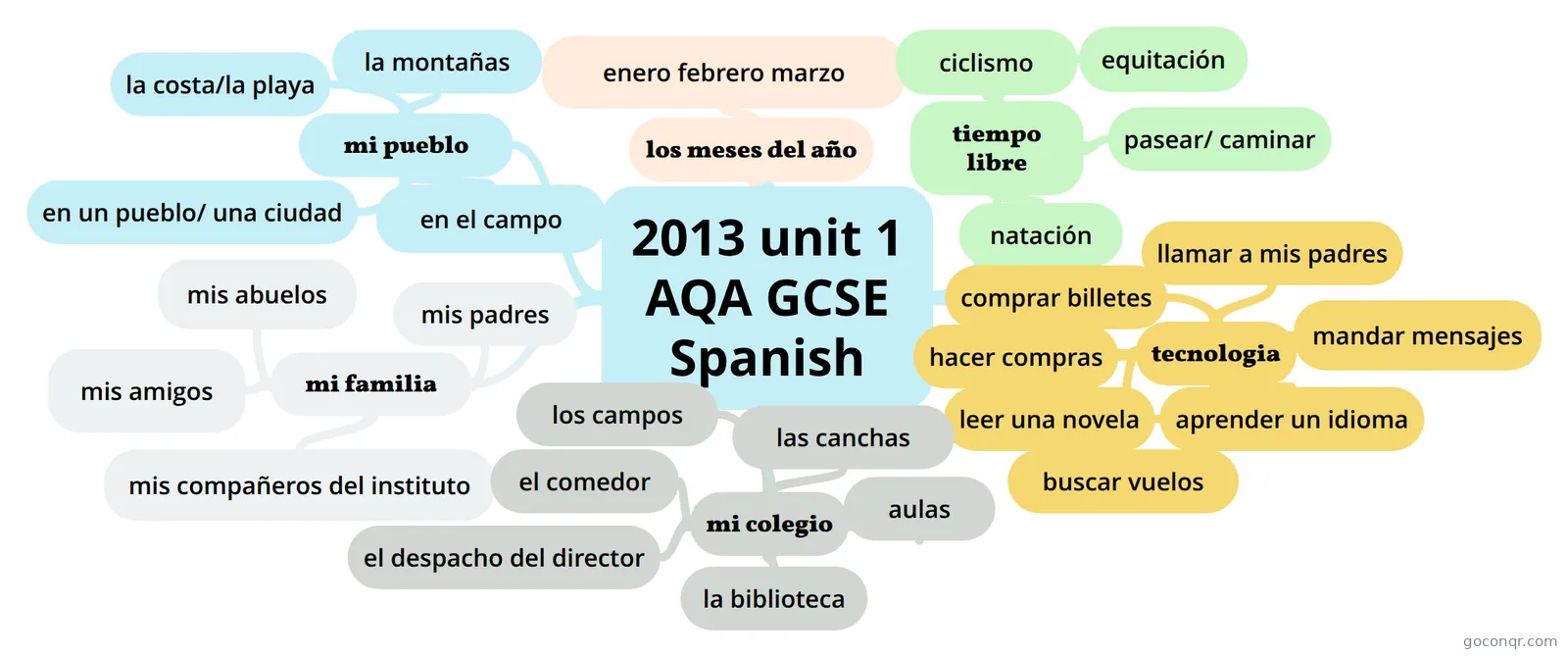
- Finish with the revision mind maps, including one for 2013 unit 1 AQA GCSE Spanish, and a test such as Spanish oral test unit 1.
Using quizzes and maps together
Read a mind map first to see how the topic fits together. Then take a quiz without looking at your notes. Any answer you miss tells you which flashcard deck to go back to. Teachers can pick a deck or quiz to set as a starter or a quick check.
Choose one deck today, work through it, and then try a quiz on the same theme.
Frequently asked questions
Which resource should I start with?
Begin with Basic Greetings flashcards. It covers hellos, goodbyes, asking how someone is, and giving your name. After that, Español 101 adds questions about where you are from and how old you are, so you can build short exchanges with a partner.
What do the mind maps cover?
There are 6 mind maps. They include Spanish Greetings, General Conversation, idiomatic expressions in Spanish, a general Spanish revision map, and one for 2013 unit 1 AQA GCSE Spanish. They work well as a quick overview before you try the quizzes.
Are there quizzes I can use to check my greetings?
Yes. There are more than 10 quizzes, including Quiz- Spanish greetings, Greetings, Practiquemos saludos en español and Spanish oral test unit 1. There is also a quiz on classroom commands. Use them after a flashcard deck to see what stuck.
Do the resources suit GCSE students?
Many of the resources are at secondary level, and one mind map refers to AQA GCSE Spanish. Greetings, introductions, likes and dislikes, and simple questions are all here, so school students can use them as practice alongside their own course materials.
Are the resources free, and who made them?
Every resource listed here is free to open, study and take, with no account needed. They were made by GoConqr users, not by GoConqr itself. A free account also saves your quiz scores and lets you create your own quizzes, maps, flashcards and notes.
What if I can't find what I need?
Try a nearby deck first. Questions, classroom phrases and idioms each have their own flashcards, so the phrase you want may sit in one of those. If not, make your own flashcards or a short quiz and use them for revision.