
Narrative, Descriptive and Creative Writing
191 resources created by 183 users
This Narrative, Descriptive and Creative Writing page on GoConqr gathers community-made quizzes, mind maps, flashcards and notes, from story structure and point of view to characters, settings and horror mood pieces. It's built for school students practising their story writing, and for teachers after ready-made material. There are over 170 resources here, including more than 120 mind maps, more than 20 flashcards decks and 8 quizzes, mostly at secondary level. Pick a topic that suits your next piece of writing and see what you can use.
Select topic
Top Narrative, Descriptive and Creative Writing resources
-
5 questionsPlots: Grasping Freytag's Pyramid Make a selection in each dropdown menu to place the parts of a story in proper chronological order: 1) [bla...
-
12 questionsCreative writing purposes Which of the following is not a form of writing to imagine, explore or entertain?
-
 Mind map Ingredients to a Successful Story Ingredients I think personally are needed to write a successful English story.
-
28 cardsElements of Fiction Review What POV is this piece of text: The boys knew they needed to get out of this house! They were all super sca...
-
42 cardsEnglish Exam the central/main character in a story, drama, or dramatic poem
-
Mind map How to write an excellent Narrative
-
Mind map How to present a clear viewpoint in writing
-
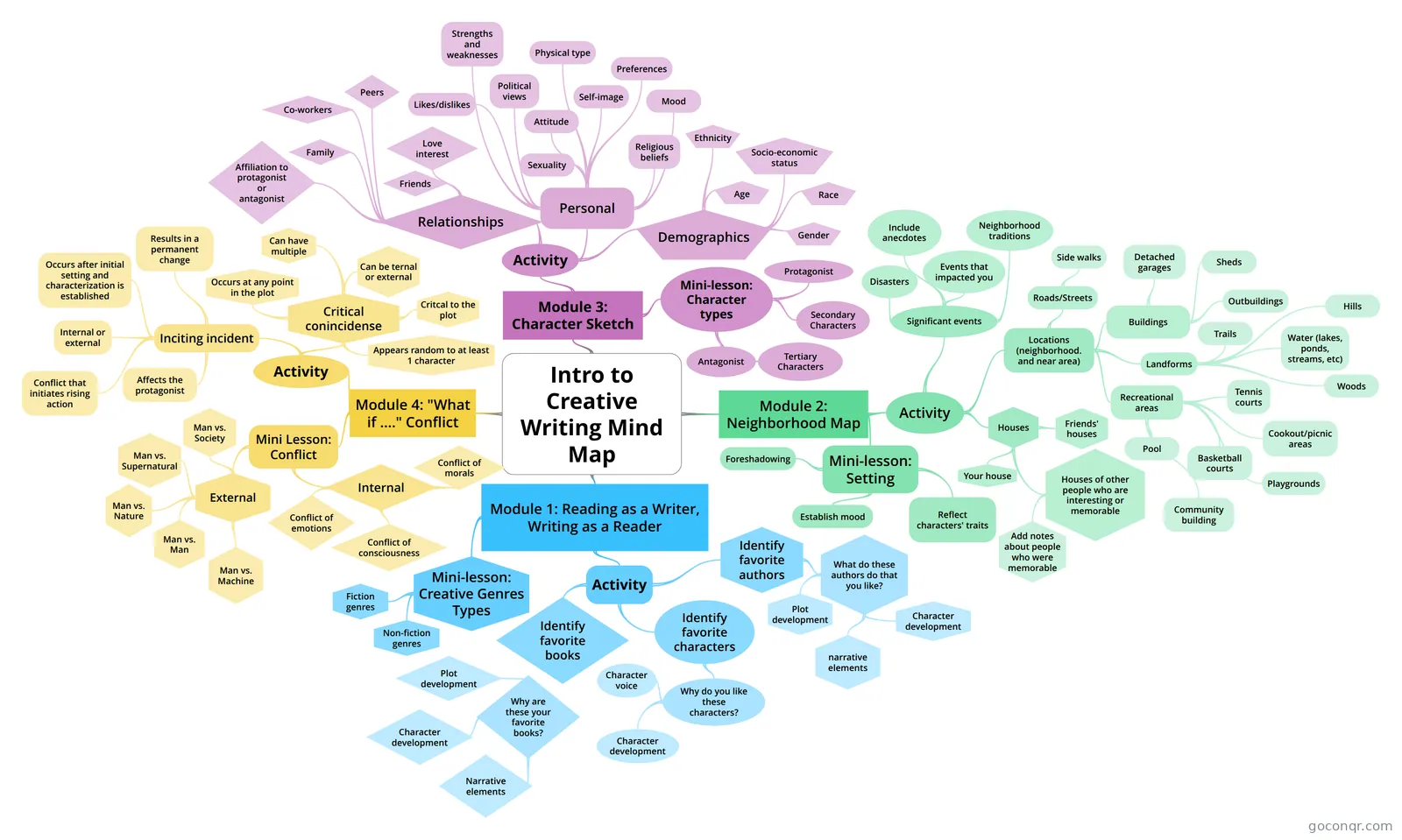 Mind map Intro to Creative Writing Mind Map Introduction to Creative Writing is a learning environment for people who would like to start a personal wr...
Quizzes
See all 11 quizzes-
5 questionsPlots: Grasping Freytag's Pyramid Make a selection in each dropdown menu to place the parts of a story in proper chronological order: 1) [bla...
-
12 questionsCreative writing purposes Which of the following is not a form of writing to imagine, explore or entertain?
-
12 questionsConcept 1 Practice Quiz This type of descriptive writing is meant to inform, and is often used in scientific writing.
-
26 questionsUntitled How many different kinds of conflict are there?
-
13 questionsLA story types An epic is a traditional story that was created to explain mysteries of the universe
-
1 questionsPlot
-
5 questionsShort Story Unit Test 1. The framework of the story; the arrangement of events that makes the story stay together.
-
3 questionsThe Three Little Pigs What animals are the main characters of the story, "The Three little Pigs?"
Mind maps
See all 139 mind maps-
Ingredients to a Successful Story Ingredients I think personally are needed to write a successful English story.
-
How to write an excellent Narrative
-
How to present a clear viewpoint in writing
-
Intro to Creative Writing Mind Map Introduction to Creative Writing is a learning environment for people who would like to start a personal wr...
-
Point of View
-
How to Write a Good Story
-
Elements of the horror story
-
Short Story Writing
Flashcards
See all 24 flashcards-
28 cardsElements of Fiction Review What POV is this piece of text: The boys knew they needed to get out of this house! They were all super sca...
-
42 cardsEnglish Exam the central/main character in a story, drama, or dramatic poem
-
30 cardsshort story reveiw
-
19 cardsNarrative Writing *MIDTERMS* What is a narrative?
-
20 cardsUntitled the part of the story where you are given any backround information
-
19 cardsUntitled
-
11 cardsShort Stories Flashcards
-
16 cardsStory Elements Flash Cards True or False: In drama, the setting is usually established by stage directions and dialogue.
Flowcharts
Notes
See all 15 notes-
Composition/Creative Writing To understand and analyse the elements of descriptive writing. • To understand and analyse the elements of a short story. • To understand and analyse the elements of a personal essay. • To practice writing for a varie...
-
Narrative writting Who is telling the story?Is it first person? Is someone in the story telling the reader directly? In these kinds of narratives the narrator might be the main character – or it might be someone who is very minor. ...
-
How to present a clear viewpoint in writing - created from Mind Map Clear structure Use grammar correctly, punctuate and spell accurately Write in the First Person – The character tells the story, using the pronoun ‘I’.
-
English Horror Mood Piece Horror Mood Piece "we're all infected here"Dr Roberts locks the door, once, twice, three times. His hands are shaking as he slips his keys into his pocket, and turns to walk back down the cool, narrow hallway. Without...
-
HOW TO WRITE A GHOST STORY - creado desde un Mapa Mental DEVELOPING YOUR PLOT DEVELOPING YOUR CHARACTERS WRITING YOUR GHOST STORY
-
Waking up from a nuclear explosion - created from Mind Map scenario 1 scenario 2 scenario 3
-
Mystery genre - created from Mind Map STRUCTURE OF A MYSTERY Characters Setting
-
Untitled Elements of Story Plot~ a literary term used to describe the events that make up a story or the main part of a story. Setting~ the place or type of surroundings where something is positioned or where a...
Slides
Topics in Narrative, Descriptive and Creative Writing
More Spanish language (as a school subject) topics
About Narrative, Descriptive and Creative Writing
GoConqr OriginalWhat this unit covers
The resources here focus on how stories are built and how to write your own. Many look at plot, character, setting and point of view. Others look at mood, tension and showing rather than telling, with a few sample pieces to read alongside.
Where to start
- Try the quiz Plots: Grasping Freytag's Pyramid. You place the parts of a story in order using dropdown menus, which is a quick check on plot structure.
- Read the mind map Elements of Fiction, which breaks down character, setting, mood, theme and style.
- Open the notes Narrative writting, which ask who is telling the story and whether it is first person.
- Look at LABOV'S NARRATIVE STRUCTURE, a mind map that begins with the abstract and the orientation.
Using quizzes and maps together
Read a mind map first, then test yourself. After Elements of Fiction, the flashcards in Elements of Fiction Review and short story reveiw let you check terms such as round character, flat character, climax and irony. Return to the map for any term you miss.
For planning, Creating a Good Story_1 walks through setting the scene, introducing a character and describing the conflict. Ingredients to a Successful Story gives examples of settings. You can then use the quizzes Plot and Short Story Unit Test to see how well the ideas have stuck.
Descriptive and creative practice
For description, the mind map Describe a sinister street at night and the notes English Horror Mood Piece show how atmosphere is built. The notes Creative Writing Tips and How to create a setting give shorter, practical advice. Several maps also retell The Three Little Pigs, which makes a handy short story for comparing structure.
Where it fits
This unit sits in the Writing strand of Spanish language as a school subject, within Languages and literature. Pick one resource that matches your next piece of writing, work through it, then add your own notes or maps.
Frequently asked questions
Which resource should I open first?
Start with the quiz Plots: Grasping Freytag's Pyramid. It asks you to put the parts of a story in order, so you quickly see how well you know plot structure. Then move on to the Elements of Fiction mind map for character, setting, mood and theme.
What do the mind maps cover?
The mind maps cover story structure, character creation, setting, point of view, mood and style. Some, such as LABOV'S NARRATIVE STRUCTURE, break a model into numbered parts. Others are planning maps for a specific piece, like Describe a sinister street at night or the horror story elements.
Are the resources free to use?
Yes. Every resource on this page is free to open, study and take, with no account needed. They were made by GoConqr users rather than by GoConqr itself, so styles vary. A free account also saves your quiz scores and lets you make your own quizzes, maps, flashcards and notes.
Are there flashcards for story terms?
Yes. There are over 20 flashcard decks, including short story reveiw, Elements of Fiction Review and Story Elements Flash Cards. They define terms like round and flat characters, narrator, theme, exposition, rising action and climax, so they work well after reading a mind map.
Who are these resources for?
They are mainly for school students, with most at secondary level, who want to plan and improve narrative, descriptive and creative writing. Teachers can also use the maps, notes and quizzes as ready-made material for lessons on story structure and setting.
What if I can't find the topic I need?
Try a nearby resource first. Notes such as Creative Writing Tips or the map How can I improve my creative writing? often cover related ground. If a topic is still missing, you can build your own mind map or flashcards on it.