
Linear Functions and Straight-Line Graphs
15 resources created by 15 users
This Linear Functions and Straight-Line Graphs page on GoConqr gathers community-made quizzes, mind maps, flashcards, notes and slides, from gradients and intercepts to parallel and perpendicular lines. It's built for school students revising a topic and teachers after ready-made material, with a nod to university students too. There are over 80 resources here, including more than 50 mind maps and more than 8 quizzes. Pick a mind map to get your bearings, then try a quiz to see what sticks.
Top Linear Functions and Straight-Line Graphs resources
-
9 questionsEQAO MC linear relations High school theatre companies earn their income through start-up grants and ticket sales. The graph shows t...
-
Mind map Linear Graphs Sorry you might need to zoom in to read stuff because i had to make things small so they could fit.
-
5 questionsSlope From Word Problems Practice Nina walks everyday to lose weight. She loses 0.3 pounds per day and has lost 4 pounds so far.
-
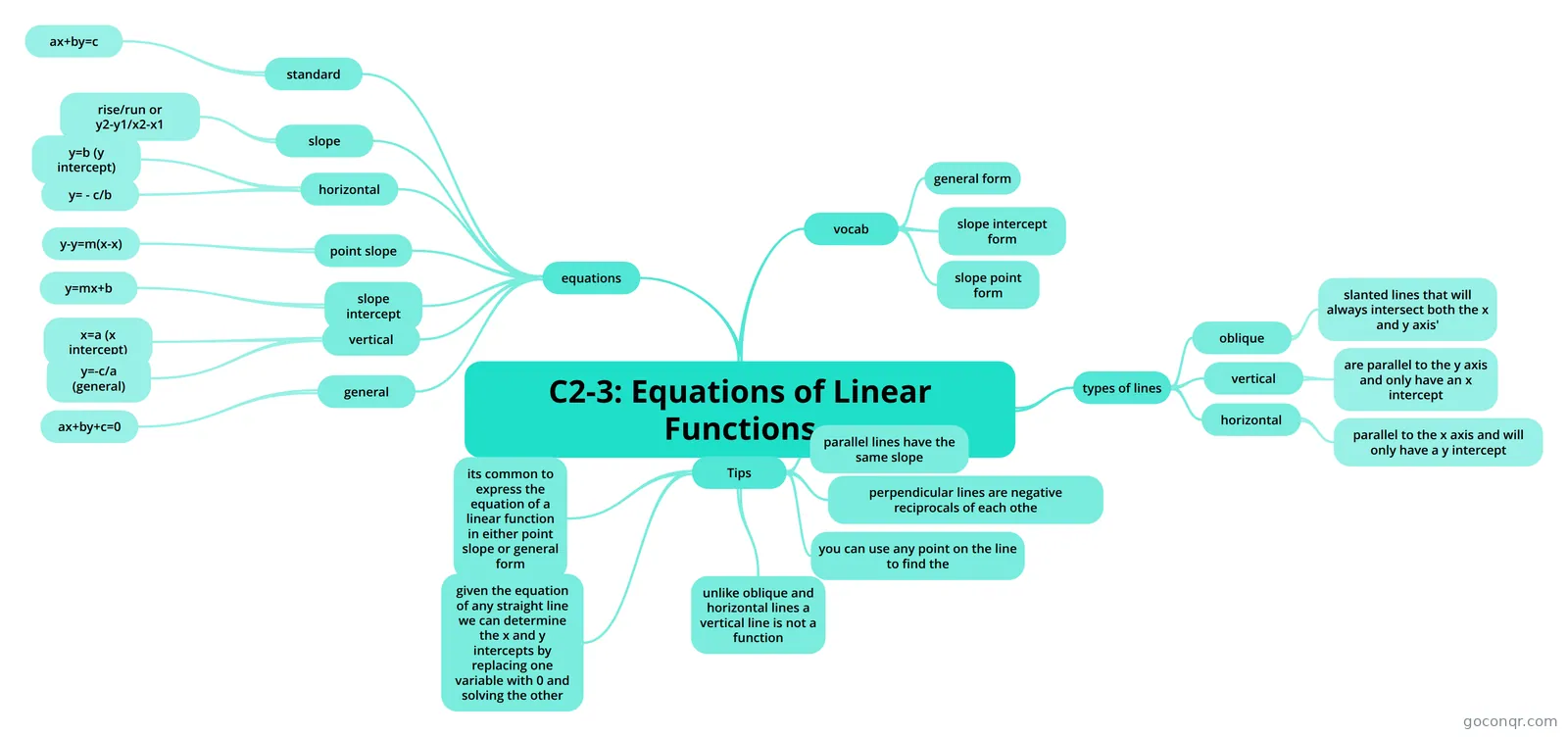 Mind map C2-3: Equations of Linear Functions
-
5 cardsParallel and perpendicular lines Parallel lines have the same...
-
4 cardsDirect Variation Direct Variation equation
-
5 questions2.1 & 2.2 Check-In Find the distance between (6,4) and (-8, 11)
-
22 cardsMath Final 137 What is a y intercept?
Quizzes
-
9 questionsEQAO MC linear relations High school theatre companies earn their income through start-up grants and ticket sales. The graph shows t...
-
5 questionsSlope From Word Problems Practice Nina walks everyday to lose weight. She loses 0.3 pounds per day and has lost 4 pounds so far.
-
5 questions2.1 & 2.2 Check-In Find the distance between (6,4) and (-8, 11)
-
2 questionsSlope From Tables what is the slope of this table
Mind maps
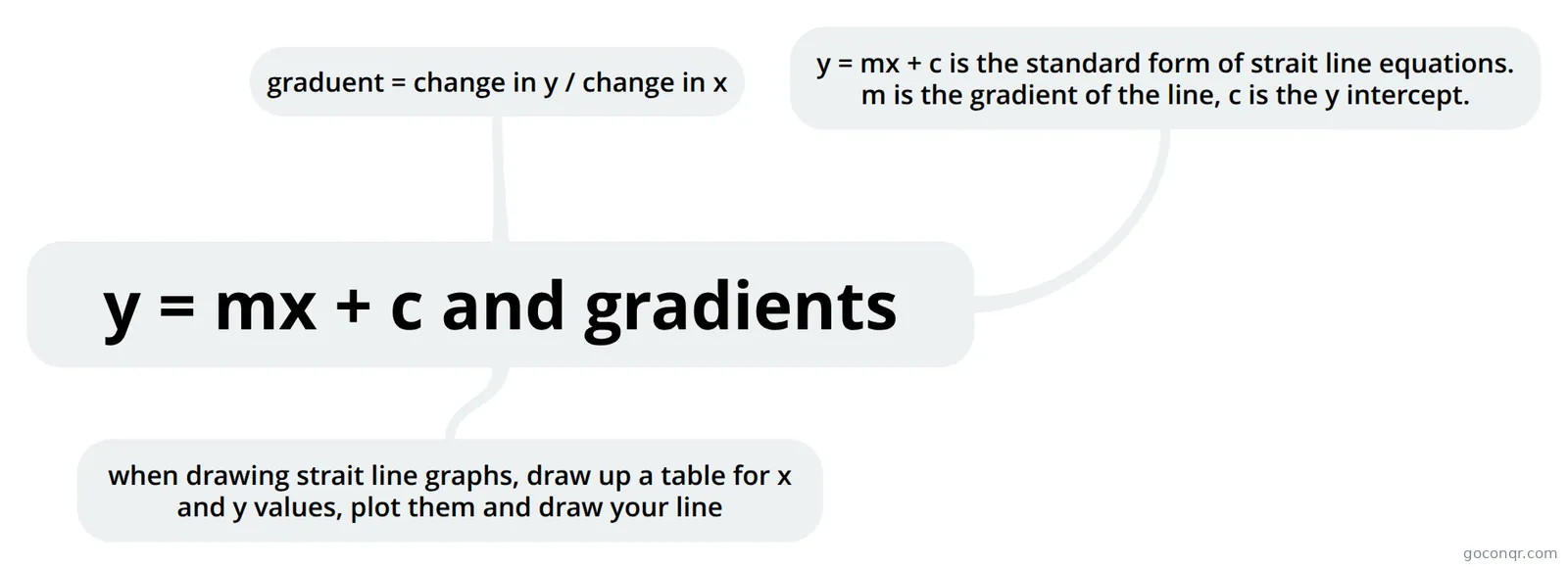
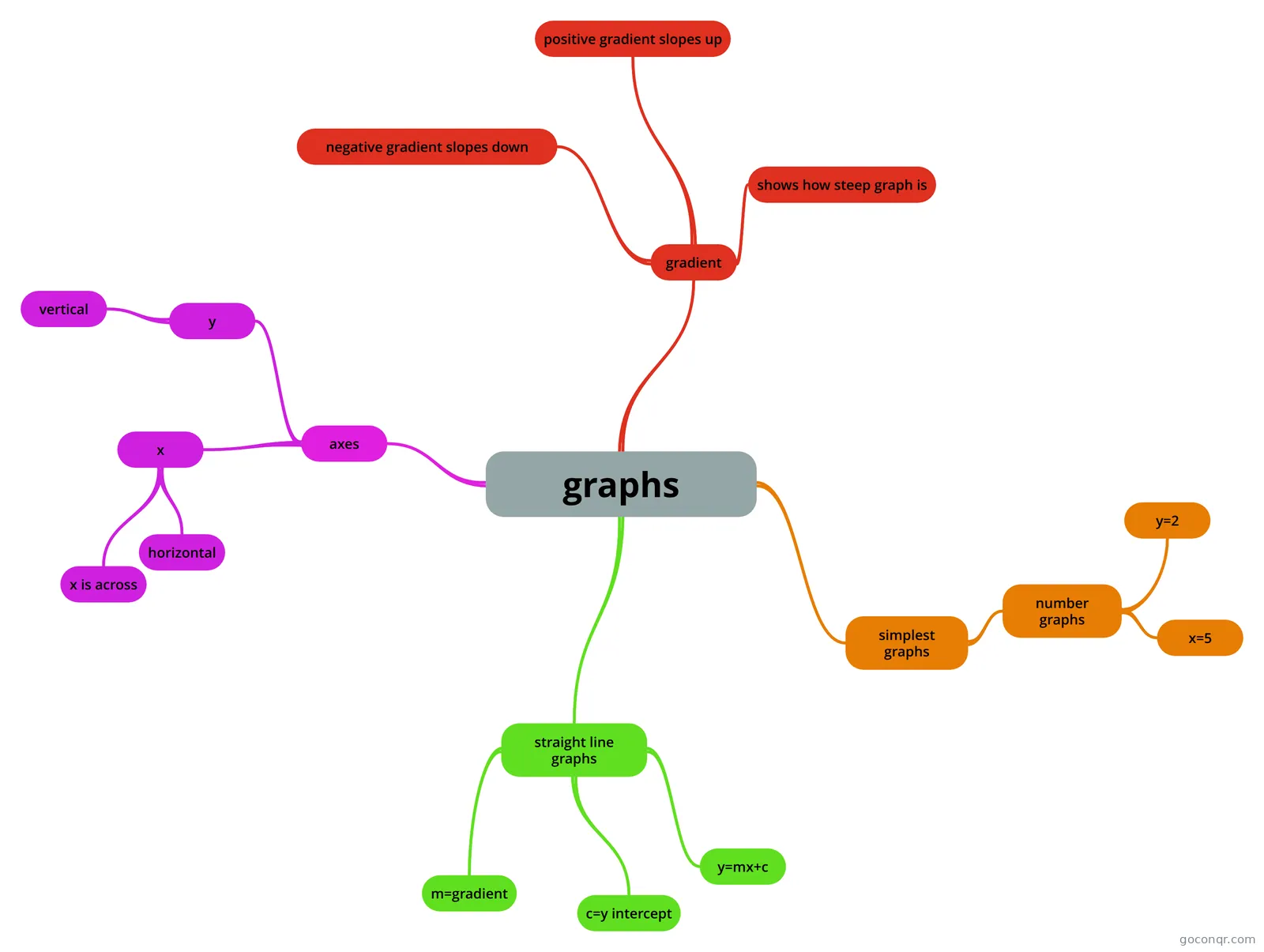
Flashcards
Notes
-
Equation of a Line Study Notes Parts of a Line: Slope (gradient) y-intercept x-intercept Other points on the line Slope y-intercept Form The equation of a linear line can be written as y=mx+b y denotes the dependent variable x denotes the independe...
-
EOG Notes 8th Math Notes: To find the slope, the equation is y2 - y1 then x2 - x1. The difference between y2 and y1 will be the top number. On a graph, find a point and then go up and over (rise then run). Put the rise...
More Mathematics topics
About Linear Functions and Straight-Line Graphs
GoConqr OriginalWhat this unit covers
The resources here all deal with straight lines: how to read them, draw them and write their equations. The mind map Linear Functions sets out slope-intercept form, standard form and point-slope form, and says when each one is useful. Linear Graphs covers parallel lines, which share the same gradient, and perpendicular lines. Linear Graph and Coordinate Geography starts at the basics of reading coordinates such as (6,2).
Where to start
Begin with a mind map. Linear Graph and Coordinate Geography is a gentle first step if coordinates feel shaky. Then move to Straight line graphs- Gradients, which walks through finding two accurate points, working out the change in y and the change in x, and checking the sign of the gradient.
Next, try Graphs for y=mx+c and finding an equation from coordinates, or C2-3: Equations of Linear Functions for finding intercepts by setting one variable to 0.
Using notes and flashcards
The Equation of a Line Study Notes break a line into its slope, y-intercept, x-intercept and other points. Once you have read them, the The Straight Line flashcards test quick facts, such as the gradient and equation of horizontal and vertical lines. The Parallel and perpendicular lines deck is a short follow-up.
Putting quizzes and maps together
Read a map, close it, then take a quiz on the same idea. Identifying Slope from table, graph and equation. and Slope From Word Problems Practice both check slope in different forms. For reading a graph in context, try EQAO MC linear relations. If a question goes wrong, go back to the matching map and look at the step you missed. For exam-style practice, the Straight Line Past Paper Questions slides sit alongside the GCSE Maths mentions in the listed resources.
Where it fits
This unit sits in the Functions and Graphs strand of Mathematics. Most of the material is aimed at school level. Teachers can pick maps or decks to share with a class. Choose one resource today and see how far a short session gets you.
Frequently asked questions
Which resource should I open first?
Start with a mind map. Linear Graph and Coordinate Geography covers coordinates, while Linear Functions compares the three equation forms. Both give a quick overview before you move on to gradients, intercepts and the quizzes.
What do the mind maps cover?
They cover gradients, intercepts, y=mx+c, point-slope and standard form, coordinates, and parallel and perpendicular lines. Some are tied to chapters or tests from a particular class, so skim the opening lines to see whether one fits what you are revising.
Are the resources free to use?
Yes. Every resource listed here is free to open, study and take, with no account needed. They were made by GoConqr users, not by GoConqr itself, so styles and depth vary from one to the next.
Which levels and exams do they suit?
Most of the resources are at school level, with a small share at university level. The listed material mentions GCSE Maths, so GCSE students will find relevant items, including the Straight Line Past Paper Questions slides.
Are there quizzes on slope?
Yes. Identifying Slope from table, graph and equation. and Slope From Word Problems Practice both test slope, and there is also a quiz called Slope From Tables. They suit checking yourself after reading a gradient map.
What if I cannot find what I need?
Try a nearby resource first, as many maps and decks overlap. If a gap remains, a free account lets you save quiz scores and make your own quizzes, mind maps, flashcards and notes for the exact topic.