
Organisational Behaviour
237 resources created by 181 users
This Organisational Behaviour page on GoConqr gathers community-made quizzes, mind maps, flashcards and notes, from job satisfaction, motivation and personality to leadership, conflict and managing diversity. It's built for university students revising a topic or filling gaps, and for teachers after ready-made material. There are over 230 resources here, including more than 10 quizzes, over 160 mind maps and over 40 flashcard decks, made by more than 170 contributors. Pick a topic, try a quiz, then make your own maps.
Select topic
- Human Relations Theory7
- Personality and Individual Differences23
- Diversity in the Workplace13
- Work Attitudes and Job Satisfaction33
- Emotions and Emotional Intelligence11
- Perception, Learning and Decision Making8
- Employee Motivation15
- Job Design and Performance16
- Groups, Teams and Communication8
- Leadership18
- Power and Organisational Politics9
- Conflict and Negotiation8
- Organisational Justice and Psychological Contracts6
- Wellbeing and Stress at Work6
- Organisational Culture, Structure and Change5
Top Organisational Behaviour resources
-
77 questionsMGT ch 14 An interdisciplinary field dedicated to the study of how individuals and groups tend to act in organization...
-
20 cardsMGMT330 Chapter 4
-
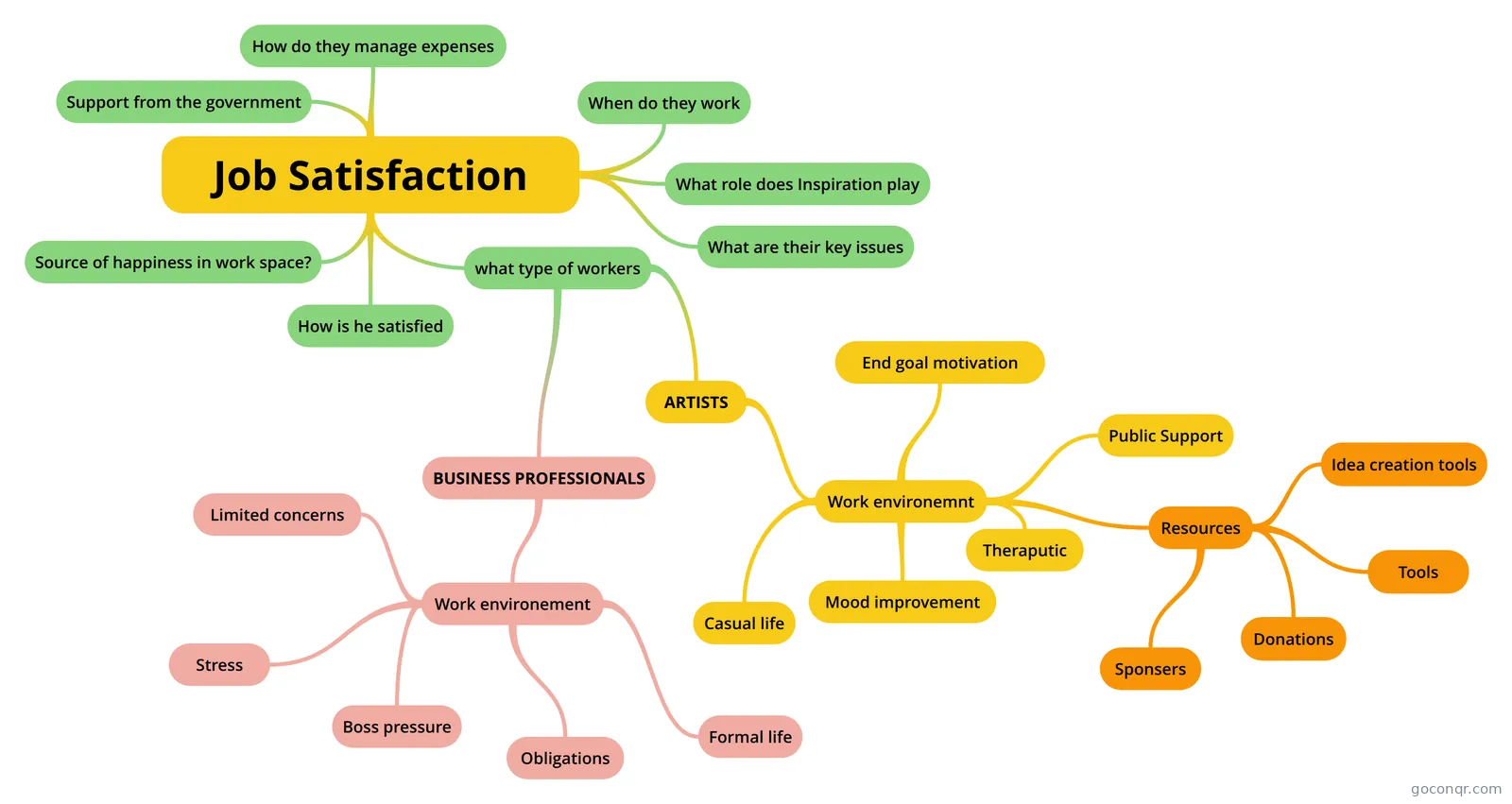 Mind map Job Satisfaction When we look at work balance of working individuals, those in creative professions are relatively low-paid,...
-
200 cardsI-O Comprehensive Exam (Deck 1) Aquino & Thau (2009)
-
29 cardsOccupational Stress Why Occupational Stress should be addressed?
-
16 cardsOCL - Leadership Definition of Leadership
-
24 cardsJob satisfaction - 7 what is job satisfaction
-
15 cardsTheories of Work Motivation in Organizational Behaviour What is Motivation?
Quizzes
See all 20 quizzes-
77 questionsMGT ch 14 An interdisciplinary field dedicated to the study of how individuals and groups tend to act in organization...
-
46 questionsMGT-312 Exam 1 Study Guide Big Five Personality Dimensions
-
35 questionsWOJD 1. Job performance has been defined as a three-dimensional phenomenon. Which of the following aspects is no...
-
25 questionsTEAM-3. L.E.A.D HR- ONLINE QUIZ ROUND One of the famous process theory of motivation comprises of which of the following components:-
-
25 questionsTEAM-1. L.E.A.D HR- ONLINE QUIZ ROUND One of the famous process theory of motivation comprises of which of the following components:-
-
25 questionsTEAM-2. L.E.A.D HR- ONLINE QUIZ ROUND One of the famous process theory of motivation comprises of which of the following components:-
-
25 questionsTEAM-5. L.E.A.D HR- ONLINE QUIZ ROUND One of the famous process theory of motivation comprises of which of the following components:-
-
25 questionsTEAM-6. L.E.A.D HR- ONLINE QUIZ ROUND One of the famous process theory of motivation comprises of which of the following components:-
Mind maps
See all 163 mind maps-
Job Satisfaction When we look at work balance of working individuals, those in creative professions are relatively low-paid,...
-
Conflict and negotiation
-
Psychological Contracts W2
-
Job Analysis and Performance
-
Final Mindmap: Job Performance & Commitment
-
Organisational Justice W5
-
Motivation and rewards W3
-
personality and selection
Flashcards
See all 45 flashcards-
20 cardsMGMT330 Chapter 4
-
200 cardsI-O Comprehensive Exam (Deck 1) Aquino & Thau (2009)
-
29 cardsOccupational Stress Why Occupational Stress should be addressed?
-
16 cardsOCL - Leadership Definition of Leadership
-
24 cardsJob satisfaction - 7 what is job satisfaction
-
15 cardsTheories of Work Motivation in Organizational Behaviour What is Motivation?
-
66 cardsManaging People Describe Theory X
-
176 cardsOrganizational Behaviour
Flowcharts
Notes
-
personality and selection - created from Mind Map Organisational behaviour provides a conceptual ‘toolbox’, a ‘Swiss army knife’, to help to explain, predict, and control organisational actions” – Bratton (2015) Personality: Relatively stable, individual difference c...
-
Power and Organisations Power - what is it? Importance of Power - positive Defining power - Weber, Inextricably part of groups Power s a resource Sources of Power Based on inequality - unequal dependence e.g. parent/child or employer/em...
-
Managing Diversity Diversity is a new issue Gender - theoretical equal access Nationality/Ethnicity - understood perceptions Physical Disability - not the same as intellectual ability Sexual Orientation - nobody else's business Ag...
-
Gender and Organisations Everyone's ConcernJob Segregation ''Women's work' - low pay. low status 'Skill' - socially constructed Career Opportunities Social Networks - exclusive Selection Processes - who 'deserves' promotion Internal ...
-
Part 1 - Human Relations. HUman relations is the study of how people get along with one another. Reinforcement is nothing more than a reward that follows something you do. Self confidence, consideration, and communication are three key factors...
-
Manager_1 - created from Mind Map Motivation Two-Factor Theory Hierarchy of Needs Theory Theory X and Y McClellan's Theory of Needs Equity Theory Affect Motivation Hygiene X=dislike works Y= as natural as rest or play Referent an employee selects Self...
-
Great Place to Work - created from Mind Map The Psychological ContractAfter one finds their great place to work the individual employee makes an implicit contract involving the mutual expectations shaped by employer and employee. * Sharing Info Broadly Ac...
-
1.1 Define human relations Introduction to Human Relations Human Relations- studying how people get along with one another.
Topics in Organisational Behaviour
More Human resources topics
About Organisational Behaviour
GoConqr OriginalWhat this unit covers
The unit sits in the People and Organisations strand of Human resources. Almost all of it is written at university level, so it suits anyone working through an organisational behaviour course. The material follows the topics a course usually moves through: attitudes, motivation, stress, leadership, groups, conflict, power and diversity.
Where to start
Begin with the flashcard deck MGMT330 Chapter 4. It defines attitude, affect, cognitive dissonance, social learning, job satisfaction and organizational citizenship behaviour, plus affective, continuance and normative commitment. Those terms come up again in many other resources here.
Next, read the mind map Job Satisfaction and the deck Job satisfaction - 7. The deck covers Hofstede's dimensions of culture and how job satisfaction is measured, with approaches such as the JDI and MSQ.
Topics to explore next
- Motivation: the deck Theories of Work Motivation in Organizational Behaviour separates intrinsic from extrinsic motivation. The maps Motivation Theories and Motivation at Work sit alongside it.
- Stress and wellbeing: the deck Occupational Stress covers Selye's General Adaptation Syndrome, stimulus-based and transactional theories. The map Work-life Balance is a lighter companion.
- Leadership: the deck OCL - Leadership compares leadership with management and works through trait and behavioural theories.
- Conflict and people: the map Conflict and negotiation separates functional from dysfunctional conflict. The notes Managing Diversity, Gender and Organisations and Power and Organisations cover diversity, gender and power.
Using quizzes and maps together
Read a mind map first to see how a topic fits together. Then take a quiz, such as MGT ch 14, which opens with the definition of organisational behaviour and moves to behaviour beyond job requirements. Wrong answers show you which flashcards to revisit. Teachers can use the quizzes and maps as ready-made starting points for a seminar or revision session.
Make it your own
Choose one topic from the list above, work through its map, deck and quiz, and then build your own version of whatever felt thin.
Frequently asked questions
Which resource should I open first?
Start with the flashcard deck MGMT330 Chapter 4. It covers attitudes, job satisfaction, organizational citizenship behaviour and the three kinds of organizational commitment. Those ideas return in many other resources on the page, so they make a sensible base before you move on to motivation, stress or leadership.
What do the mind maps cover?
The mind maps cover job satisfaction, attitudes, motivation, personality, work-life balance, organisational justice, psychological contracts, conflict and negotiation, and team and diversity management. There are also maps on job performance and on interpersonal relations at Disney and Coca-Cola, which suit anyone who likes worked examples.
Are the resources free to use?
Yes. Every resource on this page is free to open, study and take, with no account needed. They were made by GoConqr users, not by GoConqr itself. A free account also saves your quiz scores and lets you create your own quizzes, mind maps, flashcards and notes.
Who are these resources for?
They are mainly for university students, since nearly all of the material is at that level. Teachers can also use the quizzes, maps and decks as ready-made material for lessons or revision. Students use them to check definitions, compare theories and find gaps in their understanding.
Is there anything on leadership and conflict?
Yes. The flashcard deck OCL - Leadership covers the definition of leadership, leadership versus management, and trait and behavioural theories. For conflict, the mind map Conflict and negotiation explains functional and dysfunctional conflict, and the flowchart Role of conflict adds another view.
What if the topic I need is missing?
Check nearby topics first, as many resources overlap. For example, attitudes and job satisfaction appear across several decks and maps. If you still cannot find what you need, create your own flashcards, mind map or notes, using the existing resources as a model.