
Set Theory
20 resources created by 17 users
This Set Theory page on GoConqr gathers community-made quizzes, mind maps, flashcards and notes, from set notation and Venn diagrams to subsets, set difference and the axioms of set theory. It's built for school students revising a topic, university students filling gaps, and teachers after ready-made material. There are over 100 resources here, including more than 10 quizzes, more than 40 mind maps and more than 30 flashcard decks, mostly at secondary level with a good share for university. Try a quiz to find your gaps.
Top Set Theory resources
-
23 cardsA level Maths Set Notation All the Set notation you are required to know for A-level maths: Sets
-
19 cardsSet Theory What is a Set?
-
Mind map Set Operations
-
13 questionsSet - Math Grade 3 Collection of Objects
-
6 cardsSymbols in Sets What does U mean in sets?
-
Mind map set and venn diagram
-
Mind map Basics of Set Theory: Natural and Real Numbers
-
14 questionsMathematics Quiz #1 Each element of the set is easily determined.
Quizzes
-
13 questionsSet - Math Grade 3 Collection of Objects
-
14 questionsMathematics Quiz #1 Each element of the set is easily determined.
-
5 questionsGrade 7 Math Quiz This Math quiz has 40 questions. Good luck! Topics: Sets Subsets Sets of Real Numbers Integers
-
2 questionsSet Theory Quiz Quiz for set theory
Mind maps
Flashcards
-
23 cardsA level Maths Set Notation All the Set notation you are required to know for A-level maths: Sets
-
19 cardsSet Theory What is a Set?
-
6 cardsSymbols in Sets What does U mean in sets?
-
5 cardsSets A set is a collection of well-defined objects. The objects in the set are called elements.
-
8 cardsMathematics - Sets What is a set?
-
11 cardsSet Theory n ( A U B ) or A U B
-
9 cardsSet Algebra
-
7 cardsVendiagrams and sets All about Vendiagrams and sets
More Mathematics topics
About Set Theory
GoConqr OriginalWhat the resources cover
The page lists work on the core language of sets. The flashcard deck A level Maths Set Notation runs through symbols such as membership, subset, union, intersection, complement and the number sets N, Z, R and Q. Symbols in Sets asks what U, N, the dash and the backslash mean. Set Theory flashcards begin with basics: what a set is, what its objects are called, and what an empty or universal set is.
Further along, Set Theory Defintions and Set Theory: Axioms move into the axioms of extensionality, pair set, power set and unions, plus equivalence and ordering relations. These suit university students more than anyone else.
Where to start
- Begin with the Set Theory flashcards or Symbols in Sets to learn the vocabulary and signs.
- Open the Set Operations mind map, which splits the topic into subset, proper subset, union, intersection, disjoint sets and complement.
- Move to the set and venn diagram mind map to see how expressions such as A U (B - C) are read.
- Finish with the Set Difference mind map and its matching questions quiz.
Using quizzes and maps together
Read a map first, then test yourself. The quiz Set - Math Grade 3 checks the idea of a collection of objects and the element symbol. Transitions Test 2 asks you to choose the right notation, for example for the set of all irrational numbers. Wrong answers show you which branch of a map to revisit. Teachers can pair a map with a quiz as a ready-made lesson task.
Where this unit sits
Set Theory belongs to the strand Logic, Sets and Discrete Mathematics within Mathematics. Neighbouring material on the page reflects that: Discrete Math Final Part 2 covers functions such as injective and surjective maps, and a mind map looks at the countability of Q.
Pick one resource from the list above, work through it, then try making your own map of the symbols you found hardest.
Frequently asked questions
Which resource should I open first?
Start with the Set Theory flashcards, which cover what a set is, its elements, and the empty and universal sets. If you only need the signs, Symbols in Sets explains U, N, the dash and the backslash. Then move on to the Set Operations mind map.
What do the mind maps on this page cover?
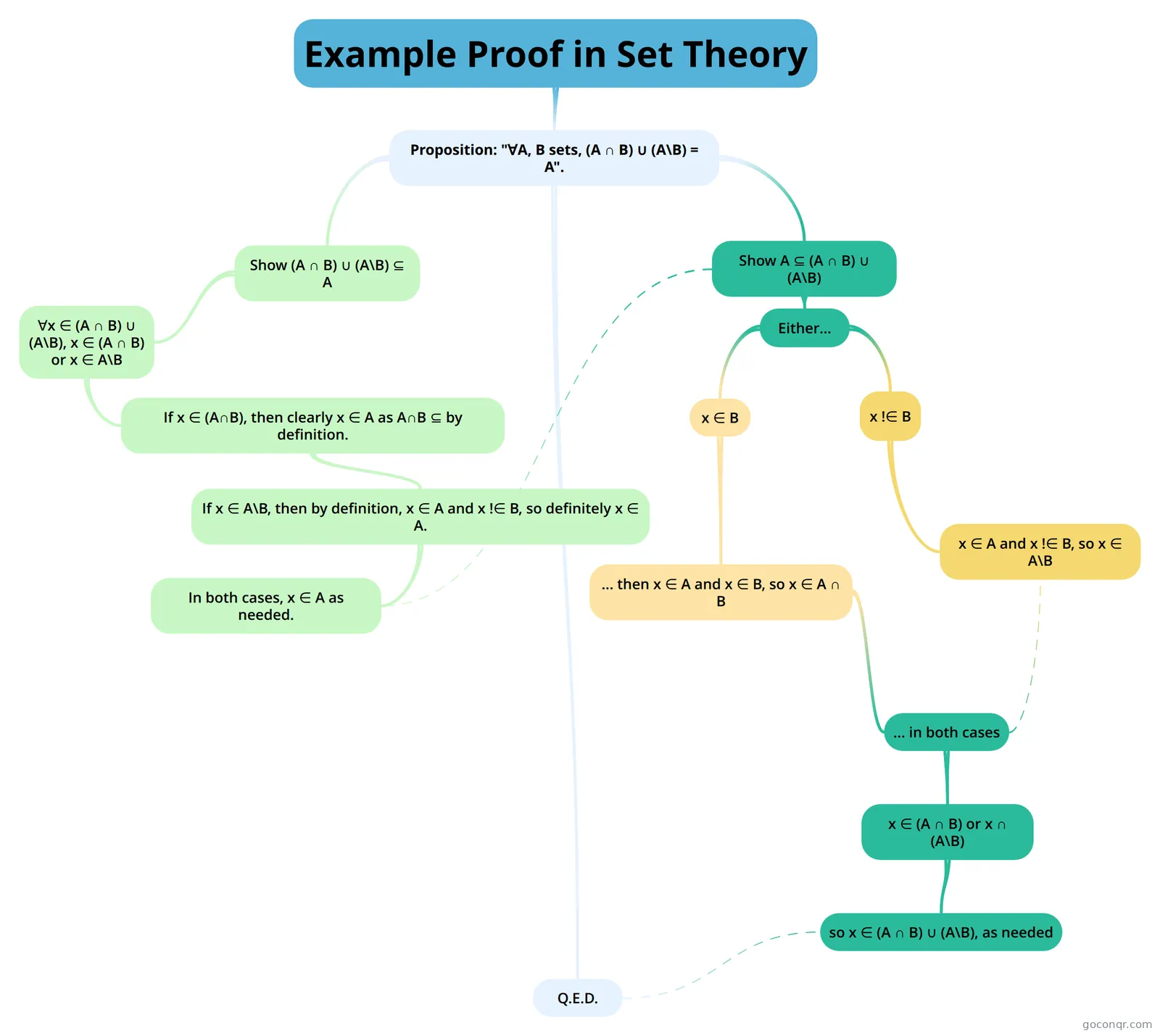
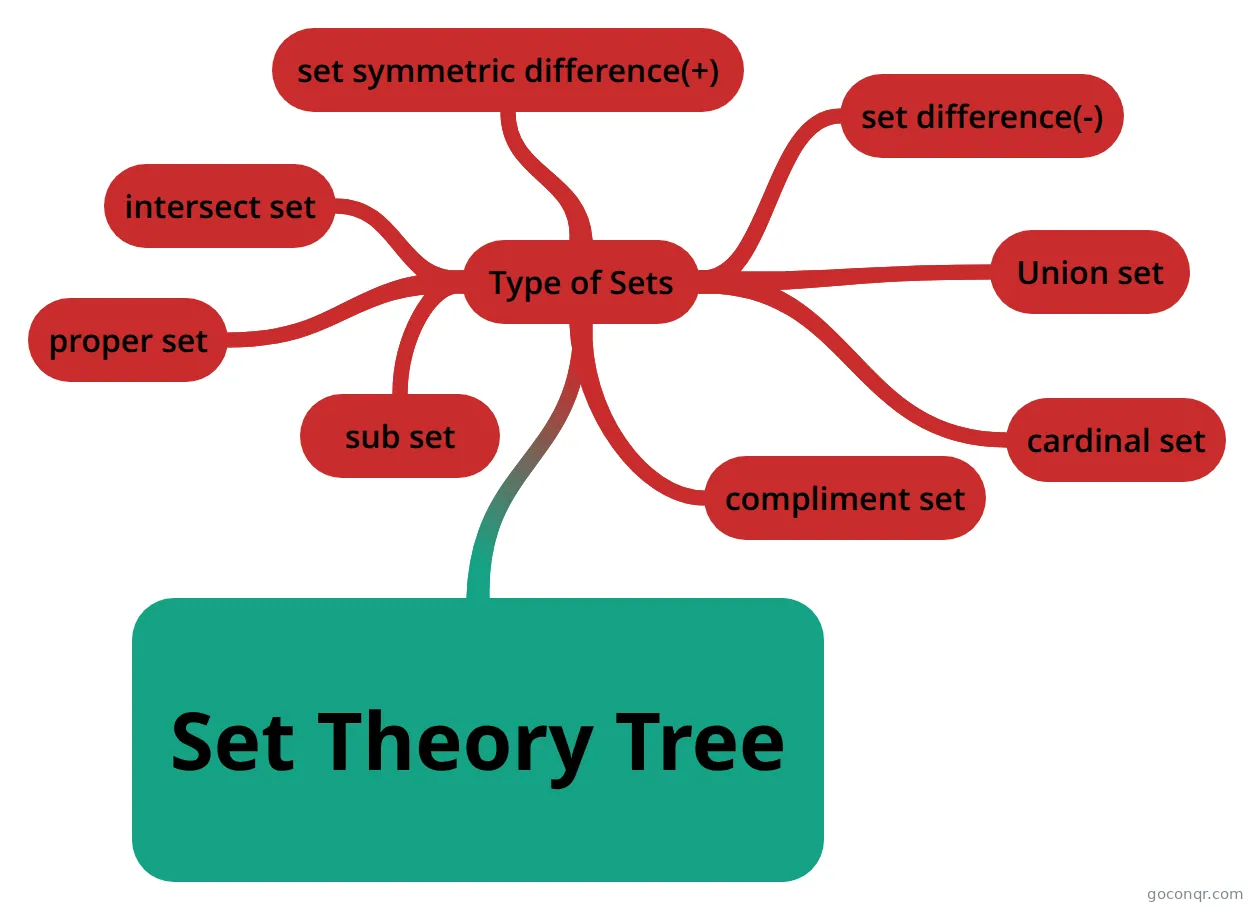
They cover set language and notation, subsets and proper subsets, union, intersection, disjoint sets, complement and set difference. Others look at Venn diagrams, inclusion and exclusion, an example proof, and the countability of Q. There are more than 40 maps to choose from.
Are the resources free to use?
Yes. Every resource listed here is free to open, study and take, with no account needed. They were made by GoConqr users rather than by GoConqr itself, so styles and depth vary. Check a title and excerpt to see whether it suits your level.
Which levels is this unit suited to?
Most of the resources are at secondary level, with a good share for university. School students will find notation, Venn diagrams and basic operations. University students can use the axiom flashcards, the Axiom of Choice deck and the discrete maths material.
Can I save my quiz scores or make my own material?
A free account saves your quiz scores and lets you make your own quizzes, mind maps, flashcards and notes. This is handy if you want a personal set of symbols or a map of the operations that you can revise from.
What if the topic I need is missing?
Try a neighbouring title first. Interval Notation is a flowchart, and Discrete Maths and Pure Math S1 sit nearby. You can also build your own map or flashcards on the missing topic, so you have something that matches your course.