
Somatosensory System and Pain
30 resources created by 24 users
This Somatosensory System and Pain page on GoConqr gathers community-made quizzes, mind maps, flashcards and notes, from receptors and receptive fields to gate control theory and descending control of pain. It's built for university students testing their recall and teachers after ready-made material. There are over 200 resources here, including more than 50 quizzes, over 60 mind maps and over 100 flashcard decks, all made by contributors. Pick a topic, try a quiz to find your gaps, then build your own study sets.
Top Somatosensory System and Pain resources
-
48 questionsSomatosensory System
-
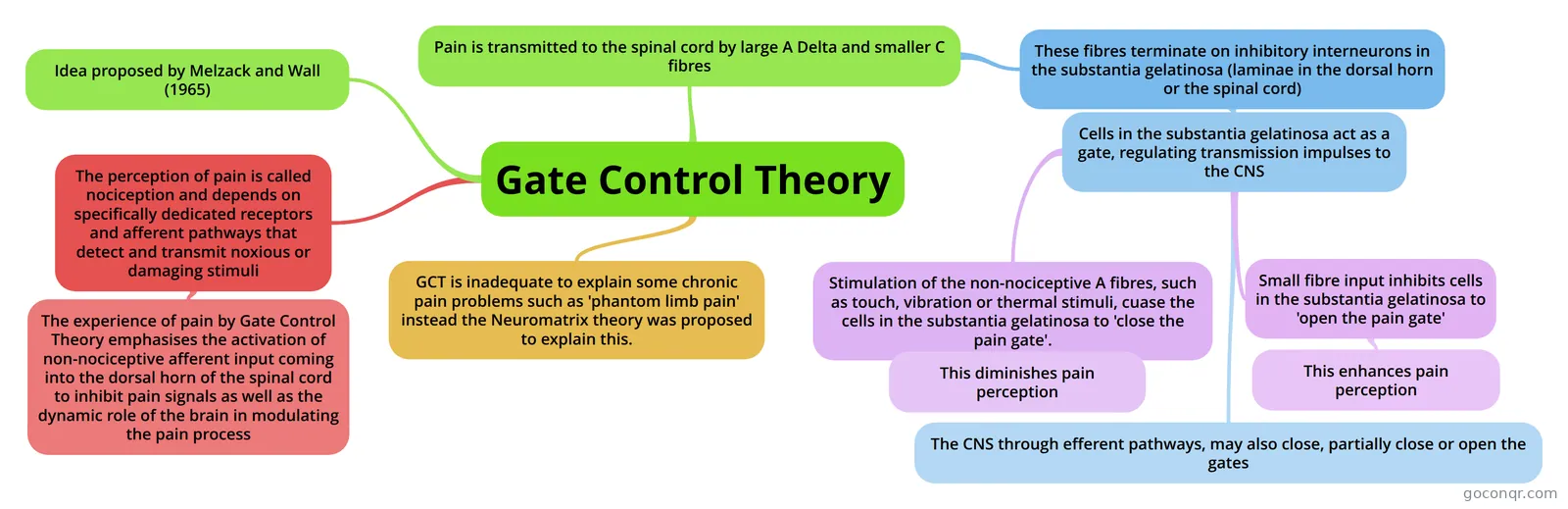 Mind map Gate Control Theory Notes taken from Physiology for Nursing Practice (1999) Hinchcliffe, S. Montague, S. Watson, R. 2nd Edition...
-
Mind map Leila has a Pain in her Arm
-
29 cardsWeek 3 What is pain?
-
35 questionsNoiceception Sherrington’s division of senses; choose correct
-
158 cardsSensory Receptors and PNS Sensory receptors detect what?
-
15 questionsSenses A&P Quiz What is in the middle ear?
-
27 cardsSensory Systems Week 9
Quizzes
-
48 questionsSomatosensory System
-
35 questionsNoiceception Sherrington’s division of senses; choose correct
-
15 questionsSenses A&P Quiz What is in the middle ear?
-
14 questionsQuiz 1 Which statement is not correct?
-
16 questionsL28 Sensory Receptors and the Somatosensory Cortex Sensory neurons are generally unipolar.
-
11 questionsPhysiology VIII: Pain and Thermosensation Physiology VIII: Pain and Thermosensation given by John peters on 7/9/2018
-
13 questionsPhysiology II: Somatosensory System 1 - Primary Sensory Neurones and their Modalities Somatosensory system 1: Primary sensory neurones and their modalities given on 3/5/18
-
18 questionsMATH TEST 2010 1. Visual acuity:
Mind maps
-
Gate Control Theory Notes taken from Physiology for Nursing Practice (1999) Hinchcliffe, S. Montague, S. Watson, R. 2nd Edition...
-
Leila has a Pain in her Arm
-
Pain
-
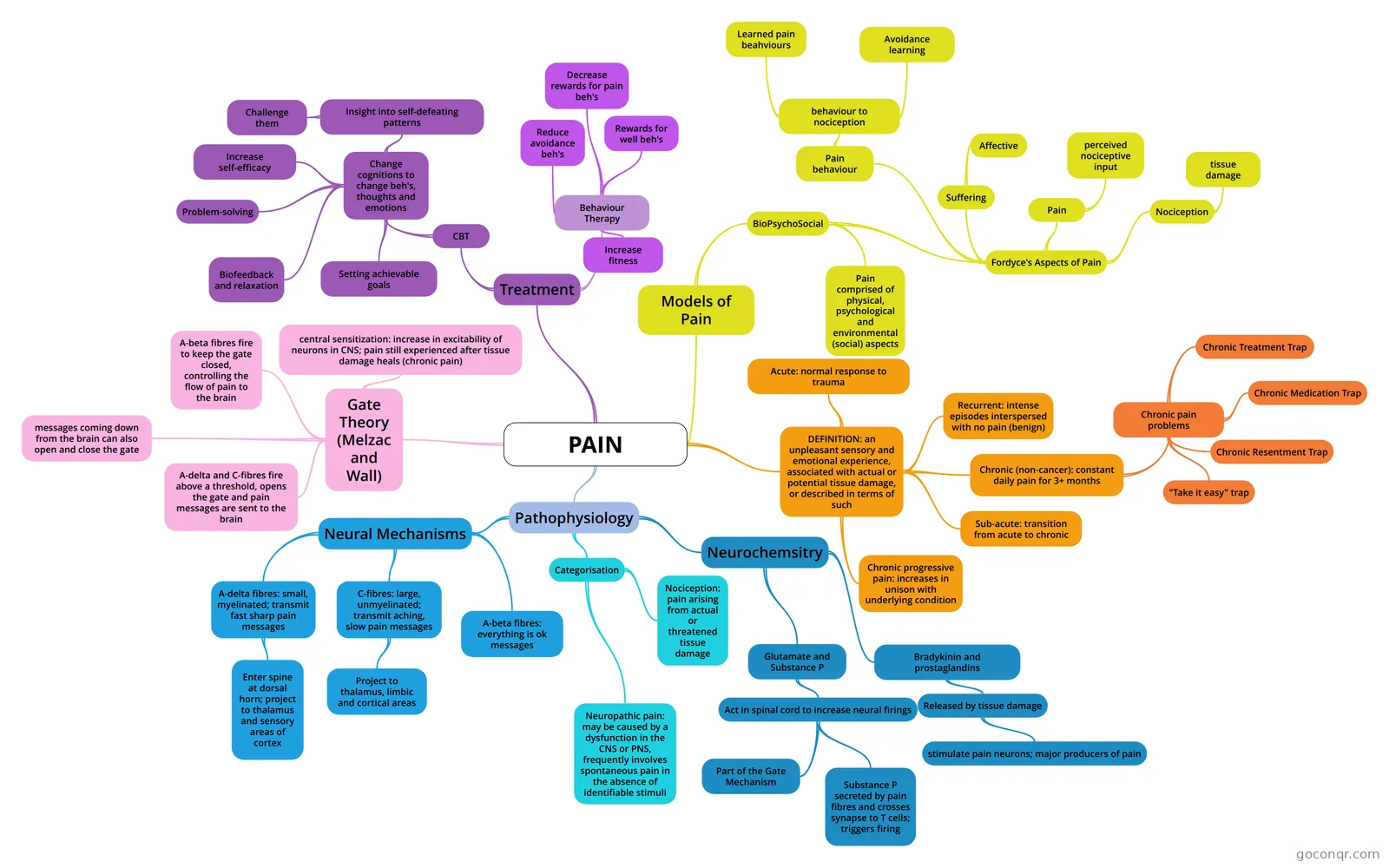 PAIN Pain
-
Laila has pain in her arm
-
Referred Pain Notes taken from Physiology for Nursing Practice (1999) Hinchcliffe, S. Montague, S. Watson, R. 2nd Edition...
Flashcards
See all 12 flashcards-
29 cardsWeek 3 What is pain?
-
158 cardsSensory Receptors and PNS Sensory receptors detect what?
-
27 cardsSensory Systems Week 9
-
40 cardsReceptors and receptive fields What do proprioreceptors respond to?
-
19 cardsPain There are two types of pain:
-
12 cardsProprioception What is proprioception?
-
9 cardsWhat is sensation? Give the two classes of sensory information.
-
7 cardsOrientation Give the three main contributors to orientation.
Notes
-
Descending control of pain
-
Ch. 5-7Studyguide 1. Mechanoreceptors a sense organ or cell that responds to mechanical stimuli such as touch or sound 2. proprioceptors pg.229 proprioceptor:a receptor that detects the position or movement of a part of the body. Ex: m...
-
Descending control of pain 2 Fig. 2. A simplified model to explain how descending control from the PAG, which targets different populations of superficial dorsal horn neurons, could produce an inhibition of deep dorsal horn neurons that is p...
More Physiology topics
About Somatosensory System and Pain
GoConqr OriginalWhat this unit covers
The page centres on how the body detects touch, temperature and pain, and how those signals travel to the brain. The quiz Somatosensory System opens with sensory transduction, the conversion of physical energy into patterns of neuronal activity. The mind map Receptors & receptive fields follows the three long neurons of the pathway, from the dorsal root ganglion through the spinal cord or brain stem to the thalamus.
Pain in depth
Pain has the largest share of the material. The mind map Pain- general covers nociceptors, the anterolateral pathway, trigeminal pain and the dorsal horn. The Gate Control Theory mind map sets out the idea proposed by Melzack and Wall in 1965, with large A Delta and smaller C fibres feeding the spinal cord. Two further pieces look at the brain's own control: the notes on descending control of pain describe the midline PAG-RVM system, and the mind map central monoamines_1 covers serotonin and endogenous analgesia.
A sensible order
- Start with the Receptors & receptive fields mind map to fix the basic pathway.
- Move to Pain- general, then Gate Control Theory.
- Read the notes on descending control of pain once the ascending route feels clear.
- Finish with the flashcard decks Pain and Exam 4: Somatosensation, which list terms such as Meissner's Corpuscle, Merkel Cell and Pacinian Corpuscle.
Using quizzes and maps together
Read a map first, then take a quiz on the same topic and note what you missed. Go back to the map for just those branches. Flashcards suit the short definitions, such as the types of nociceptor and the fast and slow pain fibres. Teachers can pick a map or quiz to set alongside a lecture.
Where it sits
This unit belongs to the Nervous System and Senses strand of Physiology. Some listed items stray into vision, hearing, taste and balance, so you can place somatosensation beside the other senses. Choose one resource today and see how much you can recall.
Frequently asked questions
Which resource should I open first?
Try the Somatosensory System quiz or the Receptors & receptive fields mind map. Both cover the basics of how stimuli become neural signals and how the pathway runs to the thalamus. Once that feels familiar, move on to the pain-focused maps and flashcards.
What do the pain mind maps cover?
They cover nociceptors, pain pathways, the dorsal horn, referred pain and central sensitization. Gate Control Theory explains how A Delta and C fibres interact with inhibitory interneurons. Other maps look at descending control and the role of monoamines such as serotonin.
Are the resources free to use?
Yes. Every resource listed here is free to open, study and take, with no account needed. They were made by GoConqr users, not by GoConqr itself. A free account also saves your quiz scores and lets you make your own quizzes, mind maps, flashcards and notes.
Who are these resources for?
They are aimed at university students who want to revise somatosensation and pain, and at teachers looking for ready-made material. Students can practise recall with quizzes and flashcards, while teachers can browse maps and notes to support teaching.
Does the page include other senses?
Yes, alongside somatosensation you will find material on vision, hearing, taste, smell and balance, such as the Auditory System flashcards and the Olfaction & Taste mind map. These help you compare how different receptors turn stimuli into signals.
What if the topic I need is missing?
Browse the related quizzes and mind maps first, since many cover neighbouring topics under different titles. If a gap remains, you can make your own flashcards, maps or notes and use them for revision.