
Stages of a Statistical Investigation
8 resources created by 8 users
This Stages of a Statistical Investigation page on GoConqr gathers community-made mind maps, notes, flashcards and a quiz, covering planning, data collection, processing, analysis and conclusions. It's built for university students working through the investigative cycle and for teachers after ready-made material, with school students mentioned only in passing. There are over 280 resources here, including more than 270 mind maps, written by over 260 contributors. Pick a map, then build your own notes and flashcards.
Top Stages of a Statistical Investigation resources
-
Mind map Statistical research stages Bibliografía:https://www.scribbr.com/category/statistics/
-
Mind map Statistics and sampling estadistica mapa mental
-
Mind map Steps to start a statistical investigation
-
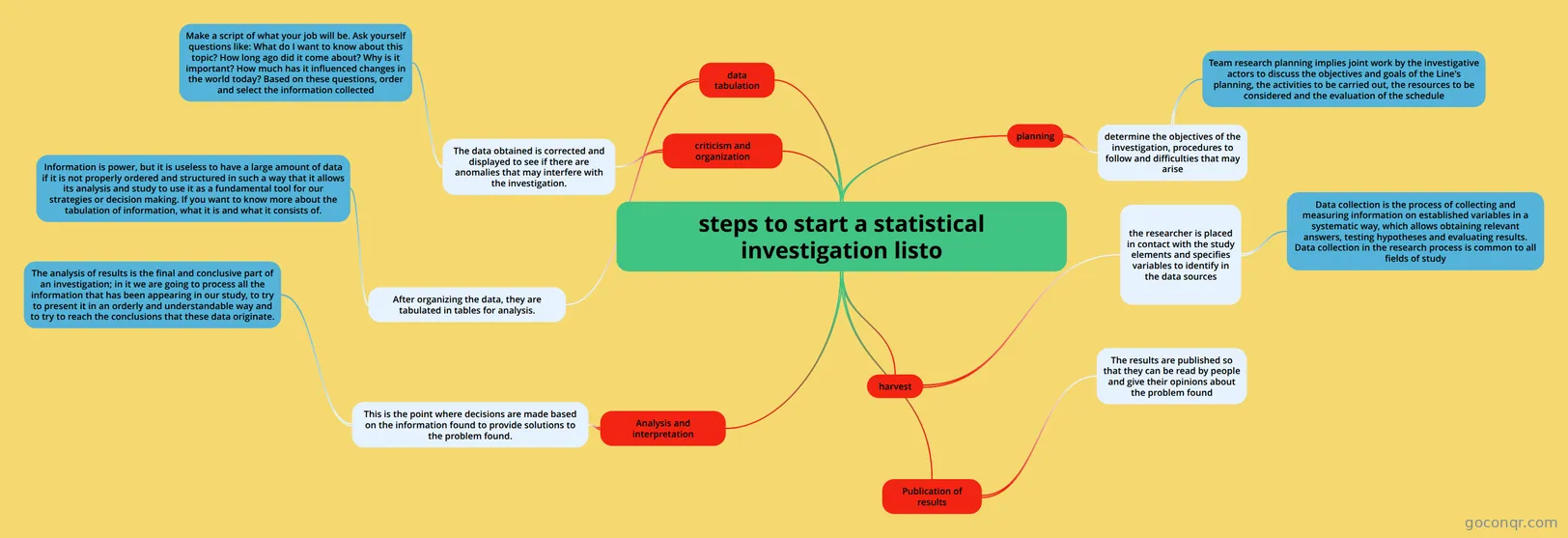 Mind map steps to start a statistical investigation listo amaman
-
Mind map Stages for the beginning of a statistical investigation. etapas de la investigación estadística, realizado por nayeli serna, estudiante del curso de estadística. UNAD
-
Mind map Stages for the start of statistical research En el presente mapa mental relaciono el inicio de una investigación estadística (planeación, recolección, o...
-
Mind map Stage of a statistical investigation. Resumen de las etapas de una investigacion estadistica
-
Mind map STAGES OF STATISTICAL INVESTIGATION -HEIDI GARZÓN-GROUP NINETY-FOUR Heidi Garzòn Vàsquez Farmacologìa Grupo: 152003_91
Mind maps
-
Statistical research stages Bibliografía:https://www.scribbr.com/category/statistics/
-
Statistics and sampling estadistica mapa mental
-
Steps to start a statistical investigation
-
steps to start a statistical investigation listo amaman
-
Stages for the beginning of a statistical investigation. etapas de la investigación estadística, realizado por nayeli serna, estudiante del curso de estadística. UNAD
-
Stages for the start of statistical research En el presente mapa mental relaciono el inicio de una investigación estadística (planeación, recolección, o...
-
Stage of a statistical investigation. Resumen de las etapas de una investigacion estadistica
-
STAGES OF STATISTICAL INVESTIGATION -HEIDI GARZÓN-GROUP NINETY-FOUR Heidi Garzòn Vàsquez Farmacologìa Grupo: 152003_91
More Statistics and probability topics
About Stages of a Statistical Investigation
GoConqr OriginalWhat this unit covers
Almost every resource here lays out the steps of a statistical investigation, from first question to final conclusion. The mind maps are the heart of the page. Several split the work into planning, collection, organisation, analysis and presentation of results. Others use the investigative cycle: problem, plan, data, analysis, conclusion.
Where to start
Begin with the mind map called Statistical research stages. It opens with Step 1, planning, and explains that you must specify your hypotheses and plan your research before collecting valid data. Then try Stages of a statistical investigation, which goes on to the processing stage and notes that it can be manual, mechanical or computerised.
Next, look at the maps on starting an investigation. They stress that all data collection needs a prior plan, and list items such as the object of the investigation, its purpose and the source of information.
Collecting data
- Open the Collecting data mind map to compare observational studies, experiments, simulations and surveys.
- Read the Stats notes on statistical reports, which explain that in observational studies there is no random allocation of subjects into groups beforehand.
- Use the flashcard deck on chapters 1 and 2 to test yourself on treatment, control, confounders, blinding and randomised grouping.
Using maps, notes and cards together
Read a map first to see the order of the stages. Then turn to the notes for detail and the flashcards for key terms. There is also a quiz, so you can check what has stuck. Many maps repeat the same stages in different words, so comparing two or three is a good way to spot what matters. Teachers can lift a map straight into a lesson.
Where it sits
This unit belongs to the strand Statistical Investigation and Data Collection, within Statistics and probability. Most of the material is aimed at university level, with a small share suited to school students.
Ready to go further? Open a map you like, then sketch your own version of the cycle and see what you can recall.
Frequently asked questions
Which resource should I open first?
Start with the mind map Statistical research stages. It begins with planning and explains that you should state your hypotheses before collecting data. After that, open Stages of a statistical investigation to see the processing stage, then move on to the notes and flashcards.
What do the mind maps cover?
They set out the order of a statistical investigation. Common stages include planning, collection, organisation or processing, analysis and presentation of results. Some use the cycle of problem, plan, data, analysis and conclusion. One map compares observational studies, experiments, simulations and surveys.
Is there anything on experiments and bias?
Yes. The flashcard deck on chapters 1 and 2 asks what a treatment, a control and a confounder are, how an experiment can be biased, and what blinding means. The Stats notes on statistical reports discuss observational studies and the lack of random allocation.
Are these resources free to use?
Yes. Every resource listed here is free to open and study, with no account needed. They were made by GoConqr users rather than by GoConqr itself, so it helps to compare a few maps on the same stage before settling on one.
Who are these resources for?
Most are at university level, so they suit university students learning how an investigation is structured. Teachers can use the maps and notes as ready-made material. A smaller share suits school students, who may find the simpler maps a useful way in.
What if I can't find what I need?
Try a different map on the same stage, since many use different wording for the same steps. If a topic is still missing, you can make your own mind map, notes or flashcards with a free account, which also saves your quiz scores.