
Mapa mental
FORMATION
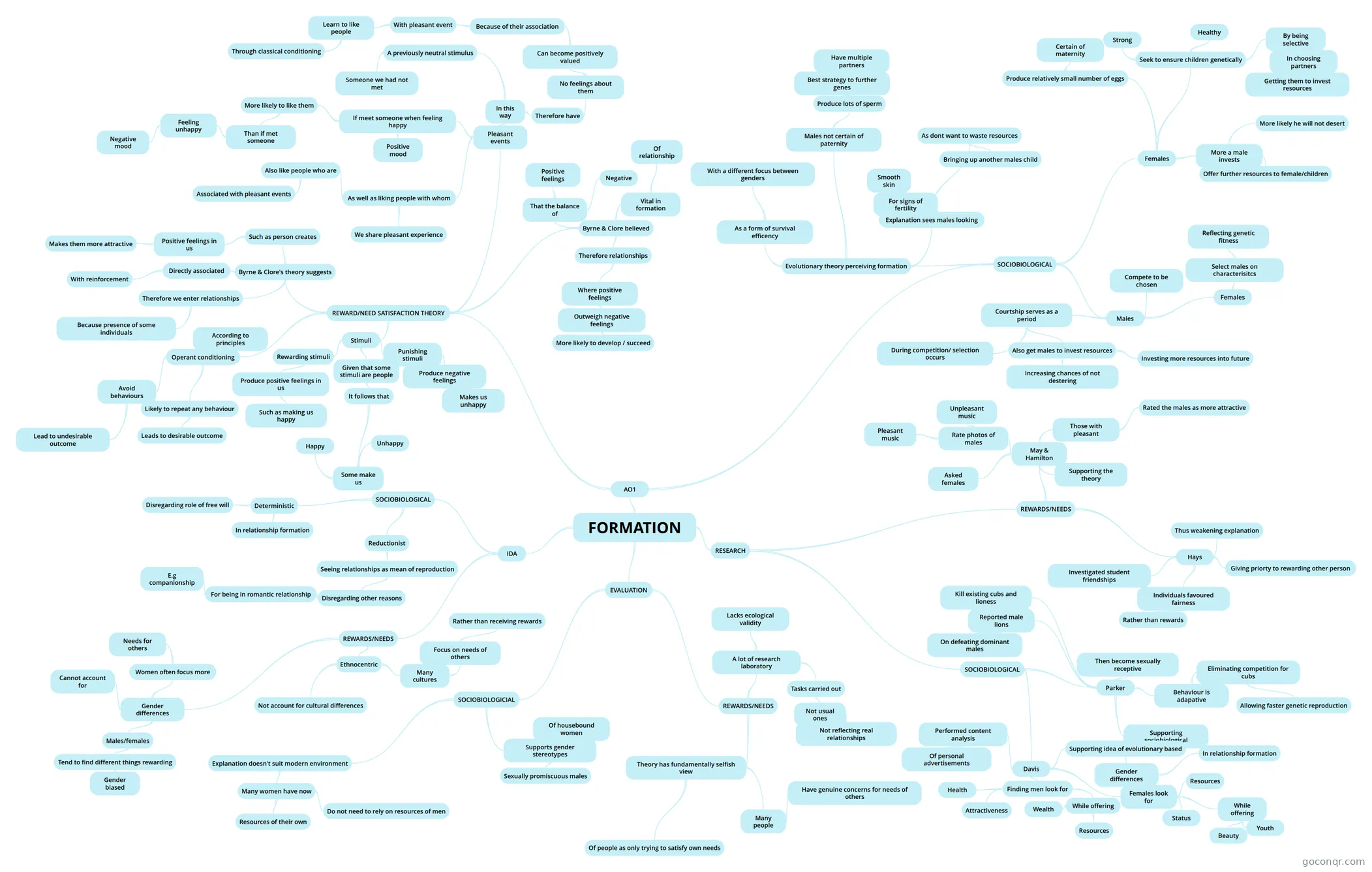
Mind map: Formation research and evaluation
Contenido del mapa
FORMATION
AO1
- REWARD/NEED SATISFACTION THEORY
- Operant conditioning
- According to principles
- Likely to repeat any behaviour
- Leads to desirable outcome
- Avoid behaviours
- Lead to undesirable outcome
- Pleasant events
- As well as liking people with whom
- We share pleasant experience
- Also like people who are
- Associated with pleasant events
- If meet someone when feeling happy
- Positive mood
- More likely to like them
- Than if met someone
- Feeling unhappy
- Negative mood
- Feeling unhappy
- Than if met someone
- In this way
- A previously neutral stimulus
- Someone we had not met
- Therefore have
- No feelings about them
- Can become positively valued
- Because of their association
- With pleasant event
- Learn to like people
- Through classical conditioning
- Learn to like people
- With pleasant event
- Because of their association
- Can become positively valued
- No feelings about them
- A previously neutral stimulus
- As well as liking people with whom
- Stimuli
- Rewarding stimuli
- Produce positive feelings in us
- Such as making us happy
- Produce positive feelings in us
- Punishing stimuli
- Produce negative feelings
- Makes us unhappy
- Produce negative feelings
- Given that some stimuli are people
- It follows that
- Some make us
- Happy
- Unhappy
- Some make us
- It follows that
- Rewarding stimuli
- Byrne & Clore's theory suggests
- Therefore we enter relationships
- Because presence of some individuals
- Directly associated
- With reinforcement
- Such as person creates
- Positive feelings in us
- Makes them more attractive
- Positive feelings in us
- Therefore we enter relationships
- Byrne & Clore believed
- That the balance of
- Positive feelings
- Negative
- Vital in formation
- Of relationship
- Therefore relationships
- Where positive feelings
- Outweigh negative feelings
- More likely to develop / succeed
- Outweigh negative feelings
- Where positive feelings
- That the balance of
- Operant conditioning
- SOCIOBIOLOGICAL
- Evolutionary theory perceiving formation
- As a form of survival efficency
- With a different focus between genders
- Males not certain of paternity
- Produce lots of sperm
- Best strategy to further genes
- Have multiple partners
- Best strategy to further genes
- Produce lots of sperm
- Explanation sees males looking
- For signs of fertility
- Smooth skin
- As dont want to waste resources
- Bringing up another males child
- For signs of fertility
- As a form of survival efficency
- Females
- Produce relatively small number of eggs
- Certain of maternity
- Seek to ensure children genetically
- Strong
- Healthy
- By being selective
- In choosing partners
- Getting them to invest resources
- In choosing partners
- More a male invests
- More likely he will not desert
- Offer further resources to female/children
- Produce relatively small number of eggs
- Males
- Compete to be chosen
- Females
- Select males on characterisitcs
- Reflecting genetic fitness
- Select males on characterisitcs
- Courtship serves as a period
- During competition/ selection occurs
- Also get males to invest resources
- Increasing chances of not destering
- Investing more resources into future
- Evolutionary theory perceiving formation
- REWARD/NEED SATISFACTION THEORY
RESEARCH
- REWARDS/NEEDS
- May & Hamilton
- Asked females
- Rate photos of males
- Pleasant music
- Unpleasant music
- Those with pleasant
- Rated the males as more attractive
- Supporting the theory
- Hays
- Investigated student friendships
- Thus weakening explanation
- Individuals favoured fairness
- Rather than rewards
- Giving priorty to rewarding other person
- May & Hamilton
- SOCIOBIOLOGICAL
- Parker
- Reported male lions
- On defeating dominant males
- Kill existing cubs and lioness
- Then become sexually receptive
- Behaviour is adapative
- Eliminating competition for cubs
- Allowing faster genetic reproduction
- Eliminating competition for cubs
- Supporting sociobiological
- Reported male lions
- Davis
- Performed content analysis
- Of personal advertisements
- Finding men look for
- Health
- Attractiveness
- While offering
- Wealth
- Resources
- Females look for
- Resources
- Status
- While offering
- Beauty
- Youth
- Supporting idea of evolutionary based
- Gender differences
- In relationship formation
- Gender differences
- Performed content analysis
- Parker
- REWARDS/NEEDS
EVALUATION
- REWARDS/NEEDS
- A lot of research laboratory
- Lacks ecological validity
- Tasks carried out
- Not usual ones
- Not reflecting real relationships
- Not usual ones
- Theory has fundamentally selfish view
- Of people as only trying to satisfy own needs
- Many people
- Have genuine concerns for needs of others
- A lot of research laboratory
- SOCIOBIOLOGICIAL
- Explanation doesn't suit modern environment
- Many women have now
- Resources of their own
- Do not need to rely on resources of men
- Many women have now
- Supports gender stereotypes
- Of housebound women
- Sexually promiscuous males
- Explanation doesn't suit modern environment
- REWARDS/NEEDS
IDA
- SOCIOBIOLOGICAL
- Deterministic
- Disregarding role of free will
- In relationship formation
- Reductionist
- Seeing relationships as mean of reproduction
- Disregarding other reasons
- For being in romantic relationship
- E.g companionship
- For being in romantic relationship
- Disregarding other reasons
- Seeing relationships as mean of reproduction
- Deterministic
- REWARDS/NEEDS
- Gender differences
- Cannot account for
- Women often focus more
- Needs for others
- Males/females
- Tend to find different things rewarding
- Gender biased
- Tend to find different things rewarding
- Ethnocentric
- Not account for cultural differences
- Many cultures
- Focus on needs of others
- Rather than receiving rewards
- Focus on needs of others
- Gender differences
- SOCIOBIOLOGICAL
Información
- Descripción
- (Relationships) Psychology A2 Mapa Mental sobre FORMATION, creado por becca_walls el 23/03/2015.
- Creado por
- becca_walls
- Visitas
- 1
- Valoración
Más sobre Relationship formation and attraction