
Flashcards
Hominid Evolution
Cards in this deck (35)
- 1family subfamilyhominidae (hominids)
homininae (hoaminines) - 2species that belong to the subfamily homininaeAustralopithecus afarensis
Australopithecus africanus
Paranthropus robustus
Homo habilis
Homo erectus
Homo neanderthalensis
Homo sapiens - 3trends for locomotionbipedal and upright
- 4trends for size of cerebral cortex- gets bigger as brain gets more complex
- 5trends of mobility of digits- fingers become less curved
- opposable thumbs - 6trends for prognathism and dentition- gets less protruding
- chin becomes more developed - 7features that enable erect posture and bipedal locomotion- position of foramen magnum
- shape of vertebral column
- pelvic structure
- carry angle
- feet
- cranium
- jaw
- knee - 8foramen magnumAPE
- towards the back of the skull
HUMAN
- middle of the head
- gradually moved forward until skull able to balance on top of the vertebral column - 9craniumAPE
- smaller brain
- dominant brow ridges
- not flat face --> nose doesn't produce
HUMAN
- large brain
- lacks dominant brow ridges
- flat face - 10jawAPE
- protruding jaw
HUMAN
- flatter facial profile
- small, non protruding - 11vertebral columnAPE
- C shaped
- quadrupedal stance
HUMAN
- S shaped
- double curvature
- upright stance - 12pelvisAPE
- narrower than humans
HUMAN
- broader
- shorter from top to bottom - 13carrying angleAPE
- weight falls inside of femur
- walk side to side when on 2 legs
HUMAN
- large head of femur contributes to carrying angle
- striding gate
- weight outside of femur - 14knee jointAPE
- adapted to bear weight through the medial condyles
HUMAN
- outer hinge larger and stronger, to take weight of body
- knee able to straighten - 15arches in feetAPE
- longitudinal arch
HUMAN
- longitudinal arch
- transverse arch - 16location of the centre of gravity in humans- pelvis
- 17location of centre of gravity in gorilla- spine
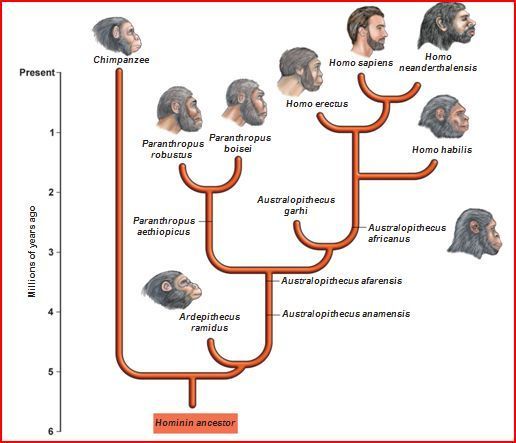
- 18phylogenetic tree
- 19trends in tools- more advanced over time
- sharper, intricate, handles, hooks - 20first used firehomo erectus
- 21used ceremonial burial- homo neanderthalensis
- homo sapiens - 22used art- homo neanderthalensis
- homo sapiens - 23used language and writing- homo habilis starting language
- homo sapiens writing - 24significance from hunter-gatherer lifestyle to agricultural lifestyle- decrease in overall health and quality of the diet
- change in climate --> more abundant land for crops - 25significance of cerebral cortex- increase in skull = more room for the brain
- brain developed as humans began to eat meat
- more complex for language etc. - 26significance of mobility of digits- increased in mobility
- able to hold food and tools - 27significance of prognathism and dentition- change in diet --> change in size of teeth
- 28Australopithecus afarensis- Bipedal & Upright
Skull = more rounded at the back
400cm3 - 500cm3
More human like brains rather than ape like ones
Strong curved fingers – adapted to climbing trees
Dentition – mixture of ape and human features
Prognathism – large and protruding
The cheekbones and zygomatic archs are flared to accommodate these large muscles
- brow ridge - 29Australopithecus africanus- Bipedal & Upright
No sagittal crest
400cm3 -500cm3
small brain same size as gorillas
Hands were probably less manipulative than those of the robust form
Teeth and jaws much larger than in humans
Jaw fully parabolic as in humans
Flared zygomatic arches, very predominant for chewing dense food such as roots
-less prominent
-higher forehead and shorter face - 30Paranthropus robustus- Bipedal & Upright
Bony ridge on top of head
410cm3 - 530cm3
Mobility of digits increased
Large prognathism
Large molars
Very prominent sagittal crest for the attachment of powerful jaw muscles
Flared zygomatic arches
Large brow ridges and no forehead - 31Homo habilis- Bipedal & Upright
Brain size large
500cm3 - 800cm3 average = 630cm3
Curved finger bones
Higher degree of manipulative ability
Smaller, narrow molars
Thinner jaw
The cheekbones and zygomatic arches are flared to accommodate these large muscles
Evident brow ridge - 32Homo erectus- Bipedal & Upright
Noticeably larger skull
750cm3 - 1250cm3 average = 1020cm3
– larger brain volumes
Hands resemble very closely the hands of a modern human
Upper jaw = strong prognathism and muzzle like appearance
Lower jaw = dentition is less large, still larger than modern humans
No chin
Protecting jaw
Zygomatic arches reduce in size significantly due to change in diet – plants and roots meat and softer material
Large brow ridge - 33Homo neanderthalensis- Bipedal & Upright
Bun Shaped swelling on the back of the brain
1200cm3 - 1750cm3
Larger cranial capacity, however not useful
Hands are pretty much the same as sapien, precision grip
Weak chin
Long low skull
Teeth are smaller than H. erectus but bigger than humans
Powerful jaw
Lightly built cheek bones
Double arched brow ridge - 34Homo sapiens- Bipedal & Upright
Smoother skull
Enlarged frontal region, and larger cerebral cortex
1100cm3 - 1400cm3
more convolutions on surface of the brain -comparison to earlier human species
Larger thumb – precision grip
Hand – strong grip and wide fingertips
Little prognathism
Teeth may be smaller, shorter jaw, chin developed
No Zygomatic arches
Lacking a brow ridge = more room for brain / cerebral cortex - 35hunter gatherer characteristics- low population density
- simple technology
- small family groups
- temporary shelter
- low birth rate
- large knowledge of plants and animals
- little social hierarchy
Information
- Description
- Year 12 Sciences Flashcards on Hominid Evolution, created by Savannah Kerr on 05/09/2017.
- Created by
- Savannah Kerr
- Views
- 1
- Rating