
Flowchart
Research methods
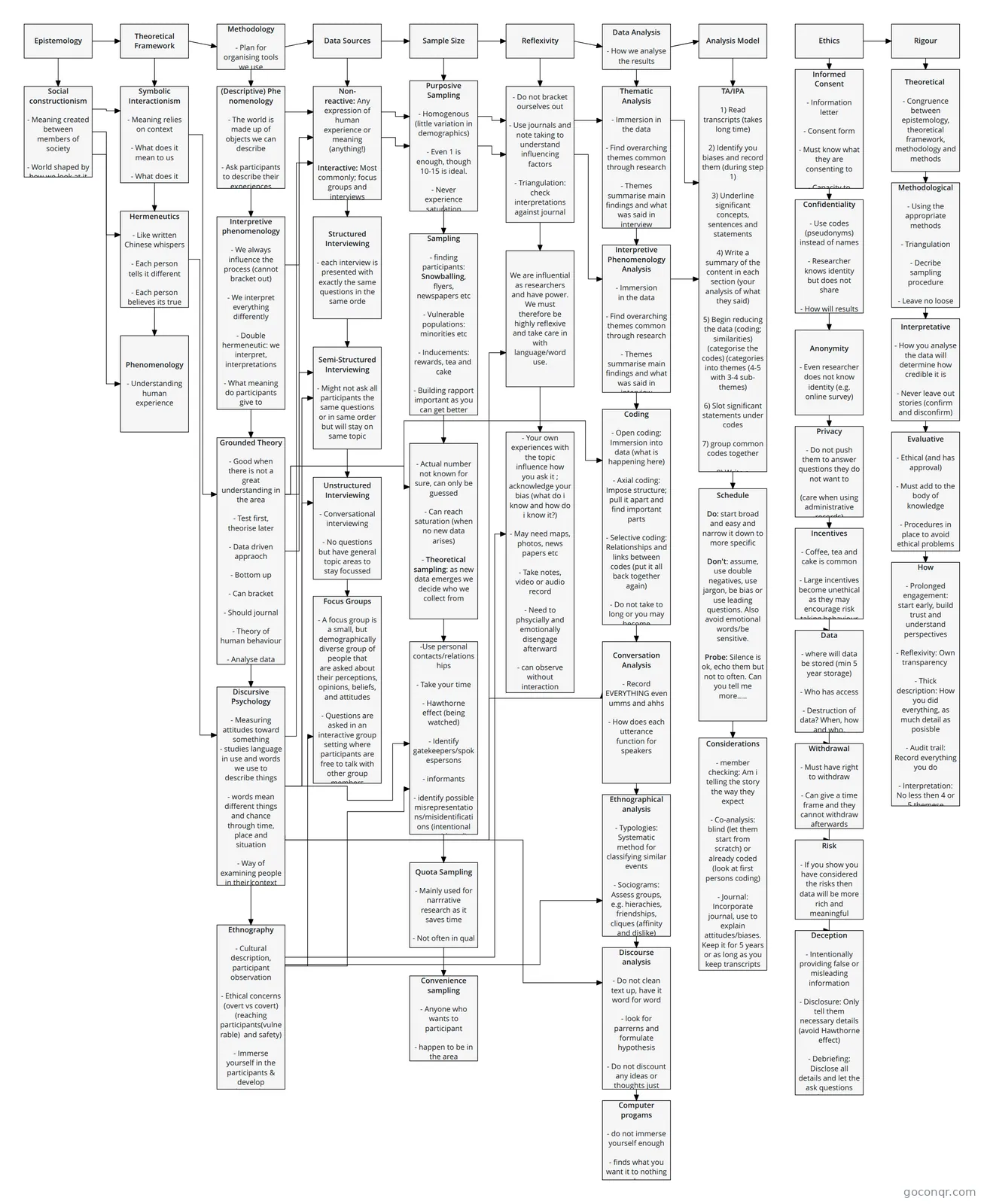
Flowchart: Research Methods and Analysis
Flowchart content
Epistemology
Social constructionism
- Meaning created between members of society
- World shaped by how we look at it
Theoretical Framework
Symbolic Interactionism
- Meaning relies on context
- What does it mean to us
- What does it mean to others
Hermeneutics
- Like written Chinese whispers
- Each person tells it different
- Each person believes its true
Methodology
- Plan for organising tools we use
(Descriptive) Phenomenology
- The world is made up of objects we can describe
- Ask participants to describe their experiences
Phenomenology
- Understanding human experience
Interpretive phenomenology
- We always influence the process (cannot bracket out)
- We interpret everything differently
- Double hermeneutic: we interpret, interpretations
- What meaning do participants give to experiences
Data Sources
Non-reactive: Any expression of human experience or meaning (anything!)
Interactive: Most commonly; focus groups and interviews
Purposive Sampling
- Homogenous (little variation in demographics)
- Even 1 is enough, though 10-15 is ideal.
- Never experience saturation
- Do not bracket ourselves out
- Use journals and note taking to understand influencing factors
- Triangulation: check interpretations against journal
Sample Size
Reflexivity
Data Analysis
- How we analyse the results
Thematic Analysis
- Immersion in the data
- Find overarching themes common through research
- Themes summarise main findings and what was said in interview
Interpretive Phenomenology Analysis
- Immersion in the data
- Find overarching themes common through research
- Themes summarise main findings and what was said in interview
Analysis Model
TA/IPA
1) Read transcripts (takes long time)
2) Identify you biases and record them (during step 1)
3) Underline significant concepts, sentences and statements
4) Write a summary of the content in each section (your analysis of what they said)
5) Begin reducing the data (coding; similarities) (categorise the codes) (categories into themes (4-5 with 3-4 sub-themes)
6) Slot significant statements under codes
7) group common codes together
8) Write a summary statement
Structured Interviewing
- each interview is presented with exactly the same questions in the same orde
Sampling
- finding participants: Snowballing, flyers, newspapers etc
- Vulnerable populations: minorities etc
- Inducements: rewards, tea and cake
- Building rapport important as you can get better answers
Grounded Theory
- Good when there is not a great understanding in the area
- Test first, theorise later
- Data driven appraoch
- Bottom up
- Can bracket
- Should journal
- Theory of human behaviour
- Analyse data while collecting
Discursive Psychology
- Measuring attitudes toward something
- studies language in use and words we use to describe things
- words mean different things and chance through time, place and situation
- Way of examining people in their context
Ethnography
- Cultural description, participant observation
- Ethical concerns (overt vs covert) (reaching participants(vulnerable) and safety)
- Immerse yourself in the participants & develop relationships
Coding
- Open coding: Immersion into data (what is happening here)
- Axial coding: Impose structure; pull it apart and find important parts
- Selective coding: Relationships and links between codes (put it all back together again)
- Do not take to long or you may become unimmersed
Semi-Structured Interviewing
- Might not ask all participants the same questions or in same order but will stay on same topic
Unstructured Interviewing
- Conversational interviewing
- No questions but have general topic areas to stay focussed
Focus Groups
- A focus group is a small, but demographically diverse group of people that are asked about their perceptions, opinions, beliefs, and attitudes
- Questions are asked in an interactive group setting where participants are free to talk with other group members
- Actual number not known for sure, can only be guessed
- Can reach saturation (when no new data arises)
- Theoretical sampling: as new data emerges we decide who we collect from
We are influential as researchers and have power. We must therefore be highly reflexive and take care in with language/word use.
Conversation Analysis
- Record EVERYTHING even umms and ahhs
- How does each utterance function for speakers
- Your own experiences with the topic influence how you ask it ; acknowledge your bias (what do i know and how do i know it?)
- May need maps, photos, news papers etc
- Take notes, video or audio record
- Need to phsycially and emotionally disengage afterward
- can observe without interaction
-Use personal contacts/relationships
- Take your time
- Hawthorne effect (being watched)
- Identify gatekeepers/spokespersons
- informants
- identify possible misrepresentations/misidentifications (intentional or accidental)
Ethnographical analysis
- Typologies: Systematic method for classifying similar events
- Sociograms: Assess groups, e.g. hierachies, friendships, cliques (affinity and dislike)
Quota Sampling
- Mainly used for narrrative research as it saves time
- Not often in qual
Convenience sampling
- Anyone who wants to participant
- happen to be in the area
Schedule
Do: start broad and easy and narrow it down to more specific
Don't: assume, use double negatives, use jargon, be bias or use leading questions. Also avoid emotional words/be sensitive.
Probe: Silence is ok, echo them but not to often. Can you tell me more.....
Discourse analysis
- Do not clean text up, have it word for word
- look for parrerns and formulate hypothesis
- Do not discount any ideas or thoughts just because they are different
Computer progams
- do not immerse yourself enough
- finds what you want it to nothing else
Considerations
- member checking: Am i telling the story the way they expect
- Co-analysis: blind (let them start from scratch) or already coded (look at first persons coding)
- Journal: Incorporate journal, use to explain attitudes/biases. Keep it for 5 years or as long as you keep transcripts
Ethics
Rigour
Informed Consent
- Information letter
- Consent form
- Must know what they are consenting to
- Capacity to consent
Confidentiality
- Use codes (pseudonyms) instead of names
- Researcher knows identity but does not share
- How will results be reported
Anonymity
- Even researcher does not know identity (e.g. online survey)
Privacy
- Do not push them to answer questions they do not want to
(care when using administrative records)
Incentives
- Coffee, tea and cake is common
- Large incentives become unethical as they may encourage risk taking behaviour
Data
- where will data be stored (min 5 year storage)
- Who has access
- Destruction of data? When, how and who.
Withdrawal
- Must have right to withdraw
- Can give a time frame and they cannot withdraw afterwards
Risk
- If you show you have considered the risks then data will be more rich and meaningful
Deception
- Intentionally providing false or misleading information
- Disclosure: Only tell them necessary details (avoid Hawthorne effect)
- Debriefing: Disclose all details and let the ask questions (afterward)
Theoretical
- Congruence between epistemology, theoretical framework, methodology and methods
Methodological
- Using the appropriate methods
- Triangulation
- Decribe sampling procedure
- Leave no loose ends
Interpretative
- How you analyse the data will determine how credible it is
- Never leave out stories (confirm and disconfirm)
Evaluative
- Ethical (and has approval)
- Must add to the body of knowledge
- Procedures in place to avoid ethical problems
How
- Prolonged engagement: start early, build trust and understand perspectives
- Reflexivity: Own transparency
- Thick description: How you did everything, as much detail as posisble
- Audit trail: Record everything you do
- Interpretation: No less then 4 or 5 themese
Information
- Description
- Flowchart on Research methods, created by Blake dorant on 31/05/2018.
- Created by
- Blake dorant
- Views
- 1
- Rating