
Electromagnetic Spectrum

Slides in this set (9)
-
- - The Electromagnetic Spectrum
- - Electricity
- > Circuits ( Parallel, Series Diagrams and Ohm's Law )
- > Photons, Neutrons and Electrons
- > Eletrical Charges
- > Measuring Electricity
- - Sound
- > The Ear and Sound
- - Light
- > Reflection, Refraction
- > Concave and Convex Mirrors
- > Focus Light
-
- What is the electromagnetic spectrum?
- The electromagnetic spectrum is a continuous range of wavelengths. The types of radiation that occur in different parts of the spectrum have different uses and dangers - depending on their wavelength and frequency.
- Types of Radiation
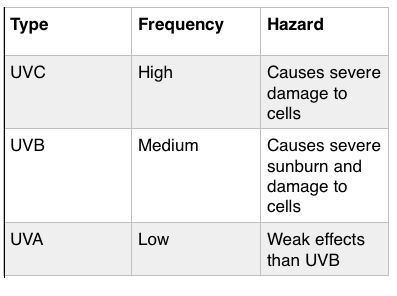
- Gamma Ray: Gamma-rays have the smallest wavelengths and the most energy of any other wave in the electromagnetic spectrum. These waves are generated by radioactive atoms and in nuclear explosions. Gamma-rays can kill living cells, a fact which medicine uses to its advantage, using gamma-rays to kill cancerous cells. Wavelength ( CM): 10^-12
- X-Ray: X-rays are very high-frequency waves, and carry a lot of energy. They will pass through most substances, and this makes them useful in medicine and industry to see inside things. X-rays are given off by stars, and strongly by some types of nebula. An X-ray machine works by firing a beam of electrons at a "target". If we fire the electrons with enough energy, X-rays will be produced.X-rays have the following properties: they can penetrate less dense matter such as skin and body tissue (but not bone). Wavelength (CM): 10^-8
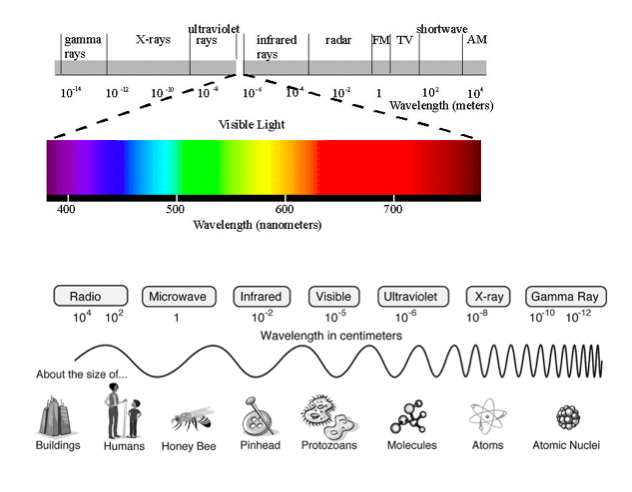
- Ultraviolet Ray: Ultraviolet (UV) radiation is a type of radiation that is produced by the sun and some artificial sources, such as solariums. The sun's UV radiation is the major cause of sunburn, premature ageing, eye damage and skin damage leading to skin cancer. However, it is also the best natural source of vitamin D. Wavelength (CM) : 10^-6
-
- Infrared: Infrared waves are just below visible red light in the electromagnetic spectrum ("Infra" means "below").You probably think of Infra-red waves as heat, because they're given off by hot objects, and you can feel them as warmth on your skin.Infrared waves are also given off by stars, lamps, flames and anything else that's warm - including us. Wavelength(CM): 10^-2
- Radiowaves: Radio waves are made by various types of transmitter, depending on the wavelength. They are also given off by stars, sparks and lightning, which is why you hear interference on your radio in a thunderstorm. Radio waves have the longest wavelengths in the electromagnetic spectrum. These waves can be longer than a football field or as short as a football. Radio waves do more than just bring music to your radio. They also carry signals for your television and cellular phones. Wavelength(CM): 10^4
- Microwaves: Microwaves are basically extremely high-frequency radio waves, and are made by various types of transmitter. In a mobile phone, they're made by a transmitter chip and an antenna, in a microwave oven they're made by a "magnetron". Their wavelength is usually a couple of centimetres. Stars also give off microwaves. Wavelength (CM): 1
-
- Visible Light: Visible light waves are the only electromagnetic waves we can see. We see these waves as the colours of the rainbow. Each colour has a different wavelength. Red has the longest wavelength and violet has the shortest wavelength. When all the waves are seen together, they make white light. Wavelength(CM): 10^-5
-
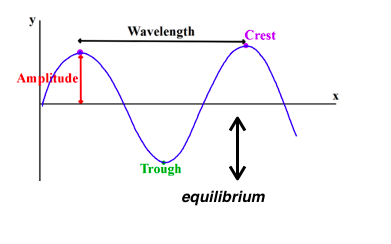
- Wavelength: The distance between successive crests of a wave, especially points in a sound wave or electromagnetic wave.
- Crest: Crest is the highest point the medium rises to.
- Trough: trough is the lowest point the medium sinks to
- Amplitude: The maximum extent of a vibration or oscillation, measured from the position of equilibrium.
- Equilibrium: The middle, centre
-
- What is frequency?
- The number of waves passing a point in a certain time, usually uses the time of one second. Frequency is measured in Hertz (Hz). 1 Hz = 1 wave per second
- What is speed?
- Distance travelled in a certain amount of time
- What is a wave?
- A wave is an oscillation accompanied by a transfer of energy that travels through a medium (space or mass
-
-
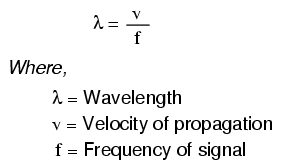
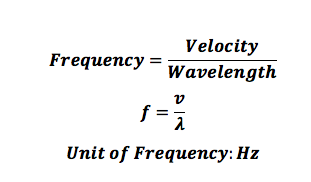
Velocity = Frequency X Wavelength
-
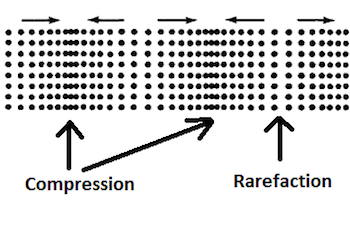
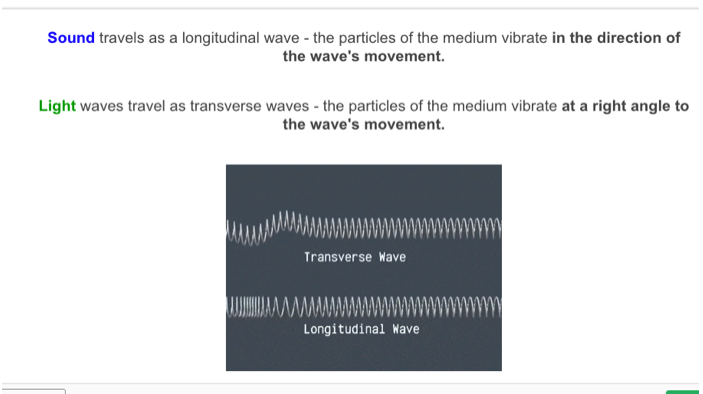
- Compression
- When the particles are bunched together we say its a compression
- Rarefraction
- When the particles are spread out its called a rarefaction
Information
- Description
- Year 9 Sciences (That's Entertainment) Slide Set on Electromagnetic Spectrum, created by K-ishe Ll on 19/09/2017.
- Created by
- K-ishe Ll
- Views
- 0
- Rating