
Angles and Parallel Lines
177 resources created by 151 users
This Angles and Parallel Lines page on GoConqr gathers community-made mind maps, flashcards, quizzes, slides and notes on parallel lines, transversals, angle pairs and angle rules. It's built for school students revising a topic and teachers after ready-made material, with GCSE Maths among the exams mentioned. There are over 150 resources here, including more than 15 quizzes, over 60 mind maps and more than 60 flashcard decks. Pick a mind map to get your bearings, then try a quiz to find your gaps.
Top Angles and Parallel Lines resources
-
Mind map PARALLEL LINES MIND MAP OF PARALLEL LINES
-
17 cardsParallel and Perpendicular Flyswatter Game Two angles that are supplementary.
-
Mind map PARALLEL LINES This mindmap is made by Kaustav Ghosh
-
6 questionsAngles What is the name of the angle that is below 90 degrees
-
Mind map Angles
-
Mind map Angle Rules The angle rules and theroms from the Edexcel IGCSE Maths Syllabus
-
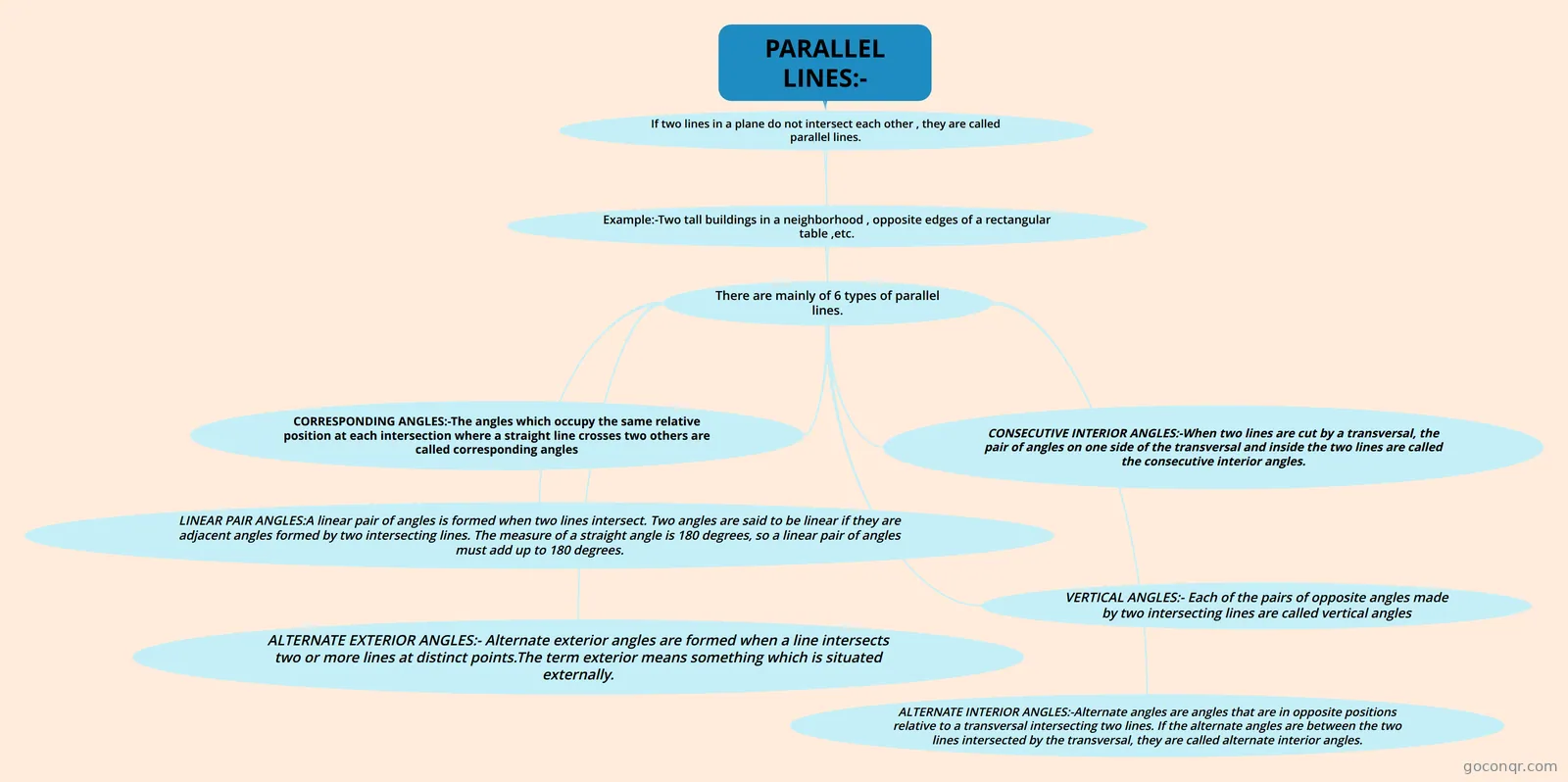 Mind map PARALLEL LINES:- Mind Map on PARALLEL LINES:-, created by RUBI MANNA on 06/11/2021.
-
11 questionsChp 3 Geometry Quiz Given the red and green lines are parallel, what is the value of x?
Quizzes
See all 23 quizzes-
6 questionsAngles What is the name of the angle that is below 90 degrees
-
11 questionsChp 3 Geometry Quiz Given the red and green lines are parallel, what is the value of x?
-
8 questionsAngles 2 A biker decides to take a short cut across two streets to get home. Below shows the angles he has created w...
-
6 questionsAngles Find ? (make sure to put degrees symbol)
-
4 questionsLines and Angles What does a complementary angle add up to?
-
5 questionsAngle quiz Angles on a straight line add to ....
-
9 questionsAngles What are alternate angles?
-
2 questionsLINES AND ANGLES An angle which is greater than 180 degree and less than 360 degree is known as
Mind maps
See all 69 mind maps-
PARALLEL LINES MIND MAP OF PARALLEL LINES
-
PARALLEL LINES This mindmap is made by Kaustav Ghosh
-
Angles
-
Angle Rules The angle rules and theroms from the Edexcel IGCSE Maths Syllabus
-
PARALLEL LINES:- Mind Map on PARALLEL LINES:-, created by RUBI MANNA on 06/11/2021.
-
Parallel Lines Mind Map of Parallel Lines
-
Angle Pair Relationships The definitions of some of the angles used in algebra
-
Angles between parallel lines
Flashcards
See all 72 flashcards-
17 cardsParallel and Perpendicular Flyswatter Game Two angles that are supplementary.
-
8 cardsFinding/Classifying Angles Study guide for classifying angles
-
11 cards10.1 Lines and Angle Relationships Which line is the transversal?
-
4 cardsObjective 11 Flashcards Define and solve problems proving lines are parallel/define and solve problems with transversals, alternate...
-
40 cardsAngles and Parallel Lines
-
10 cardsAngles in Parallel Lines Math Question: What do Co-interior Angles add up to?
-
9 cardsDefinitions - Chapter 3
-
6 cardsMML 11.3 Geometry 2020
Notes
Slides
More Mathematics topics
About Angles and Parallel Lines
GoConqr OriginalWhat the resources cover
The unit starts with the idea of parallel lines: two lines in a plane that never meet. Several mind maps called Parallel Lines set out the definition and the properties that follow from it. Others, such as Angles in parallel lines and Angles between parallel lines, focus on the angles made when a line crosses a pair of parallels.
Alongside these sit maps on wider angle work: Angle Rules, Angle Pair Relationships, Right Angles, Measuring angles and Bearings.
Where to start
- Open a Parallel Lines mind map to see the definition and key properties.
- Read the Pairs of Angles note, which explains vertically opposite and corresponding angles.
- Look at the three slide sets on corresponding, alternate and allied angles, one for each angle pair.
- Work through the slide set Find the angles - parallel lines, where co-interior angles are added to make a straight-line total, then used to find the missing angle.
Using quizzes and maps together
Read a map first, then test yourself. The quiz Angles begins with basic vocabulary such as acute angles and perpendicular lines. The Chp 3 Geometry Quiz asks you to find a value of x when two lines are parallel, so you need to choose the right angle pair and then solve.
If a question catches you out, go back to the matching map or slide set and try again. Flashcard decks such as Parallel and Perpendicular Flyswatter Game and Parallel Lines Reasons help you learn the names and reasons you will need to write down.
Where it fits
This unit sits in the Geometry, Measurement and Trigonometry strand of Mathematics. Most of the material is aimed at secondary school students, and one or more resources mention GCSE Maths. Teachers can use the maps, slides and quizzes as ready-made starting points for lessons or revision.
Choose one resource that matches what you are stuck on, then try a quiz to see how it went.
Frequently asked questions
Which resource should I open first?
Start with one of the Parallel Lines mind maps. They give the definition of parallel lines and the properties that follow, so the later angle work makes more sense. After that, the Pairs of Angles note and the slide sets on corresponding, alternate and allied angles are a good next step.
Are the resources free to use?
Yes. Every resource on this page is free to open, study and take, with no account needed. They were made by GoConqr users rather than by GoConqr itself, so styles and depth vary from one resource to the next.
What do the quizzes test?
There are more than 15 quizzes. Some, like Angles and Basic Geometry Quiz, check vocabulary and angle types. Others, such as Chp 3 Geometry Quiz and QZ 3.1: Naming Angle Pairs, ask you to name angle pairs or solve for x when lines are parallel.
Which exams and levels do these suit?
Most of the resources are made for secondary school students, and the listed resources mention GCSE Maths. A few are aimed at younger pupils. Teachers can also use the maps, slides and quizzes as ready-made material for classes.
Can I make my own resources?
Yes. A free account saves your quiz scores and lets you make your own quizzes, mind maps, flashcards and notes. That is handy if you want to turn the angle rules you find here into a set of revision cards in your own words.
What if I cannot find the angle topic I need?
Try a nearby resource first. Angle Rules, Angle Facts and Finding Missing Angles cover wider angle work, and Bearings covers directions. If a gap remains, you can build your own mind map or flashcards on the topic.